When a regular root canal is not enough to save a tooth, endodontic surgery becomes the next reliable step. Among these surgical options, an apicoectomy is the most common procedure used to remove infection from the root tip and protect the surrounding bone.
Many patients feel anxious when they hear the word “surgery.” But endodontic procedures today are precise, minor, and designed to save your natural tooth.
This guide explains the different types of endodontic surgery, their benefits, and what to expect, so you can make an informed decision with confidence.
What Is Endodontic Surgery?
Endodontic surgery refers to a group of minor dental procedures done to treat infection, inflammation, or damage inside the tooth root that cannot be solved with a regular root canal.
These surgeries focus on the root tip, surrounding bone, or soft tissues. The main goal is always the same — to save your natural tooth and prevent the spread of infection.
According to the American Association of Endodontists, endodontic surgery is often the best option when nonsurgical root canal treatment alone cannot solve the problem.
When Is Endodontic Surgery Needed?
Not every infected tooth requires surgery. However, your dentist may recommend it in certain situations where standard treatment falls short.
Below are the most common reasons:
- Persistent infection after a root canal: Sometimes infection remains near the root tip even after a successful root canal. Surgery helps clean and seal the area completely.
- Hidden cracks or extra canals: Tiny fractures or unusual canal anatomy may not show up on X-rays. Surgery allows the endodontist to examine and treat the root directly.
- Calcified or blocked canals: Calcium deposits can make canals too narrow for instruments to reach. Surgical access helps clean the deeper portions safely.
- Damaged root surface or surrounding bone: When the root or nearby bone is affected, surgery helps repair the area and supports natural healing.
Types of Endodontic Surgery and Their Benefits
There are several types of endodontic surgical procedures. Each one is chosen based on the tooth’s condition, location, and the cause of the problem.
Let’s look at each type in detail.
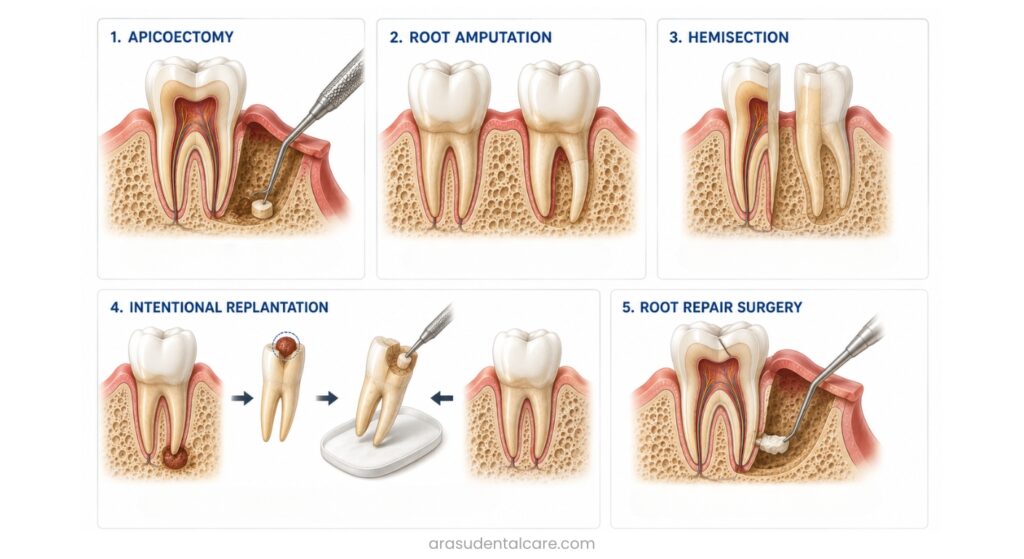
1. Apicoectomy (Root-End Surgery)
An apicoectomy is the most common type of endodontic surgery. It involves removing the very tip of the root along with any infected tissue around it.
After cleaning, a small biocompatible filling is placed at the end of the root to seal it. This prevents bacteria from re-entering and allows the bone to heal naturally over time.
Benefits of apicoectomy:
- Saves the natural tooth: Helps you keep your original tooth instead of going for extraction and replacement.
- Stops infection at the source: Removes the infected root tip and surrounding tissue completely.
- High success rate: Studies published on PubMed show modern microsurgical apicoectomy has success rates between 85% and 95%.
- Quick recovery: Most patients return to normal activities within one to two days.
2. Root Amputation
Root amputation is performed on multi-rooted teeth, such as molars, when only one root is damaged or infected.
In this procedure, the affected root is removed while the rest of the tooth and its healthy roots remain intact. This helps preserve the chewing function of the tooth.
Benefits of root amputation:
- Preserves the rest of the tooth: Only the diseased root is removed, keeping the crown and other roots functional.
- Avoids full extraction: Useful when one root is healthy and the other is severely affected.
3. Hemisection
Hemisection is similar to root amputation but more extensive. Here, the tooth is divided into two halves, and the damaged half (root and crown together) is removed.
The remaining healthy half is restored with a crown to keep it functional. This is mostly done on lower molars.
Benefits of hemisection:
- Saves part of the tooth: Even when half the tooth is damaged, the healthy section can still be used.
- Maintains bite stability: Prevents shifting of nearby teeth that often follows full extraction.
4. Intentional Replantation
This is a less common but useful procedure. The tooth is carefully removed, treated outside the mouth, and then placed back into its socket.
It is usually considered when other surgical approaches are not possible due to the tooth’s location or anatomy.
Benefits of intentional replantation:
- Last option to save the tooth: Used when surgical access inside the mouth is difficult.
- Preserves the natural root and bone: Helps maintain natural jaw structure.
5. Surgical Repair of Root Perforation or Resorption
Sometimes a tooth’s root develops a hole (perforation) or starts dissolving (resorption). These problems can weaken the tooth and lead to infection if untreated.
Surgical repair involves cleaning the affected area and sealing it with a biocompatible material such as Mineral Trioxide Aggregate (MTA).
Benefits of surgical repair:
- Stops further damage: Repairs the defect before it spreads deeper into the tooth.
- Supports long-term tooth survival: Allows the tooth to function normally for years.
What to Expect During an Apicoectomy
Understanding the procedure helps reduce anxiety. An apicoectomy is straightforward and usually completed in 30 to 90 minutes.
Here is what typically happens:
- Local anesthesia: The area around the tooth is numbed completely so you do not feel pain during the procedure.
- Small gum incision: The endodontist opens the gum tissue gently to reach the root tip beneath the bone.
- Removal of root tip and infection: Just a few millimeters of the root, along with infected tissue, are carefully removed.
- Cleaning and sealing: The end of the root canal is cleaned and sealed with a small filling to prevent reinfection.
- Suturing: The gum tissue is stitched back into place, and healing begins naturally over the following weeks.
You should not feel pain during the procedure due to local anesthesia. Mild soreness afterward is normal and manageable.
Recovery After Endodontic Surgery
Recovery from endodontic surgery is usually quick and uncomplicated when proper care is followed.
Here are the key recovery tips:
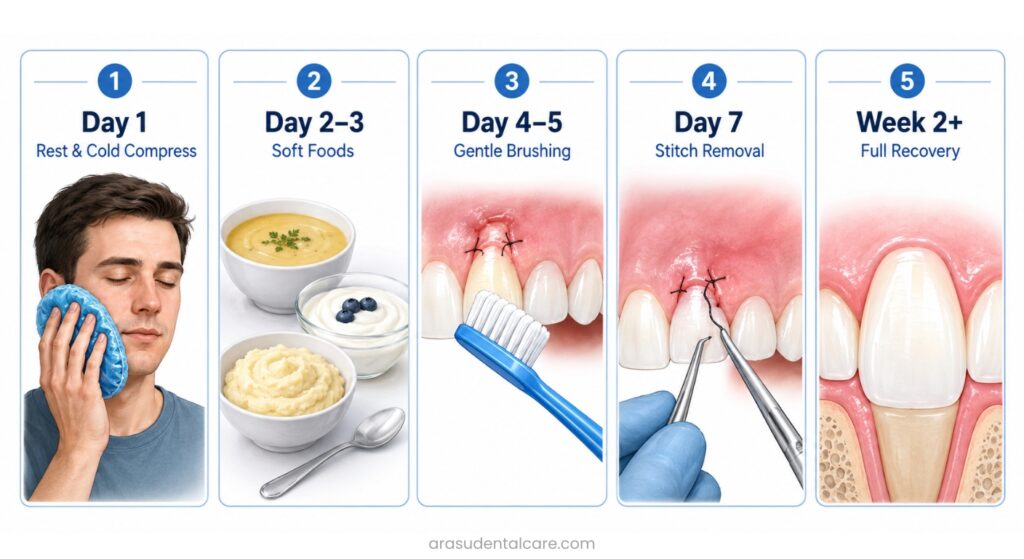
- Manage discomfort with care: Mild swelling and tenderness are common in the first 24 to 48 hours. Over-the-counter pain relievers are usually enough.
- Apply a cold compress: Gently placing a cold pack on the cheek helps reduce swelling during the first day.
- Eat soft foods: Stick to soft, lukewarm foods like soups, yogurt, and smoothies for the first few days. Avoid chewing on the surgical side.
- Maintain gentle oral hygiene: Brush carefully and avoid the surgical area until your dentist confirms it is safe to clean it normally.
- Avoid smoking and strenuous activity: Both can delay healing and increase the risk of complications.
Stitches are usually removed within a week, and full bone healing continues over several months.
Benefits of Choosing Endodontic Surgery Over Extraction
Many patients wonder whether to go for surgery or simply extract the tooth. In most cases, saving the natural tooth is the better choice.
Here is why:
- Maintains your natural bite: Your original tooth supports natural chewing, speaking, and jaw alignment.
- Prevents bone loss: Tooth roots stimulate the jawbone. Keeping the tooth helps preserve bone density over time.
- Avoids the need for replacements: Extraction usually requires an implant, bridge, or denture, which involves more time and cost.
- Long-lasting results: With proper care, a tooth saved through endodontic surgery can last for many years, sometimes a lifetime.
Learn more about What Happens During a Simple Tooth Extraction?
Are There Any Risks?
Like any surgical procedure, endodontic surgery has minor risks. However, these are uncommon when performed by an experienced endodontist.
Possible risks include:
- Mild swelling or bruising: Usually settles within a few days.
- Temporary nerve sensitivity: Rare and often resolves on its own.
- Reinfection: Very uncommon, especially with modern microsurgical techniques.
Your dentist will evaluate your overall health and dental condition to ensure the procedure is right for you.
When to See a Dentist
If you have already had a root canal but still feel discomfort, do not ignore the symptoms. Persistent pain, swelling, or a small bump on the gum could indicate the need for endodontic surgery.
Watch out for these signs:
- Lingering pain: Discomfort that continues weeks or months after a root canal.
- Swelling near the gum or jaw: Especially around the previously treated tooth.
- Tenderness while chewing: A sign that infection may still be present near the root.
- Recurring gum boil or pimple: Often points to a deeper infection that needs surgical attention.
A proper dental examination, along with X-rays or 3D imaging, can help identify the exact cause and the right treatment.
Final Thoughts
Endodontic surgery offers a reliable path to saving teeth that cannot be treated through a root canal alone. Whether it is an apicoectomy, root amputation, or another surgical option, these procedures are precise, well-tolerated, and designed to protect your natural tooth for the long term. Choosing the right type of surgery depends on your specific condition, which is why a thorough clinical evaluation always comes first.
If you have lingering pain, recurring swelling, or a gum boil that keeps coming back after a root canal, it is worth getting it checked sooner rather than later. The earlier the problem is identified, the more options you have to save the tooth.
At Arasu Dental Care in Coimbatore, our team takes the time to understand your dental history and recommend the most appropriate treatment for your situation. If endodontic surgery is what you need, we are equipped to handle it with care and precision. Book a consultation with us today and let us help you find the best way forward for your tooth.
Frequently Asked Questions
1. Is an apicoectomy painful?
No. The procedure is done under local anesthesia, so you should not feel pain. Mild soreness afterward is normal and easily managed.
2. How long does an apicoectomy take?
Most apicoectomies take between 30 and 90 minutes, depending on the tooth’s location and complexity.
3. How successful is endodontic surgery?
Modern microsurgical techniques have a success rate of around 85–95%, especially when performed by a trained endodontist.
4. How long is the recovery period?
Most patients resume normal activities within one to two days. Full bone healing may take a few months.
5. Will I need a crown after the surgery?
In most cases, the existing crown or filling is preserved. Your dentist will check whether any restoration is needed afterward.
6. Can the infection come back after surgery?
Reinfection is rare. Following proper oral hygiene and regular dental check-ups helps maintain long-term success.
7. Is endodontic surgery better than tooth extraction?
Whenever possible, saving the natural tooth is preferred. It maintains your bite, jawbone, and overall oral health better than replacement options.
8. How do I know if I need endodontic surgery?
Only a dental examination and detailed X-rays can confirm whether endodontic surgery is necessary. Your dentist or endodontist will evaluate the condition of the tooth, the surrounding bone, and the root canals to determine the best course of action.