When a child loses a baby tooth too early, the empty space may seem harmless at first. But that small gap can quietly affect how the permanent teeth come in later. This is where space maintainers for kids play an important role.
Space maintainers are simple dental appliances that hold the space open until the permanent tooth is ready to erupt. They protect your child from future problems like crowding, crooked teeth, and bite issues.
In this guide, we explain what space maintainers are, why they are needed, the types available, the procedure involved, and how to care for them. The aim is to help parents make informed decisions with clarity and confidence.
What Are Space Maintainers for Kids?
A space maintainer is a small, custom-made dental appliance fitted in a child’s mouth after the early loss of a baby tooth. It keeps the gap open so neighbouring teeth do not drift into the empty space.
These appliances are usually made of metal or acrylic. They are designed to be comfortable, safe, and gentle on a child’s developing mouth.
Why Do Children Lose Baby Teeth Early?
Baby teeth are meant to fall out naturally when the permanent teeth are ready. However, certain situations can cause early tooth loss in children.
Tooth decay or deep cavities: Severe decay can damage a baby tooth so badly that it has to be extracted. Cavities are one of the most common reasons for premature tooth loss in kids.
Dental injuries or trauma: Falls, sports accidents, or knocks during play can cause a baby tooth to break or fall out before its time. This is common in active children between ages 4 and 9.
Infection in the tooth or gum: A deep infection that cannot be treated through fillings or root canal therapy may require extraction. This protects the surrounding teeth and the developing permanent tooth.
Congenital dental conditions: Some children may have weak enamel or genetic conditions that lead to early tooth loss. These cases need careful pediatric dental monitoring.
According to the American Academy of Pediatric Dentistry (AAPD), early loss of primary teeth is one of the leading causes of future orthodontic issues in children.
Why Are Space Maintainers Important?
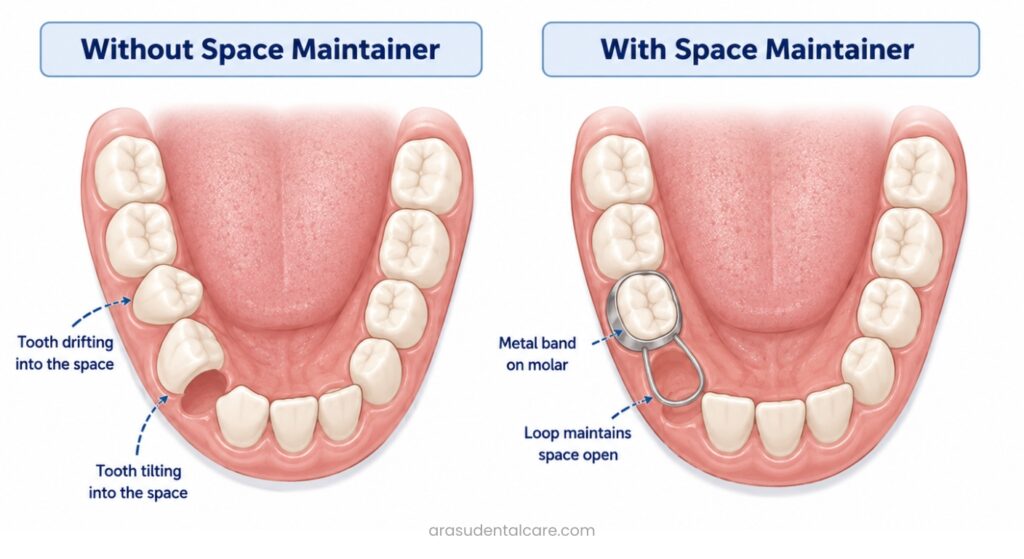
Baby teeth do more than help children chew and smile. They also act as natural guides for permanent teeth. When a baby tooth is lost early, the surrounding teeth may slowly tilt or shift into the gap.
This shifting can block the permanent tooth from erupting in the right position. Over time, it may lead to crowding, misalignment, or bite problems that need braces later.
A space maintainer prevents these issues by holding the natural space until the permanent tooth is ready to come through.
Key Benefits of Space Maintainers for Kids
Space maintainers offer several long-term benefits for a child’s dental development. Here are the most important ones explained simply.
Prevents tooth drifting: When a baby tooth is missing, nearby teeth can move into the empty space. A space maintainer holds them in place so the permanent tooth has room to erupt correctly.
Reduces the need for future braces: By guiding proper tooth eruption early, space maintainers can lower the chances of complex orthodontic treatment later. This often saves time, cost, and effort for families.
Supports proper chewing and speech: Missing teeth can make chewing harder and may affect how a child pronounces certain sounds. The appliance helps maintain normal oral function during this important growth phase.
Protects jaw and arch development: Early tooth loss can affect how the jaw bone grows. Space maintainers help maintain the natural arch length, supporting balanced facial and dental development.
Boosts your child’s confidence: Children with healthy, well-aligned teeth often feel more comfortable smiling and speaking. Preventive care like this builds positive dental habits early on.
Types of Space Maintainers Used in Pediatric Dentistry
Not every child needs the same type of appliance. The choice depends on which tooth is missing, the child’s age, and how many teeth are involved.
1. Fixed Unilateral Space Maintainers
These are cemented to the teeth on one side of the mouth and cannot be removed by the child.
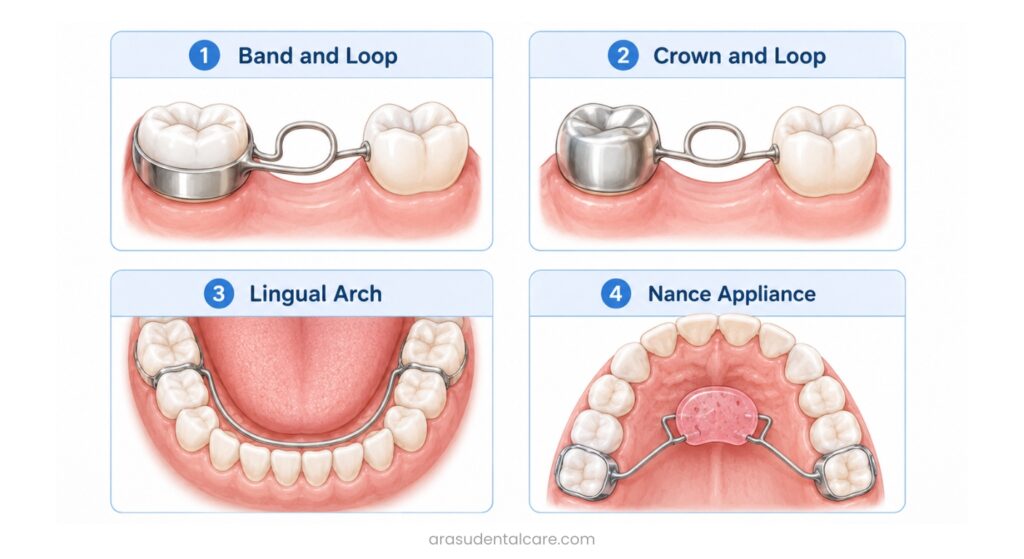
Band and loop maintainer: A metal band is placed around a nearby tooth, with a wire loop extending into the gap. It is one of the most commonly used appliances when a single baby molar is lost.
Crown and loop maintainer: Similar to the band and loop, but uses a stainless-steel crown for added strength. It is preferred when the supporting tooth is weak or has a large filling.
Distal shoe maintainer: Used when a second baby molar is lost before the first permanent molar erupts. A small wire extension under the gum guides the new molar into its proper position.
2. Fixed Bilateral Space Maintainers
These appliances are attached to teeth on both sides of the mouth and are used when multiple teeth are missing.
Lingual arch: Fitted in the lower jaw with a thin wire running behind the front teeth. It prevents the lower molars from drifting forward.
Transpalatal arch: Used in the upper jaw, with a wire crossing the palate to connect both molars. It maintains arch width and stability.
Nance appliance: Similar to the transpalatal arch but includes a small acrylic button that rests against the palate for added support.
3. Removable Space Maintainers
These look similar to small retainers and can be taken out for cleaning. They are usually recommended for older, cooperative children since they require careful handling.
The Space Maintainer Procedure: What to Expect
Many parents wonder what the process actually involves. Here is a step-by-step look at how space maintainers are placed.
Step 1 – Dental examination and X-rays: The dentist first checks the child’s mouth and takes an X-ray to see the developing permanent tooth. This helps decide if a space maintainer is needed.
Step 2 – Taking dental impressions: A soft impression material is used to capture the shape of the child’s teeth. This impression is sent to a dental lab to create a custom appliance.
Step 3 – Fitting the space maintainer: During the next visit, the dentist checks the fit and makes minor adjustments. The appliance is then cemented or fitted comfortably in place.
Step 4 – Follow-up visits: Regular check-ups every 3 to 6 months help the dentist monitor the appliance, gum health, and the eruption of the permanent tooth.
The procedure is gentle, non-surgical, and usually painless. Most children adjust to the appliance within a few days.
Caring for Your Child’s Space Maintainer
Good care helps the appliance last longer and keeps your child’s mouth healthy.
Maintain regular brushing and flossing: Encourage your child to brush twice a day and floss carefully around the appliance. This prevents plaque buildup and gum irritation.
Avoid sticky and hard foods: Foods like chewing gum, toffees, hard candies, and popcorn can loosen or damage the appliance. Softer, balanced meals are a safer choice.
Schedule routine dental visits: Regular check-ups allow the dentist to monitor the appliance and the developing permanent tooth. Early detection of any issue prevents bigger problems later.
Watch for discomfort or looseness: If your child mentions pain or the appliance feels loose, contact the dentist promptly. Quick action helps avoid further dental complications.
For more guidance, the Indian Society of Pedodontics and Preventive Dentistry (ISPPD) offers useful resources on children’s preventive dental care.
When Should Parents Consult a Pediatric Dentist?
If your child has lost a baby tooth earlier than expected, it is a good idea to consult a pediatric dentist soon. A timely evaluation can determine whether a space maintainer is needed.
You should also seek advice if you notice crowded teeth, delayed eruption, or shifting in your child’s smile. Early intervention often leads to simpler, more effective outcomes.
Conclusion
Space maintainers are a small but powerful step in protecting your child’s long-term dental health. They keep the natural space open, guide permanent teeth into the right position, and reduce the need for complex orthodontic treatment later.
If your child has recently lost a baby tooth earlier than expected, early evaluation can make a big difference. A simple dental visit can help you understand the right next step.
At Arasu Dental Care, our pediatric dental team in Coimbatore offers gentle, child-friendly evaluations and personalised space maintainer solutions. Book a consultation today to give your child a healthy, well-aligned smile for the future.
Frequently Asked Questions (FAQs)
1. Are space maintainers painful for kids?
No, the procedure is gentle and non-invasive. Most children feel only mild discomfort for a day or two as they get used to the appliance.
2. How long does a child need to wear a space maintainer?
It depends on when the permanent tooth is ready to erupt. Some children wear it for a few months, while others may need it for a few years.
3. Can space maintainers be removed at home?
Fixed space maintainers should never be removed at home. Only your dentist can safely remove or adjust them when needed.
4. Do all children need space maintainers after losing a baby tooth?
Not always. If the permanent tooth is close to erupting, your dentist may recommend monitoring instead of placing an appliance.
5. Will a space maintainer affect my child’s speech?
There may be minor changes for a few days, but children adapt quickly. Speech usually returns to normal within a short time.
6. What happens if the space maintainer breaks or falls out?
Contact your pediatric dentist as soon as possible. A replacement or repair is often needed to prevent the teeth from shifting.
7. Are space maintainers safe for young children? Y
es, they are made from safe, child-friendly materials and have been used in pediatric dentistry for decades.
8. How much do space maintainers cost in Coimbatore?
The cost varies based on the type and the child’s specific needs. A consultation can give you an accurate estimate.