When a child loses a baby tooth too early, it can quietly create problems that show up years later. This is where space maintainers come in. They are small dental appliances that hold the empty space until the permanent tooth is ready to come in.
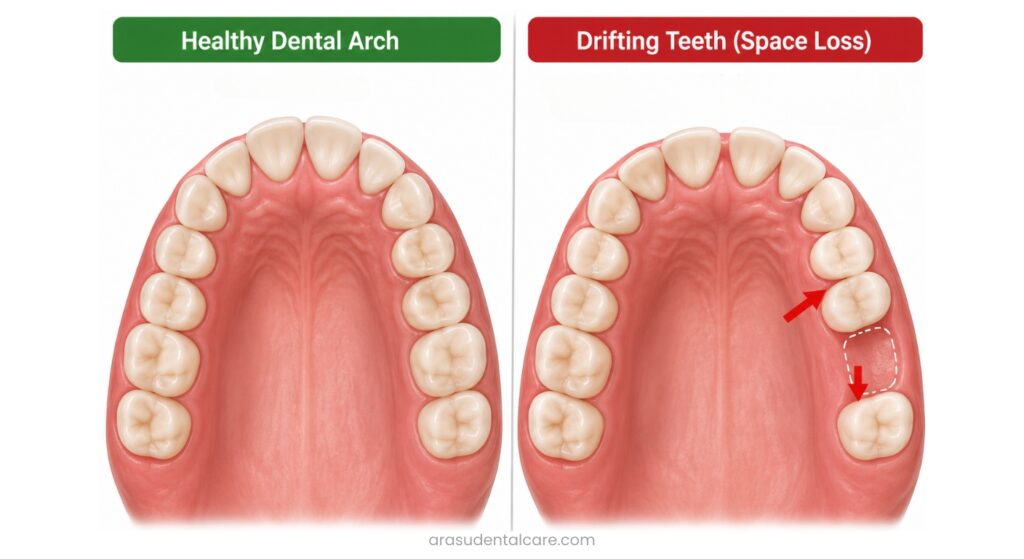
Many parents are surprised to learn that baby teeth do more than help with chewing and smiling. They also guide permanent teeth into the correct position. If a baby tooth is lost early due to decay, injury, or infection, nearby teeth can drift into the gap and block the new tooth from erupting properly.
This guide explains what space maintainers are, when they are needed, the different types available, and how to care for them. The goal is to help parents make calm, informed decisions about their child’s dental future.
What Are Space Maintainers?
A space maintainer is a small custom-made dental appliance used to hold the gap left behind when a baby tooth falls out earlier than expected. It can be made of metal or acrylic and is fitted by a pediatric dentist based on your child’s specific needs.
The main job of this appliance is simple. It keeps the surrounding teeth from shifting into the empty space, so the permanent tooth has enough room to erupt in the right position. Think of it as a gentle placeholder that protects your child’s developing smile.
According to the American Academy of Pediatric Dentistry, preserving space after the early loss of primary teeth is an important part of preventing future orthodontic problems.
Why Are Space Maintainers Needed?
Baby teeth are meant to fall out on their own when permanent teeth are ready to take their place. When this natural process is disturbed, the dental arch can lose its balance.
Loss of arch length: When a baby tooth is missing, neighbouring teeth slowly drift into the empty space. This shortens the arch and reduces room for the permanent tooth.
Crowding of permanent teeth: With less space available, permanent teeth may erupt crooked, rotated, or overlapping. This often leads to longer orthodontic treatment later.
Impacted permanent teeth: Sometimes the permanent tooth cannot push through the gum at all. It stays trapped under the bone, which may need surgical correction.
Bite problems: Missing teeth can also affect how the upper and lower jaws meet. This can lead to an uneven bite, jaw discomfort, or chewing difficulties.
Speech and chewing concerns: In some cases, especially when front teeth are lost very early, children may face minor speech or eating challenges during the adjustment period.
Common Reasons for Early Loss of Baby Teeth
Understanding why baby teeth are lost early helps parents take preventive steps and act quickly when needed.
Severe tooth decay: Deep cavities can damage a baby tooth beyond repair. When the tooth cannot be saved, extraction becomes the only option.
Dental trauma or injury: Children are active and falls or sports injuries can knock out a baby tooth before its natural shedding time.
Infection in the tooth or gums: A spreading infection may force the dentist to remove the tooth to protect the developing permanent one underneath.
Congenitally missing teeth: Some children are born without certain teeth, which can also affect spacing in the dental arch.
Crowding-related early loss: In tight arches, a baby tooth may shed too soon because the permanent tooth pushes from an unusual angle.
When Does a Child Need a Space Maintainer?
Not every child who loses a baby tooth early needs a space maintainer. The decision depends on several factors that your dentist will carefully evaluate.
Age of the child: The younger the child at the time of tooth loss, the higher the chance that a space maintainer is needed.
Which tooth is missing: Loss of back teeth (molars) usually requires space maintenance more often than front teeth.
Time before the permanent tooth erupts: If the permanent tooth is expected within a few months, an appliance may not be needed. If it is years away, a space maintainer becomes important.
Amount of bone covering the permanent tooth: A dental X-ray helps determine whether the new tooth is close to erupting or still deep in the bone.
Presence of crowding or oral habits: Habits like thumb sucking or tongue thrusting can also influence the need for space maintenance.
Types of Space Maintainers
Space maintainers are mainly divided into two categories: fixed and removable. Each type has its own design and purpose.
1. Fixed Space Maintainers
These are cemented onto the teeth and stay in place until the permanent tooth erupts. They are ideal for younger children who may not consistently wear a removable appliance.
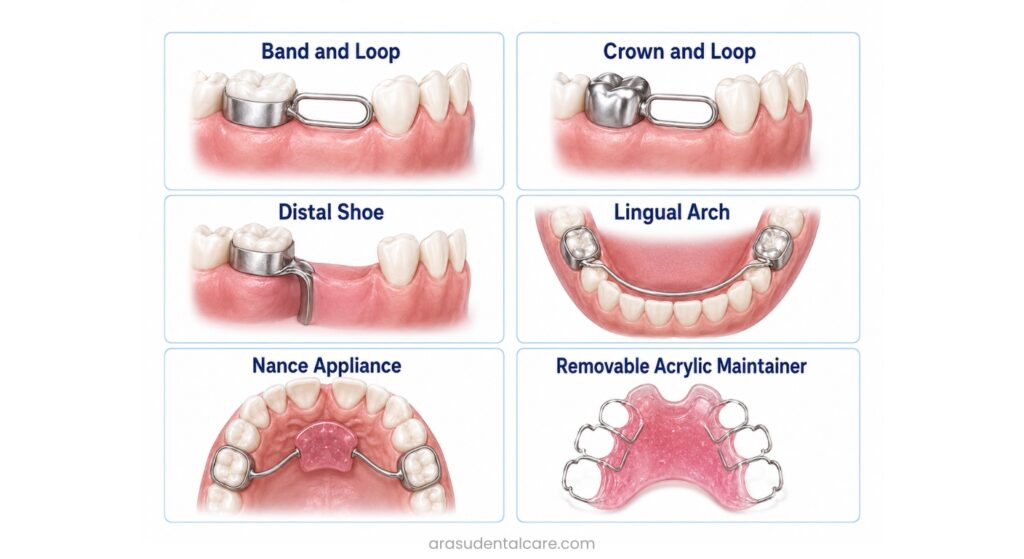
Band and Loop: This is one of the most common types. A metal band wraps around an adjacent tooth, and a wire loop extends to hold the gap. It is mostly used when a single back tooth is missing.
Crown and Loop: Similar to the band and loop, but a stainless steel crown is used instead of a band. This is helpful when the supporting tooth has a large filling or is weak.
Distal Shoe: Used when a second baby molar is lost before the first permanent molar erupts. A small extension guides the new molar into its correct position.
Lingual Arch: A bilateral appliance used in the lower jaw when multiple teeth are missing. A wire runs along the inside of the lower teeth to hold space on both sides.
Nance Appliance: Used in the upper jaw, with a small acrylic button resting against the palate. It prevents upper molars from drifting forward.
Transpalatal Arch: Another upper jaw option. It connects two molars with a wire across the palate without touching the soft tissue, making it more comfortable.
2. Removable Space Maintainers
These look similar to small retainers and can be taken in and out. They are typically used for older children who can follow care instructions.
Acrylic Removable Maintainer: Made of acrylic with metal clasps. It can include artificial teeth to improve appearance and chewing, especially when front teeth are missing.
Space maintainers cost in Coimbatore
One of the practical concerns for families is the space maintainer cost. The good news is that space maintainers are genuinely affordable.
In Coimbatore, the pediatric dental appliance cost varies depending on the type of maintainer needed:
| Types of Maintainer | Average cost |
| Band and Loop / Lingual Arch (Fixed) | ₹2,500 – ₹5,000 |
| Distal Shoe | ₹5,000 – ₹8,000 |
| Lingual arches | ₹4,000 – ₹7,000 |
| Removable Space Maintainer | ₹3,000 – ₹6,000 |
At Arasu Dental Care, we believe that cost should never be a barrier to preventive care for children. The above table suggests the average pricing of kids dental appliances in coimbatore. We provide transparent pricing during your consultation so that families can make informed decisions. Our team will assess your child’s specific needs and provide a clear estimate before any treatment begins.
To get an accurate idea of the pediatric dental appliance cost for your child’s situation, we recommend booking an appointment at our clinic. Every case is different, and a thorough examination is the best way to determine the right appliance and associated cost.
What to Expect During the Procedure
Getting a space maintainer is usually a simple and comfortable process for most children.
Initial examination: The dentist examines your child’s mouth and takes an X-ray to check the position of the developing permanent tooth.
Impression or digital scan: A mould or digital scan of the teeth is taken to design a custom appliance that fits perfectly.
Fitting the appliance: Once ready, the space maintainer is gently placed and cemented (for fixed types). The visit is usually short and pain-free.
Adjustment period: Children may need a few days to get used to the appliance. Mild awareness or slight tongue irritation is common but settles quickly.
Follow-up visits: Regular check-ups help the dentist monitor the appliance and remove it at the right time when the permanent tooth is ready to erupt.
Improves confidence: When front teeth are involved, functional appliances can also restore a child’s smile and speech.
Conclusion
Space maintainers are small appliances with a big purpose. They quietly protect your child’s developing smile and reduce the chances of complex dental issues in the future. By holding the space left by a lost baby tooth, they guide permanent teeth into their natural position — preventing crowding, misalignment, and the need for lengthy orthodontic treatment later on.
Investing in a space maintainer today means fewer worries tomorrow. At Arasu Dental Care, we believe every child deserves a healthy, confident smile that lasts a lifetime. Our experienced team is here to evaluate your child’s needs and recommend the best solution for their growing smile.
Frequently Asked Questions
1. At what age are space maintainers usually placed?
Space maintainers are typically placed in children between ages 3 and 10, depending on when the baby tooth is lost and the stage of permanent tooth development.
2. Are space maintainers painful for children?
No, the procedure is not painful. Some children may feel mild awareness or tongue irritation for a few days, which usually goes away quickly.
3. How long does a child need to wear a space maintainer?
It depends on when the permanent tooth is ready to erupt. Some children wear it for a few months, while others may need it for a few years.
4. Will my child be able to eat normally with a space maintainer?
Yes, most children adjust within a few days. However, sticky and hard foods should be avoided to protect the appliance.
5. Can a space maintainer affect my child’s speech?
There may be slight changes in speech during the first few days, especially with appliances near the front teeth. This usually improves quickly as the child adapts.
6. What happens if the space maintainer falls out or breaks?
Contact your paediatric dentist immediately. A loose or broken appliance cannot perform its function and may need adjustment or replacement.
7. Do all children with early tooth loss need a space maintainer?
Not always. The dentist evaluates several factors before recommending one, including the child’s age, the missing tooth, and X-ray findings.
8. Are space maintainers covered under regular dental check-ups?
Most paediatric dental clinics offer space maintainer evaluation as part of routine examination when early tooth loss is detected.