A Glass Ionomer Filling is a tooth-coloured dental material that bonds directly to your tooth and slowly releases fluoride to help protect against decay. It is often recommended for children, sensitive areas near the gum line, and patients who need gentle, minimally invasive care.
Many patients hear the term during a consultation but rarely get a clear explanation of what it actually means. This guide will help you understand the different types of glass ionomer fillings, where they work best, and where they may not be the right choice.
The goal here is simple. Help you feel informed before you sit in the dental chair, so the conversation with your dentist feels easier.
What Is a Glass Ionomer Filling?
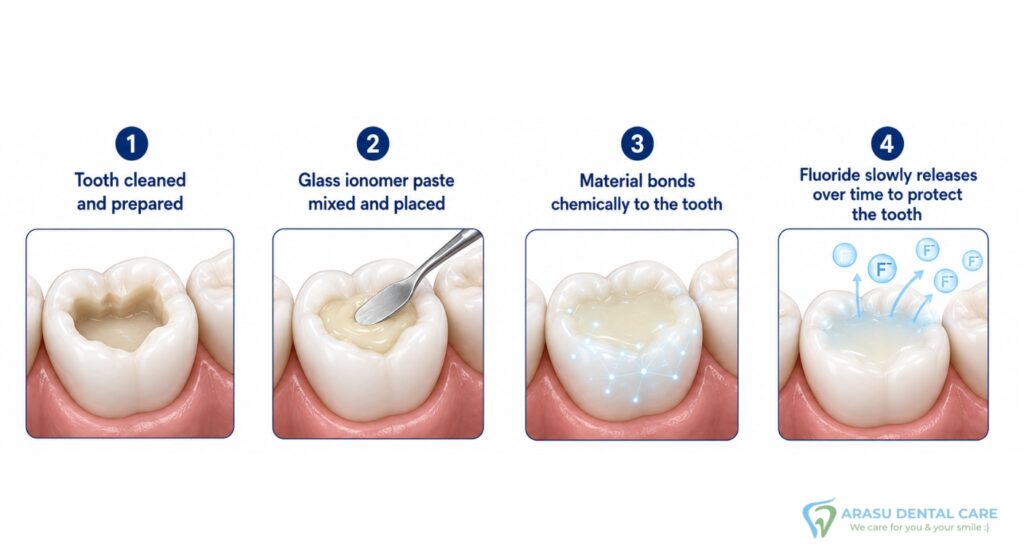
A glass ionomer filling is made by combining a special silicate glass powder with an organic acid, usually polyacrylic acid. When mixed, the two form a paste that hardens inside the tooth and bonds chemically to the natural tooth structure.
What makes this material unique is its ability to release fluoride slowly over time. This fluoride helps strengthen the surrounding tooth and reduces the chances of new decay forming around the filling.
According to the World Health Organization, glass ionomer cement is included on its List of Essential Medicines, which highlights its global importance in modern dentistry.
Why Dentists Often Recommend Glass Ionomer Fillings
Glass ionomer fillings are not the strongest material available, but they offer benefits that other fillings simply cannot match. They are especially useful in situations where moisture control is difficult or where extra fluoride protection is needed.
They are also gentle on the tooth. Very little drilling is required, which helps preserve more of the natural tooth structure.
Types of Glass Ionomer Filling
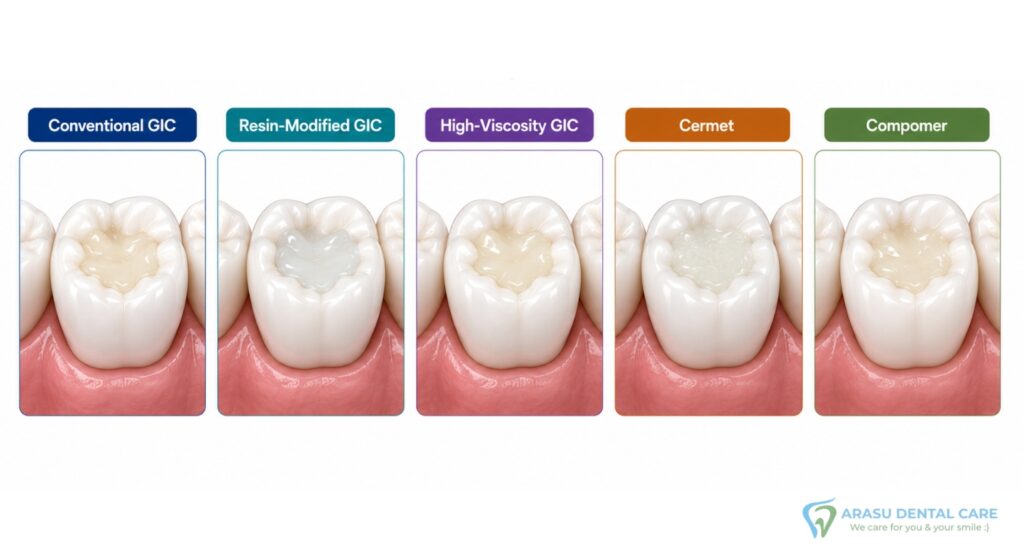
There are several types of glass ionomer fillings used in modern dentistry. Each type has its own strengths and is chosen based on the location of the tooth, the size of the cavity, and the patient’s age.
Understanding these types can help you have a clearer conversation with your dentist about which option suits your case.
1. Conventional Glass Ionomer Cement
Composition and setting:This is the original form made from a fluoroaluminosilicate glass powder mixed with polyacrylic acid. It sets through a natural acid-base reaction without needing a curing light.
Common uses:It is often used for small cavities, root surface decay, and as a base or liner under other fillings. It works well in areas that do not face heavy chewing pressure.
2. Resin-Modified Glass Ionomer (RMGIC)
Composition and setting:This type combines traditional glass ionomer with a small amount of light-cured resin. The resin gives it added strength and a quicker setting time.
Common uses:RMGIC is commonly used for fillings in baby teeth, cavities near the gum line, and small to medium cavities in adults. It also looks more natural than conventional glass ionomer.
3. High-Viscosity Glass Ionomer (HVGIC)
Composition and setting:This is a thicker, more packable version of conventional glass ionomer. It was developed mainly for the Atraumatic Restorative Treatment (ART) technique.
Common uses:HVGIC is widely used in children, elderly patients, and in cases where drilling needs to be minimised. It is especially helpful for patients who feel anxious about dental treatment.
4. Metal-Reinforced Glass Ionomer (Cermet)
Composition and setting:Fine metal particles such as silver are added to the glass powder to improve strength and wear resistance.
Common uses:Cermets are sometimes used as core build-up materials or in back teeth where extra strength is needed. They are less common today because resin-based options often perform better in the same situations.
5. Compomer (Polyacid-Modified Composite)
Composition and setting:A compomer is a hybrid material that combines features of both composite resin and glass ionomer. It is light-cured and offers better aesthetics.
Common uses:Compomers are often used in children’s teeth and in non-stress-bearing areas of adult teeth. They release a small amount of fluoride, though less than conventional glass ionomer.
Benefits of Glass Ionomer Fillings
Glass ionomer fillings offer several advantages that make them a trusted choice in many dental situations. They are particularly valued for their fluoride release and gentle approach to the tooth.
Fluoride release for ongoing protection:The material slowly releases fluoride into the surrounding tooth structure. This helps reduce the chances of new decay forming around the filling.
Chemical bond to tooth structure:Glass ionomer bonds directly to enamel and dentine without needing a separate bonding agent. This creates a tight seal that helps block bacteria.
Minimal tooth removal needed:Because of its bonding ability, the dentist does not need to remove much healthy tooth structure. This is helpful for preserving the natural tooth as much as possible.
Tooth-coloured appearance:The material blends reasonably well with the natural tooth shade. It is not as cosmetic as composite filling resin but looks far better than silver fillings.
Good for moisture-prone areas:Glass ionomer can set even when the area is slightly moist. This makes it useful for fillings near the gums or in young children where keeping the area dry is difficult.
Biocompatible and gentle:The material is well tolerated by the gums and surrounding tissues. Allergic reactions are rare, which makes it a safe option for most patients.
A study published in the National Library of Medicine confirms that fluoride release from glass ionomer cement plays an important role in reducing demineralisation around the filling.
Limitations of Glass Ionomer Fillings
While glass ionomer fillings have many advantages, they also have some limitations. Knowing these helps you understand why your dentist may suggest a different material in certain situations.
Lower strength compared to composite or amalgam:Glass ionomer is more brittle and wears down faster under heavy chewing pressure. This makes it less suitable for large cavities in back teeth.
Shorter lifespan in load-bearing areas:In areas that face strong biting force, the filling may last only a few years. In low-stress areas, it can last much longer.
Less ideal for highly visible front teeth:The colour match is acceptable but not perfect. For front teeth where appearance matters most, composite resin is usually preferred.
Sensitive to moisture during setting:Although it tolerates slight moisture, too much saliva contamination during placement can affect its strength. Careful technique is important.
Slower full setting time:The material continues to mature over 24 hours. Patients are usually advised to avoid hard foods on that tooth for at least a day.
When Is a Glass Ionomer Filling the Right Choice?
Your dentist may recommend a glass ionomer filling in specific situations where its unique properties offer real benefits. The decision always depends on your individual dental condition.
Cavities in baby teeth:Children’s teeth do not need a filling that lasts decades. The fluoride release and gentle bonding make glass ionomer a strong option here.
Cavities near the gum line:This area is hard to keep dry during treatment. Glass ionomer bonds well even in slightly moist conditions.
Patients with high decay risk:The continuous fluoride release helps protect the tooth from future cavities. This is helpful for patients with dry mouth or frequent decay.
Temporary or interim fillings:Glass ionomer works well as a short-term restoration before a crown or larger procedure is planned.
Atraumatic Restorative Treatment (ART):For patients who cannot tolerate drilling, such as very young children or anxious adults, glass ionomer offers a minimally invasive solution.
Glass Ionomer vs Composite Filling: A Quick Comparison
| Feature | Glass Ionomer Filling | Composite Filling |
| Fluoride release | Yes, continuous | No |
| Strength | Moderate | Higher |
| Aesthetics | Good | Excellent |
| Moisture tolerance | Better | Needs dry area |
| Best for | Children, gum line, high-risk patients | Most adult cavities, front teeth |
| Lifespan in load areas | Shorter | Longer |
The American Dental Association (ADA) notes that the right filling material depends on the location of the cavity, the size of the decay, and the patient’s overall oral health.
What to Expect During the Procedure
The process is usually simple and comfortable. Most fillings are completed in a single visit.
Examination and diagnosis:The dentist checks the tooth and may take an X-ray to understand the depth of decay. This helps in choosing the right filling material.
Tooth preparation:The decayed portion is gently removed. Very little healthy tooth structure is lost because glass ionomer bonds chemically.
Placement of the filling:The material is mixed and placed into the cavity. It is shaped to match the natural contour of the tooth filling.
Setting and polishing:The filling sets within a few minutes and is polished for a smooth finish. A protective coating may be applied to help it mature properly.
Aftercare:Soft foods are recommended for the first 24 hours. Regular brushing, flossing, and dental checkup near me help the filling last longer.
Final Thoughts
Glass ionomer fillings come in several types, and each one has a specific role in modern dentistry. From conventional GIC for small cavities to resin-modified versions for better strength and aesthetics, the right type depends entirely on your tooth, its location, and your individual dental needs. No single material works best for every situation — and that is exactly why a proper clinical examination always comes before any recommendation.
If you have a cavity that needs attention, or you are simply unsure which filling material is right for you, the earlier you get it assessed, the easier the treatment tends to be.
At Arasu Dental Care in Coimbatore, we take the time to understand your dental history, explain your options clearly, and recommend the filling type that genuinely suits your tooth — not just the most convenient one. Book a consultation with us today and let us help you make the right choice for your smile.
Frequently Asked Questions
1. How long does a glass ionomer filling last?
In low-stress areas, it can last several years. In areas that face heavy chewing, it may last 3 to 5 years on average.
2. Is a glass ionomer filling safe for children?
Yes. It is one of the most preferred materials for baby teeth because of its fluoride release and gentle bonding.
3. Does it look like a natural tooth?
It is tooth-coloured but slightly more opaque than composite resin. For visible front teeth, composite is usually preferred.
4. Can I eat right after the filling?
It is best to wait at least an hour and stick to soft foods for 24 hours while the material fully matures.
5. Will the filling cause sensitivity?
Mild sensitivity may occur briefly. It usually settles within a few days. Inform your dentist if discomfort continues.
6. Is glass ionomer better than amalgam?
Both have their place. Glass ionomer is more aesthetic and releases fluoride, while amalgam filling is stronger for large back-tooth cavities.
7. Can a glass ionomer filling be replaced later?
Yes. If the glass ionomer filling becomes worn, chipped, discoloured, or no longer provides adequate protection for the tooth, it can be easily replaced with a new filling.
8. Which type of glass ionomer filling is best for children?
Resin-modified glass ionomer fillings and high-viscosity glass ionomer fillings are considered the most suitable options for children.