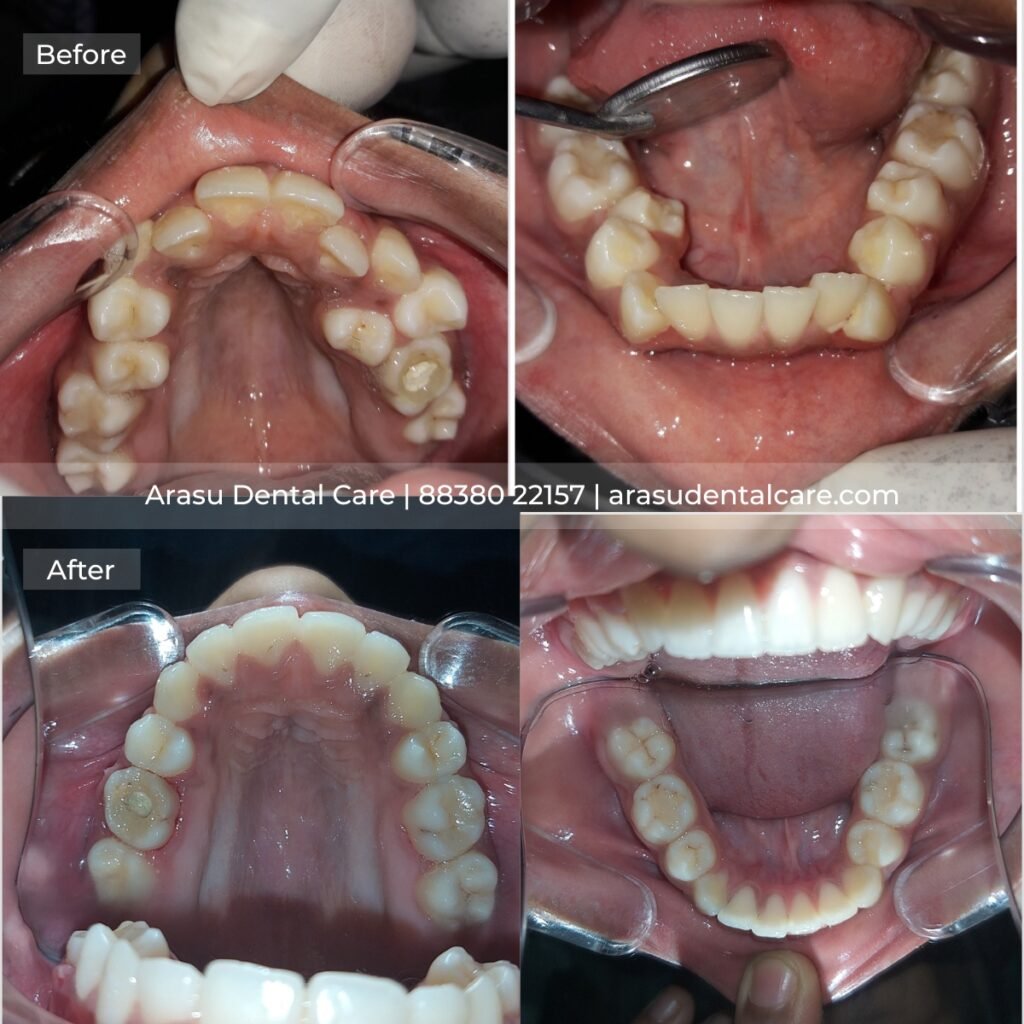
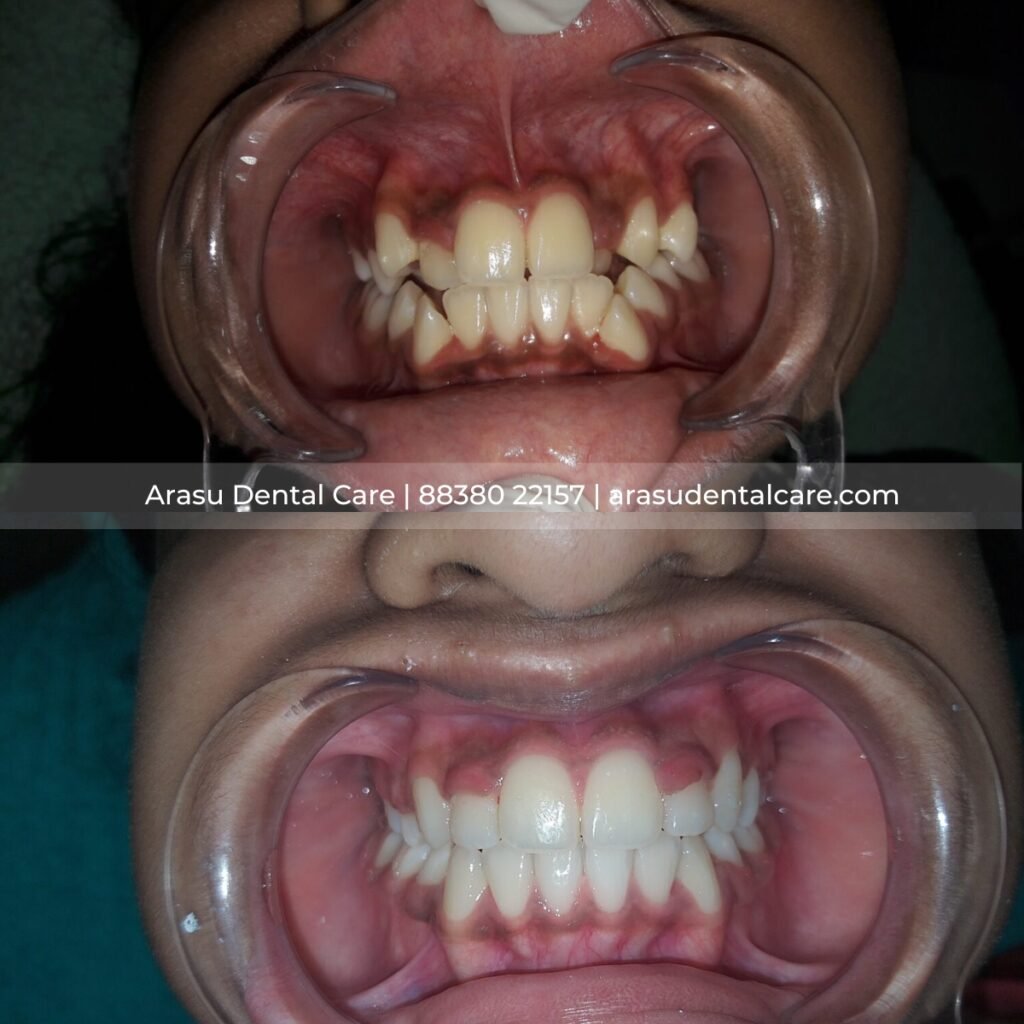
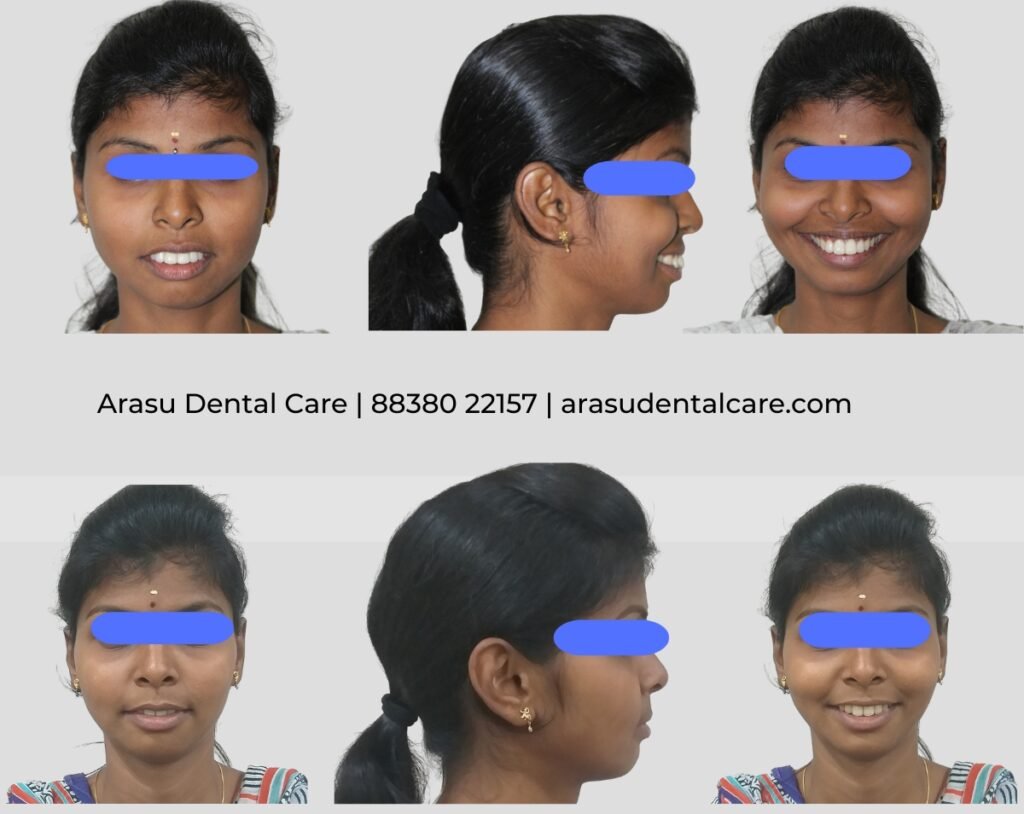
Class III correction planned by an MDS orthodontist & in-house surgical team
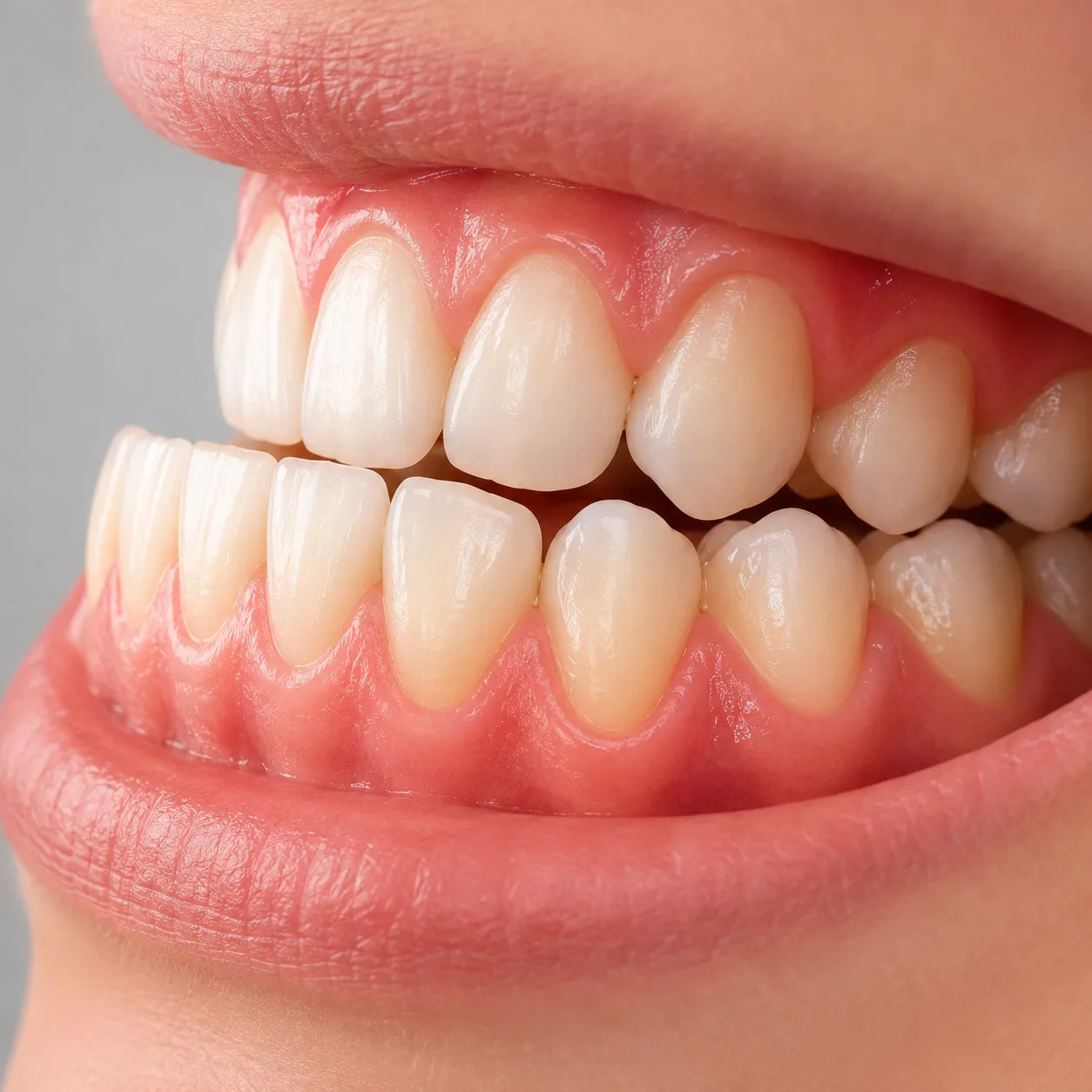
At Arasu Dental Care, we correct an underbite — the reverse bite where your lower teeth and jaw sit in front of the upper ones — so your teeth meet the way they should, your chewing is balanced, and your profile is brought back into proportion. Depending on what's driving it, we do that with braces, clear aligners, or braces co-ordinated with jaw surgery for the more skeletal cases.
The single most important thing about an underbite is that not all of them are the same. Some are a dental problem — the teeth are tilted the wrong way but the jaws are fine — and those we can often fully correct with orthodontics alone. Others are skeletal — the lower jaw has genuinely outgrown the upper — and those need a different plan. The first thing we do is work out which one you have, because that decides everything that follows. This page is for adults and parents in Coimbatore trying to understand their options before committing.
Open all seven days, 10:00 AM – 8:30 PM · R.S. Puram +91 88380 22157 · Saibaba Colony +91 74491 88777
Medically reviewed by Dr. P.S. Sree Cumar, MDS (Orthodontics & Dentofacial Orthopedics, FWFO) · Last reviewed July 2026
Not sure if your underbite is dental or skeletal? A consultation and a set of records tell us in one visit — and tell you honestly which route fits. Call RS Puram on +91 88380 22157 or Saibaba Colony on +91 74491 88777.
The routing question
An underbite is one of the least common bite problems — across Indian population studies, a Class III malocclusion (the clinical name for an underbite) shows up in only about 1.4% to 3% of people, far behind the more usual crowding and overbite patterns. That rarity is one reason it's often mishandled: the plan that works for a crowded smile is the wrong plan for a reverse bite. What matters for your treatment is not how the underbite looks, but what is causing it.
| What you notice | What it usually means | Likely route |
|---|---|---|
| Lower front teeth bite just ahead of the uppers; teeth are tilted but your jaw and chin look balanced | A mostly dental underbite — the teeth are in the wrong position, the jaws are not | Braces or aligners alone |
| Lower jaw and chin visibly sit forward; side profile looks concave; this runs in your family | A skeletal underbite — the lower jaw has outgrown the upper, or the upper jaw is under-developed | Braces + jaw-surgery co-ordination (adults) or growth guidance (children) |
| Only one or two teeth cross over; the rest of the bite is normal | A localised anterior crossbite — often the simplest version to fix | Braces or aligners, sometimes quickly |
| Your child (7–10) already shows the lower teeth biting in front | An early / developing underbite while the jaw is still growing | Interceptive growth guidance — see below |
The honest part, which we'll tell you plainly at your consultation: many people who fear their jaw is “wrong” actually have a dental underbite that orthodontics can fully correct — and a few who assume it's “just the teeth” have a skeletal pattern that explains why a bite problem keeps coming back. We don't guess this from a glance. We take records — photographs, scans and, where the jaw is in question, a panoramic X-ray or CBCT — because moving teeth to disguise a jaw that's genuinely out of proportion tends not to hold. Getting the diagnosis right is the difference between a result that lasts and one that relapses.
An underbite is also worth correcting for reasons beyond appearance. When the bite is reversed, the front teeth do a job they weren't built for — that uneven load can wear enamel down faster, strain the jaw joint, and in some people make clear speech and comfortable chewing harder. Straightening the bite deals with the cause, not just the look.
An underbite is one of the least common bite problems in India — Class III malocclusion appears in only about 1.4% to 3% of people across Indian population studies (Jaipur 1.4%, Telangana 2.8%, South Indian 2.14%). Rarity is exactly why the diagnosis — dental vs skeletal — must be made properly. General research figures; individual cases vary.
Treatment routes
There are four routes, and the right one depends on your age and on whether the problem is dental or skeletal. Our orthodontic care is led by Dr. P.S. Sree Cumar, MDS (Orthodontics & Dentofacial Orthopedics), our founder — whose named areas of expertise include the growth-guidance and functional-appliance work that sits at the heart of underbite correction, and who also manages the jaw-joint (TMJ) strain that reversed bites can cause.
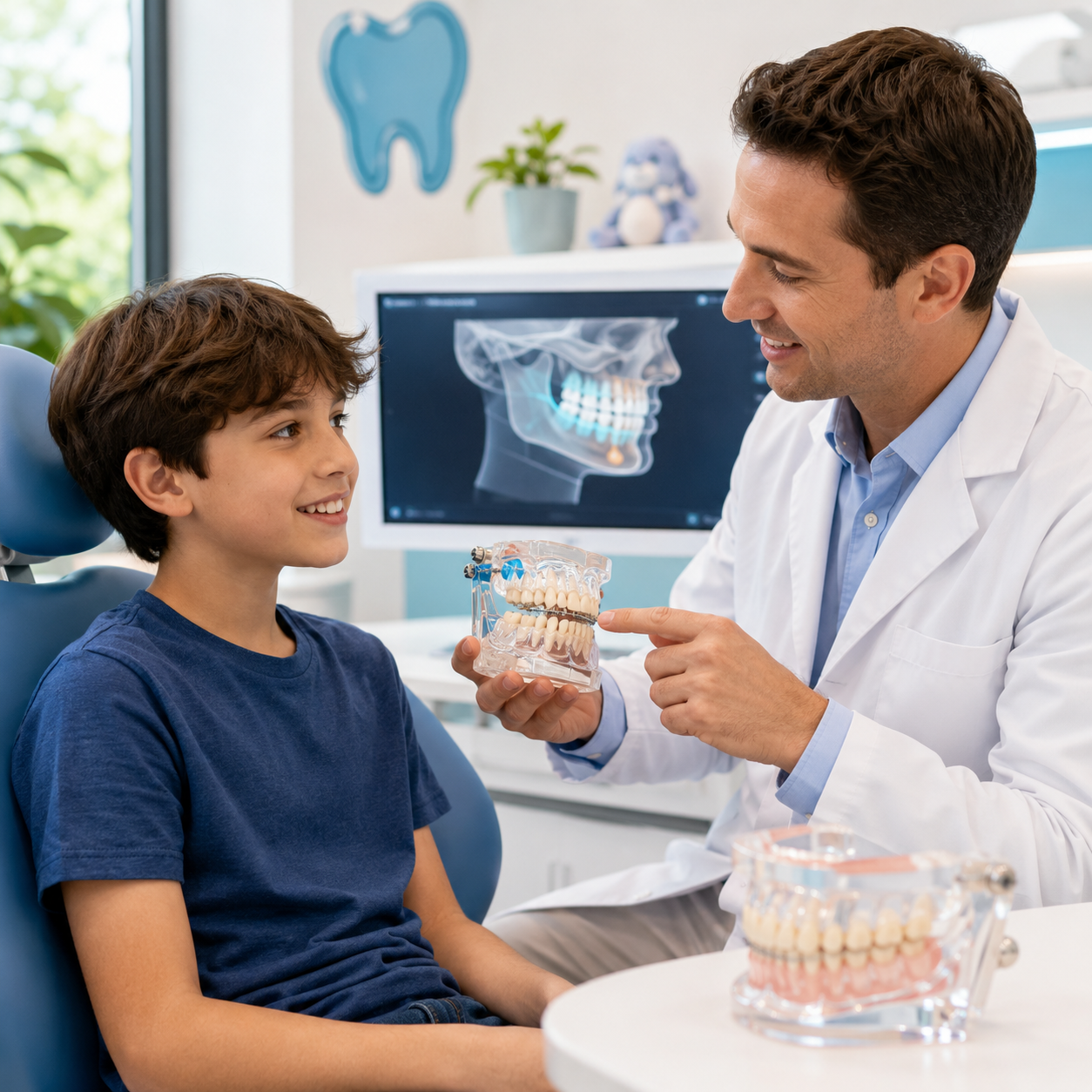
Children roughly 7–10 · the route we most want families to know about
Timing changes what's possible. In a child of roughly 7 to 10, the jaws are still developing, and we can steer that growth — encouraging an under-developed upper jaw forward, or holding back an over-growing lower one, with functional and myofunctional appliances (sometimes a face-mask with palatal expansion). Handled at the right age, growth guidance can reduce a developing underbite substantially, and in some children prevent what would otherwise become a surgical case in adulthood. This is exactly why we and the American Association of Orthodontists recommend a first orthodontic check by around age 7 — not for braces at 7, but so a jaw pattern can be caught while it's still steerable. If your child is showing an early underbite, our braces for children page covers how early treatment works.
Most dental underbites · continuous, precise control
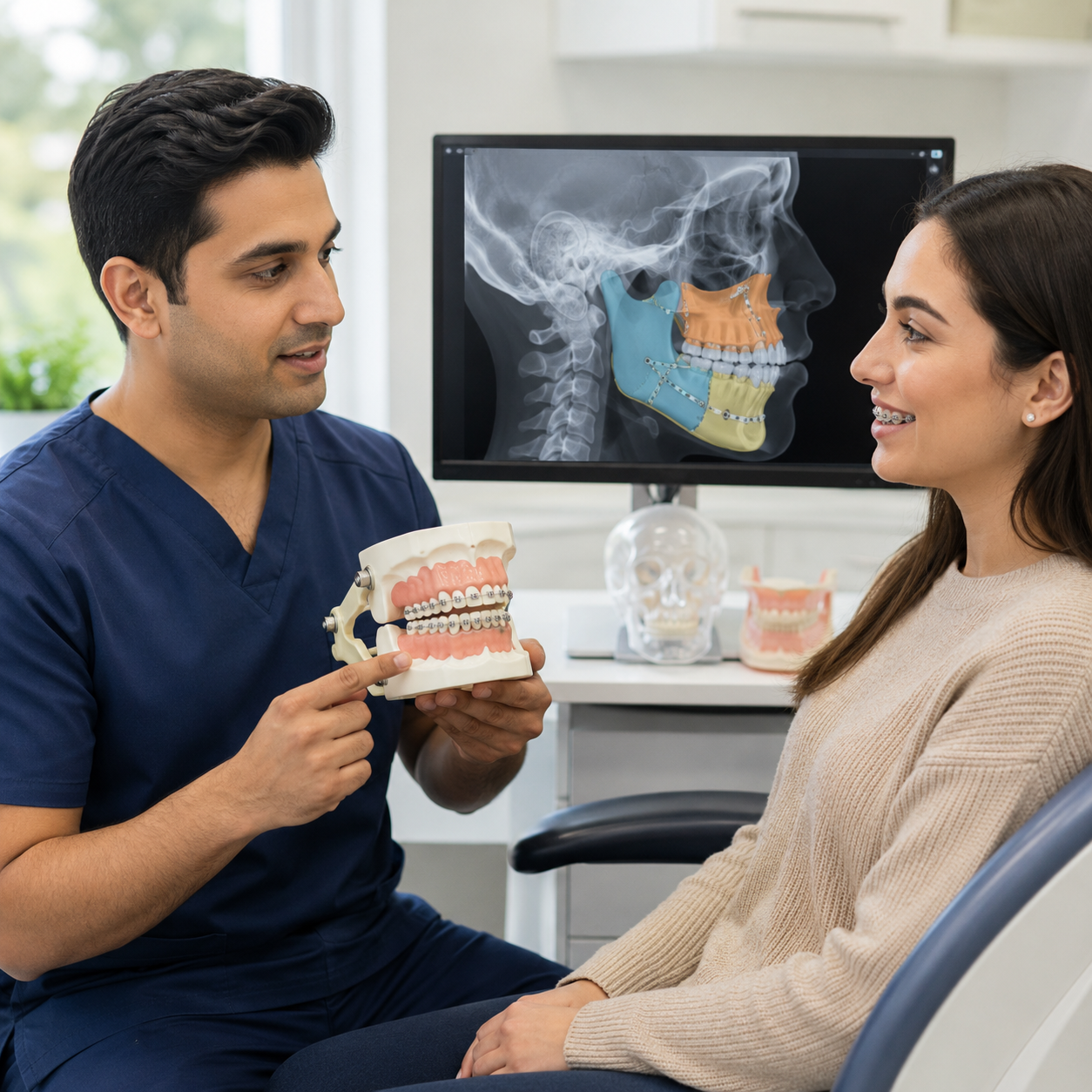
For a dental underbite, fixed braces — usually with cross-elastics — tip the upper front teeth forward and the lower ones back until they meet correctly. Braces give us the continuous, precise control that reverse bites demand, which is why they're the workhorse for anything beyond the mildest case, and why they're used before and after jaw surgery in skeletal cases too. Metal and tooth-coloured ceramic options are both available.
Milder dental cases & localised crossbites · near-invisible
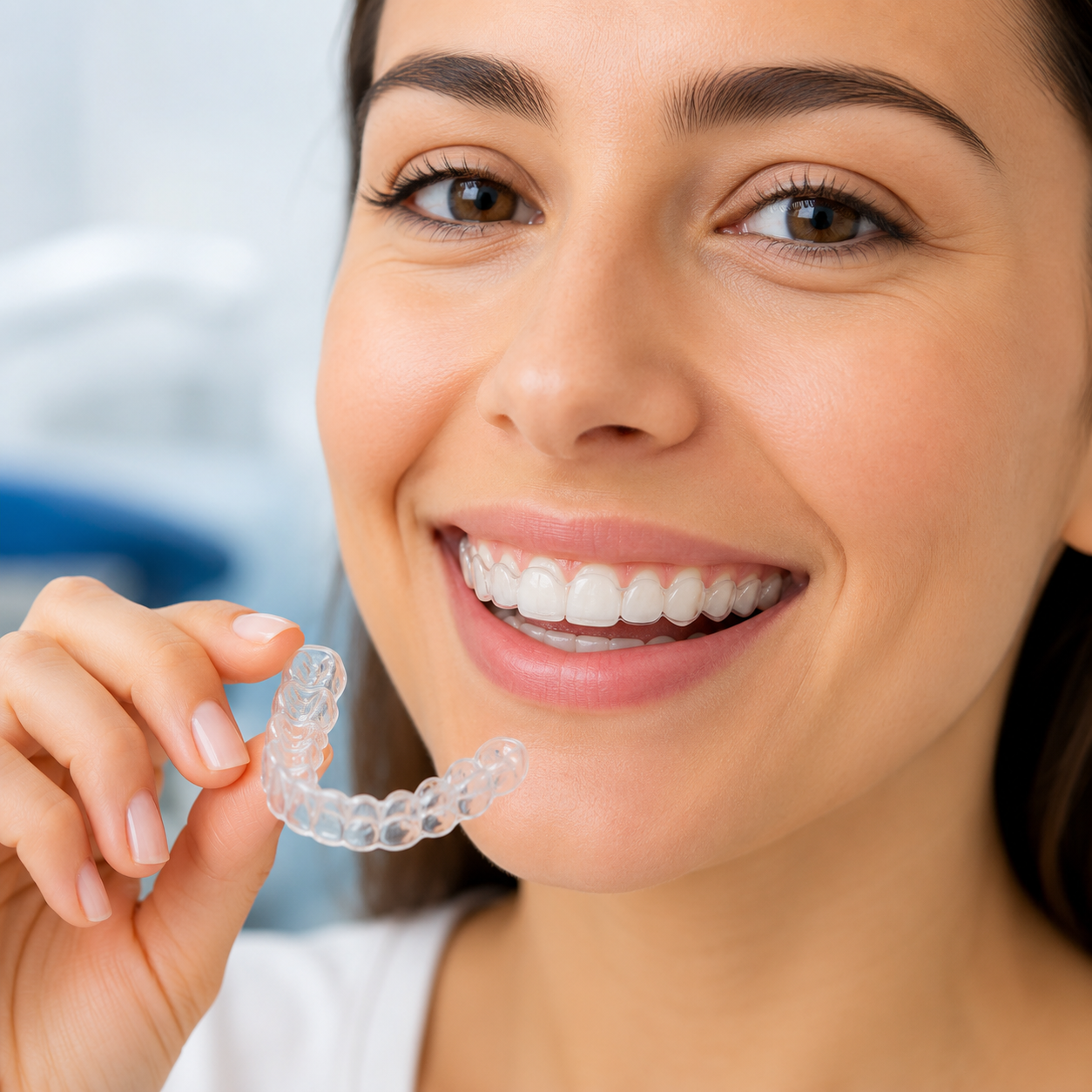
For milder dental underbites and localised crossbites, clear aligners are a discreet alternative — removable, near-invisible, and often paired with small bite ramps and elastics to encourage the right jaw position. They suit adults who want the correction without visible hardware. The honest limit: aligners depend on you wearing them around 22 hours a day, and they're not the right tool for a genuinely skeletal underbite. We'll tell you at the consultation whether your case is one aligners can finish.

Adult skeletal cases · planned together, under one roof
Once jaw growth is finished, bone can only be repositioned surgically — teeth can be moved, but the jaws can't be re-grown. For an adult with a genuine skeletal underbite, the stable answer is usually orthodontics combined with corrective jaw surgery (orthognathic surgery): braces align the teeth within each jaw first, the surgery repositions the jaw, and braces afterward fine-tune the bite. Where the discrepancy is only mild, a “camouflage” approach — moving the teeth to disguise the jaw position without surgery — can be an option, and we'll be straight with you about its trade-off: it can improve the bite but won't change the facial profile, and it carries a higher chance of relapse. Our founder's orthodontic planning combined with our in-house oral & maxillofacial surgery team means the orthodontic and surgical sides of a case are planned together, under one roof. See our jaw & face correction page for how surgical cases are sequenced.
The realistic timeline. A simple dental underbite or single-tooth crossbite can resolve in months. A full dental correction typically runs around 12–24 months. A surgical skeletal case is a longer, staged journey — pre-surgical alignment, surgery, then finishing — and we map the whole sequence for you before anything starts, so there are no surprises. Every timeline is confirmed after we see your records.
Real Arasu cases


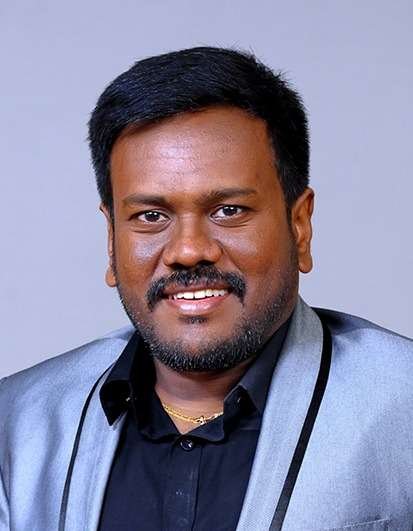
Founder · Orthodontics & Dentofacial Orthopedics · Fellow, World Federation of Orthodontists (USA)
Named Dentist of the Year – South Region at the 2023 Economic Times Healthcare Awards. His named expertise — growth guidance, functional appliances, fixed appliances, clear aligners and TMJ disorders — covers the full spectrum an underbite can involve. View profile

Orthodontist
Our second orthodontic specialist, supporting bite-correction cases across both branches. View profile
Before you commit
Why Arasu
Underbite correction is orthodontics and, in skeletal cases, jaw work — the two things our founder Dr. Sree Cumar is specifically trained in (MDS Orthodontics & Dentofacial Orthopedics), with growth-guidance and functional appliances among his named areas of expertise. You're not being routed to a generalist for a problem that needs a specialist's read — see our orthodontists.
Because we field a named multispecialty team — orthodontics plus in-house oral & maxillofacial surgery — a skeletal case can be planned across both sides together, rather than referred out and fragmented.
If your case is mild enough to leave alone, or better served by a treatment we've described here, we'll tell you that plainly. The diagnosis-first approach an underbite genuinely needs means you're set up for the full range — from a quick single-tooth crossbite to a co-ordinated surgical case.
We're open 10:00 AM to 8:30 PM every day — R.S. Puram: 129, W Sambandam Road, Coimbatore 641002 (+91 88380 22157) and Saibaba Colony: 160, NSR Road, Coimbatore 641011 (+91 74491 88777) — so adjustment visits fit around your work or your child's school.
Transparent pricing
There's no single price for “fixing an underbite”, because the cost follows the appliance your case actually needs — and that's set by whether the problem is dental or skeletal, how severe it is, and whether surgery is involved. What shapes your number: the route (aligners vs braces vs surgical case), the type of braces if that's the path (metal, ceramic, self-ligating or lingual), the length of treatment, and the diagnostic records needed up front. Here are the current appliance ranges we work from at Arasu:
| Treatment route | Price range (₹) | Best suited to |
|---|---|---|
| Clear aligners — mild case | ₹50,000 – ₹70,000 | Mild dental underbite / localised crossbite |
| Clear aligners — full / complex | ₹1,50,000 – ₹3,00,000 | Moderate dental underbite, adult, discreet |
| Metal braces | ₹30,000 – ₹50,000 | Most dental underbites; backbone of complex cases |
| Ceramic (tooth-coloured) braces | ₹35,000 – ₹70,000 | Dental underbite, less visible option |
| Self-ligating braces | ₹50,000 – ₹80,000 | Where fewer adjustment visits suit the patient |
| Lingual (behind-the-teeth) braces | ₹70,000 – ₹1,00,000 | Fully hidden correction |
| Braces + jaw surgery (skeletal case) | Quoted after consultation | Adult skeletal underbite — surgical + orthodontic |
Prices are subject to individual consultation and confirmation of your diagnosis. We accept UPI, cash, cards and net banking, and EMI options are available for the larger treatment plans. Surgical cases are quoted individually once the orthodontic and surgical plan is set — we don't put a headline number on a plan we haven't yet designed. For a full breakdown by appliance, see our braces cost and clear aligners cost pages.
Want a real figure for your underbite, not a range? A consultation gives you a written plan and price tied to your actual diagnosis.RS Puram: +91 88380 22157 · Saibaba Colony: +91 74491 88777 — open 10 AM to 8:30 PM, all seven days.
Book a consultationKeep exploring
If you're weighing up bite problems more broadly, our orthodontic treatment hub covers the full range, and the jaw & face correction page goes deeper on skeletal cases and surgery. Underbite is often confused with a crossbite (some upper teeth biting inside the lowers) or discussed alongside its opposite, an overbite. For the appliances themselves, see braces and clear aligners.
FAQs
Often, yes — if it's a dental underbite, or a mild skeletal one. Braces or clear aligners with elastics can move the teeth into a correct bite. Surgery becomes the recommendation when the lower jaw has genuinely outgrown the upper and the discrepancy is beyond what moving teeth can stably correct. We work out which category you're in from your records before recommending anything.
The earlier a developing underbite is caught, the more we can do without surgery. In children around 7–10, while the jaw is still growing, growth-guidance appliances can steer the jaws and sometimes prevent a future surgical case entirely — which is why a first orthodontic check by about age 7 matters. In adults, growth is finished, so the plan is either orthodontics alone (for dental cases) or orthodontics with jaw surgery (for skeletal ones).
It's not too late. Adults are treated every day. A dental underbite in an adult can usually be corrected with braces or aligners. A skeletal underbite in an adult can't be grown out, so it's corrected with braces plus jaw surgery, or — in mild cases — camouflaged with orthodontics alone, with the trade-offs we explain honestly at the consultation.
A localised single-tooth crossbite can resolve in months. A full dental correction usually runs about 12–24 months. A surgical skeletal case is longer and staged — alignment, surgery, then finishing. We give you the specific timeline once we've seen your records.
For a dental underbite, usually yes — braces with cross-elastics are the standard route. For a skeletal underbite, braces are still essential, but they work alongside jaw surgery rather than instead of it. The diagnosis decides which applies to you.
It's rarely only cosmetic. A reversed bite loads the front teeth in a way they aren't designed for, which can wear enamel faster, strain the jaw joint, and make chewing and clear speech harder over time. Correcting it addresses function as well as appearance.
It depends on the appliance your case needs. Dental corrections with braces at Arasu start from around ₹30,000, aligner cases run higher, and skeletal cases involving surgery are quoted individually after planning. You'll get a written plan and price tied to your actual diagnosis at the consultation.
Medical disclaimer: this page is general information, not a diagnosis. Statistics reflect published dental research, not a promise of individual outcomes — results vary. Please consult our dentists for a personalised assessment.
Arasu Dental Care — open all 7 days, 10:00 AM – 8:30 PM
An underbite is one problem where the right first step — an accurate diagnosis — makes the whole difference. Bring yours to us and we'll tell you honestly whether it's dental or skeletal, which route fits, what it will take, and what it will cost. Let's get you a bite that works. WhatsApp +91 96007 56297 · arasudentalcare@gmail.com.
More From Arasu