If the thought of getting a tooth removed makes you anxious, you are not alone. Many patients delay treatment because they fear pain, but modern dentistry has changed that experience completely.
A painless tooth extraction is now a safe, gentle, and well-controlled procedure. With the help of advanced anaesthesia, careful technique, and proper planning, most patients feel only mild pressure rather than pain.
This stepwise guide explains what painless tooth extraction means, when it is needed, and what happens at each stage. Our goal is to help you feel informed, prepared, and calm before your visit.
What Is a Painless Tooth Extraction?
A painless tooth extraction is the safe removal of a tooth using modern numbing techniques and gentle instruments. The aim is to keep the patient comfortable from start to finish.
The word “painless” mainly refers to the procedure itself. Mild soreness during healing is normal, but the actual extraction is done without sharp pain, thanks to local anaesthesia and refined surgical methods.
At a trusted dental clinic, your dentist also focuses on reducing fear, explaining each step, and protecting the bone and gum tissue around the tooth.
When Is a Tooth Extraction Needed?
Tooth removal is never the first option. Dentists usually try to save a tooth through fillings, root canal treatment, or gum therapy before considering extraction.
However, some situations may make removal the safer and healthier choice.
Severe tooth decay: When decay reaches deep into the tooth and cannot be restored with a filling or crown. Removing the tooth helps stop the infection from spreading further.
Advanced gum disease: When the bone supporting the tooth has been destroyed and the tooth becomes loose. Extraction may protect nearby healthy teeth and gums.
Impacted wisdom teeth: Wisdom teeth that cannot erupt properly often press against other teeth or cause repeated infections. Early removal can prevent long-term complications.
Broken or fractured teeth: A tooth fractured below the gum line may not be repairable. In such cases, extraction prevents pain and future infection.
Orthodontic reasons: Sometimes, a healthy tooth is removed to create space for proper alignment during braces or aligner treatment. This is planned carefully by your orthodontist.
Extra or poorly positioned teeth: Supernumerary teeth or teeth in abnormal positions may crowd the mouth and need removal for better oral health.
Stepwise Guide to Painless Tooth Extraction
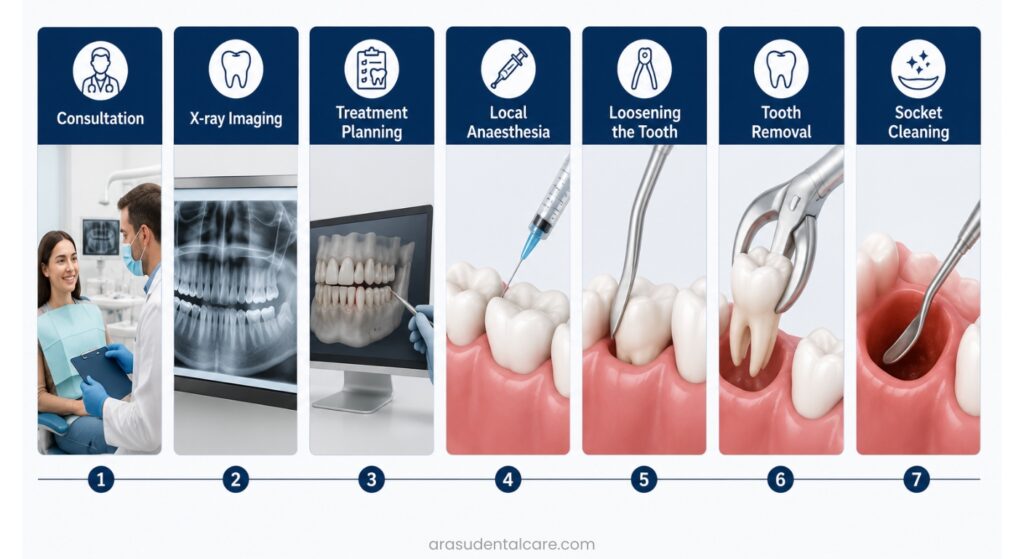
A smooth extraction follows a clear, organised process. Here is what each step looks like.
Step 1: Consultation and Examination
Your dentist begins with a full oral examination and reviews your medical history. This helps identify any conditions that may affect treatment, such as diabetes, blood pressure, or blood thinners.
A clear discussion at this stage helps you understand whether extraction is truly needed or if another option may work.
Step 2: Digital X-rays or 3D Imaging
A digital X-ray or, in complex cases, a CBCT scan helps the dentist see the tooth root, bone structure, and nearby nerves.
This planning step is important for safety, especially for impacted wisdom teeth or teeth close to the sinus or nerve.
Step 3: Treatment Planning and Pre-Procedure Instructions
Your dentist explains the type of extraction needed, simple or surgical, and discusses anaesthesia options. You will receive instructions about eating, medications, and what to expect.
Patients with anxiety can also discuss sedation options at this stage. Clear communication makes the visit much calmer.
Step 4: Numbing the Area with Local Anaesthesia
A small amount of numbing gel is first applied to the gum. Then local anaesthesia is given gently, which blocks pain signals from the tooth and surrounding area.
Within a few minutes, the area becomes fully numb. You stay awake but feel no sharp pain during the procedure.
Step 5: Loosening the Tooth
The dentist uses precise instruments to gently loosen the tooth from its socket. This is done slowly to protect the bone and surrounding tissues.
You may feel mild pressure or movement, but not pain. According to the American Dental Association, pressure sensation during extraction is completely normal.
Step 6: Removing the Tooth
Once the tooth is loose enough, it is lifted out carefully. For impacted or broken teeth, a small surgical approach may be used, which involves a tiny gum incision and sometimes sectioning the tooth.
Modern tools make even surgical extractions smooth and efficient.
Step 7: Cleaning and Closing the Socket
After removal, the socket is cleaned to remove any debris or infected tissue. In some cases, a bone graft may be placed to preserve bone for a future implant.
Stitches may be used if needed, and a gauze pad is placed to control bleeding.
What Makes the Extraction Truly Painless?
Several factors work together to make the experience comfortable.
Effective local anaesthesia: Modern anaesthetics numb the area quickly and last long enough to complete the procedure without discomfort.
Gentle, precise tools: Newer instruments allow dentists to remove teeth with minimal pressure on the bone and gums. This reduces trauma and speeds up healing.
Experienced dental team: A skilled dentist understands tooth anatomy and uses techniques that protect surrounding tissues. Experience plays a major role in patient comfort.
Sedation options when needed: For nervous patients or complex cases, options like nitrous oxide or oral sedation can help. These are discussed during consultation.
Calm, supportive environment: A reassuring chairside approach reduces fear, which often makes the procedure feel even smoother.
What to Expect After the Procedure
Recovery is usually straightforward when aftercare is followed properly. Most patients return to normal activities within a day or two.
Mild swelling and soreness: Some swelling around the cheek is normal for the first 24 to 48 hours. Cold compresses help reduce it.
Light bleeding: Slight oozing for a few hours is expected. Biting gently on the gauze helps form a healthy blood clot.
Soft food diet: Stick to soft foods like curd, khichdi, soup, or mashed vegetables for the first day. Avoid very hot, spicy, or hard foods.
Avoid straws and smoking: Suction can dislodge the clot and cause a painful condition called dry socket. Smoking also delays healing.
Gentle oral hygiene: Continue brushing, but avoid the extraction site for the first day. A warm salt-water rinse from day two helps keep the area clean.
Take prescribed medications: Pain relievers and, if needed, antibiotics should be taken as directed. Do not skip doses.
For more on safe recovery, the National Institutes of Health provides reliable post-extraction guidelines.

When to Contact Your Dentist After Extraction
Most patients heal smoothly, but a few signs need attention.
Heavy bleeding after 24 hours: Slight oozing is normal, but persistent bleeding should be reviewed.
Severe or increasing pain: Pain that gets worse after the third day may indicate dry socket or infection.
High fever or pus discharge: These can be signs of infection and need prompt dental care.
Numbness that does not fade: If numbness lasts longer than expected, your dentist should evaluate the area.
Reaching out early helps prevent complications and keeps healing on track.
Replacing the Extracted Tooth
A missing tooth can affect chewing, speech, and the alignment of nearby teeth. Replacing it at the right time helps maintain oral balance.
Dental implants: A long-lasting option that mimics a natural tooth. Implants also help preserve the jawbone.
Dental bridges: A fixed option that uses neighbouring teeth for support. Suitable for many patients depending on tooth location.
Removable dentures: A more affordable choice when multiple teeth are missing. Modern dentures are comfortable and natural-looking.
Your dentist will guide you on the option that suits your oral health, bone level, and lifestyle.
Conclusion
A painless tooth extraction is no longer something to fear. With careful planning, modern anaesthesia, and gentle techniques, the procedure is safe, smooth, and well tolerated by most patients.
The most important step is choosing a dental team that listens, explains clearly, and puts your comfort first. Early action also prevents small dental issues from turning into bigger problems.
If you are considering dental implants or want to know if they are right for you, please check Arasu dental care.
Frequently Asked Questions
1. Is painless tooth extraction really painless?
The procedure itself is virtually pain-free thanks to local anaesthesia. You may feel pressure or movement, but not sharp pain. Mild soreness during healing is normal.
2. How long does a tooth extraction take?
A simple extraction usually takes 15 to 30 minutes. Surgical extractions, such as for impacted wisdom teeth, may take 30 to 60 minutes depending on the case.
3. How soon can I eat after the procedure?
You can eat soft foods a few hours after the extraction, once the numbness wears off. Avoid hot, spicy, or hard foods for at least 24 hours.
4. How long does healing take?
The gum usually heals within 1 to 2 weeks. Complete bone healing inside the socket may take a few months, but daily life returns to normal much sooner.
5. Can I go to work the next day?
Most patients with simple extractions can resume work the next day. Surgical extractions may need 1 to 2 days of rest for proper recovery.
6. Will I need a tooth replacement?
It depends on the location of the extracted tooth. Back teeth often need replacement to maintain chewing function and prevent shifting of nearby teeth.
7. Is tooth extraction safe for diabetic or hypertensive patients?
Yes, with proper medical evaluation and controlled health parameters. Inform your dentist about all medications and conditions before the procedure.
8. What is dry socket and how can I avoid it?
Dry socket happens when the protective blood clot is dislodged. Avoiding straws, smoking, and vigorous rinsing in the first 24 hours helps prevent it.