Periodontist-led · rebuilds gum lost to recession
At Arasu Dental Care, gum grafting rebuilds the gum tissue you've lost to recession — covering exposed roots, easing the sharp sensitivity that comes with them, and restoring an even, healthy-looking gumline. Once gum tissue recedes, it does not grow back on its own; grafting is how we repair it — performed by our periodontist with a minimally invasive approach: smaller incisions, gentler healing.
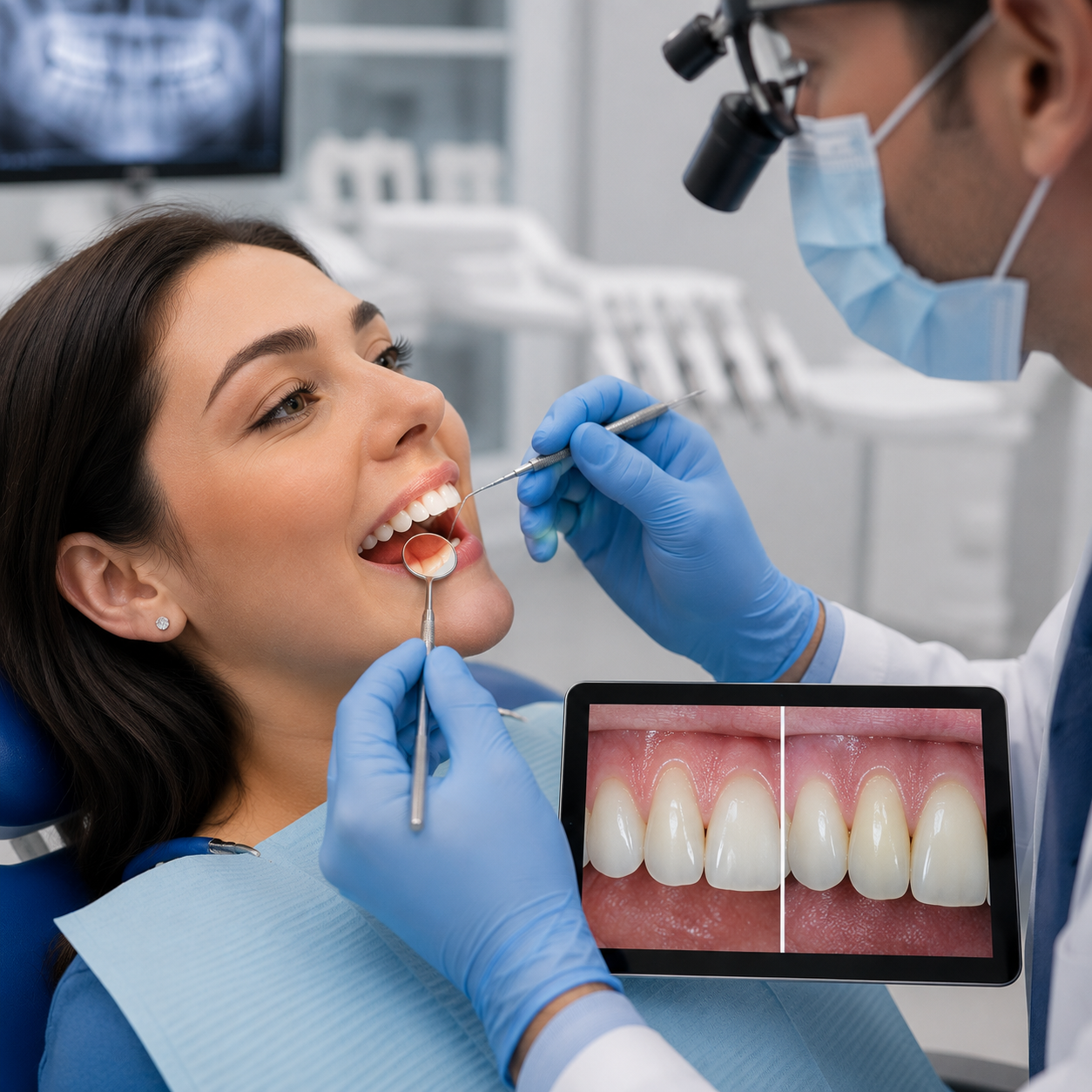
Medically reviewed by the Arasu Dental Care clinical team · Last reviewed July 2026
Noticed your gums pulling back, teeth looking longer, or a wince at anything cold? A consultation at either of our Coimbatore branches will tell you exactly where you stand — and whether a graft is genuinely what you need. R.S. Puram: +91 88380 22157 · Saibaba Colony: +91 74491 88777
Where To Start
Gum grafting is the right treatment when recession has gone far enough to expose the root or threaten the tooth's support. If your recession is caused by ongoing gum infection rather than lost tissue, the pathway starts on our gum disease treatment route instead. These are the signs that actually matter for the grafting decision:
Your teeth look longer than they used to, or the gumline sits unevenly across your smile.
Sharp sensitivity at the gumline to cold, sweet or sour — the classic sign of an exposed root surface.
A visible notch or groove near the gumline, or a darker, yellowish band where the root shows.
Your dentist has flagged thin or receding gums before braces, aligners or an implant — grafting first protects the result.
Recession that keeps progressing year on year despite good brushing.
If your recession is mild and stable, you may not need surgery at all — and we'll tell you so.
You're in common company. In an Indian clinical study of 710 patients, around 41% showed gum recession, most often on the lower front teeth — with plaque build-up and incorrect brushing technique the two leading causes. International reviews put it higher with age: roughly half of adults aged 18–64, and 88% of those over 65, have at least one site of recession.
Your Options
There isn't one gum graft — there are several, and choosing the right one for your recession pattern, tissue thickness and smile line is most of the skill. Our periodontist selects between:
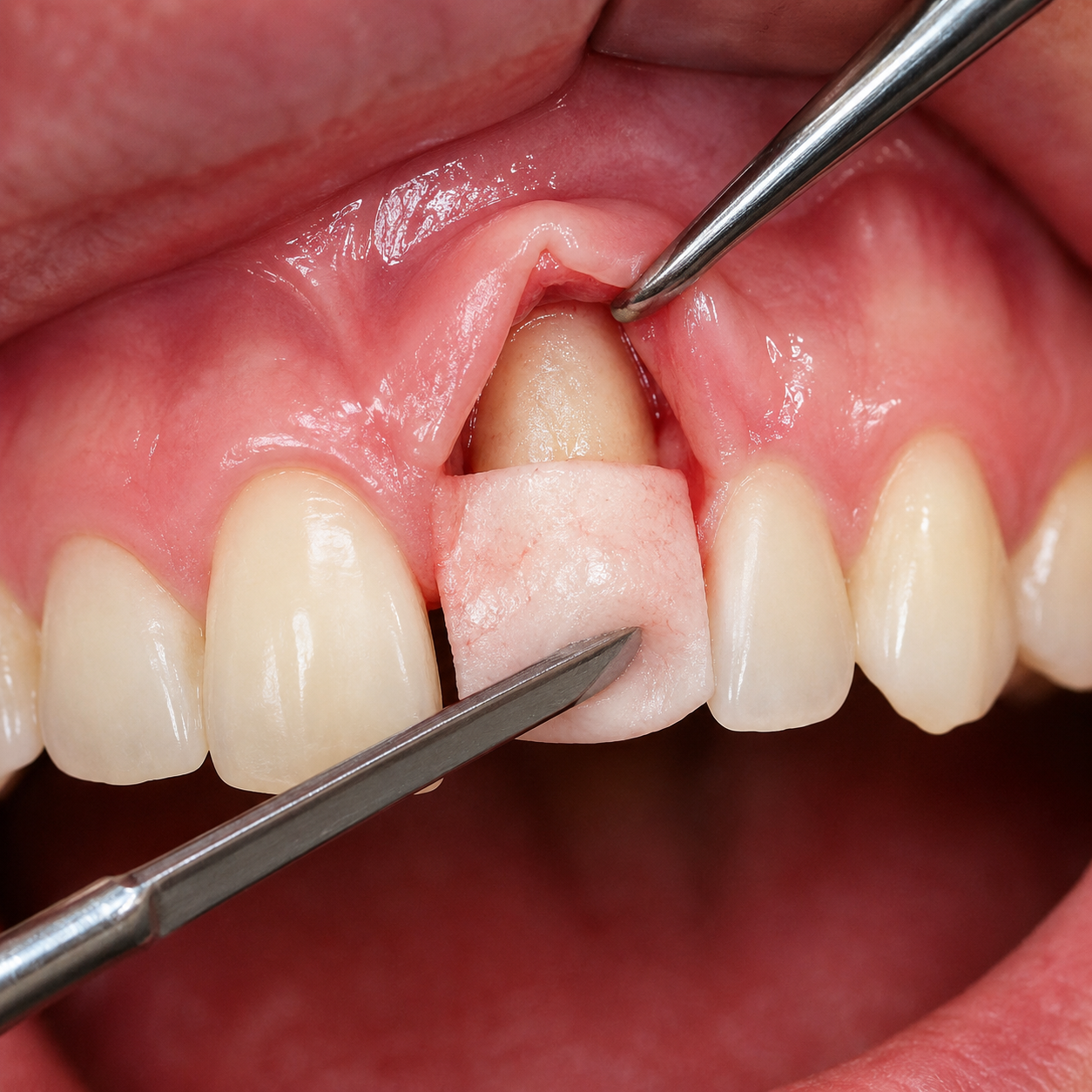
The workhorse of root coverage. A thin layer of tissue is taken from under the surface of your palate and secured over the exposed root. It's the most predictable option for covering recession: clinical studies report mean root coverage of around 97% at three months, holding at around 98% when patients were reviewed more than two years later.
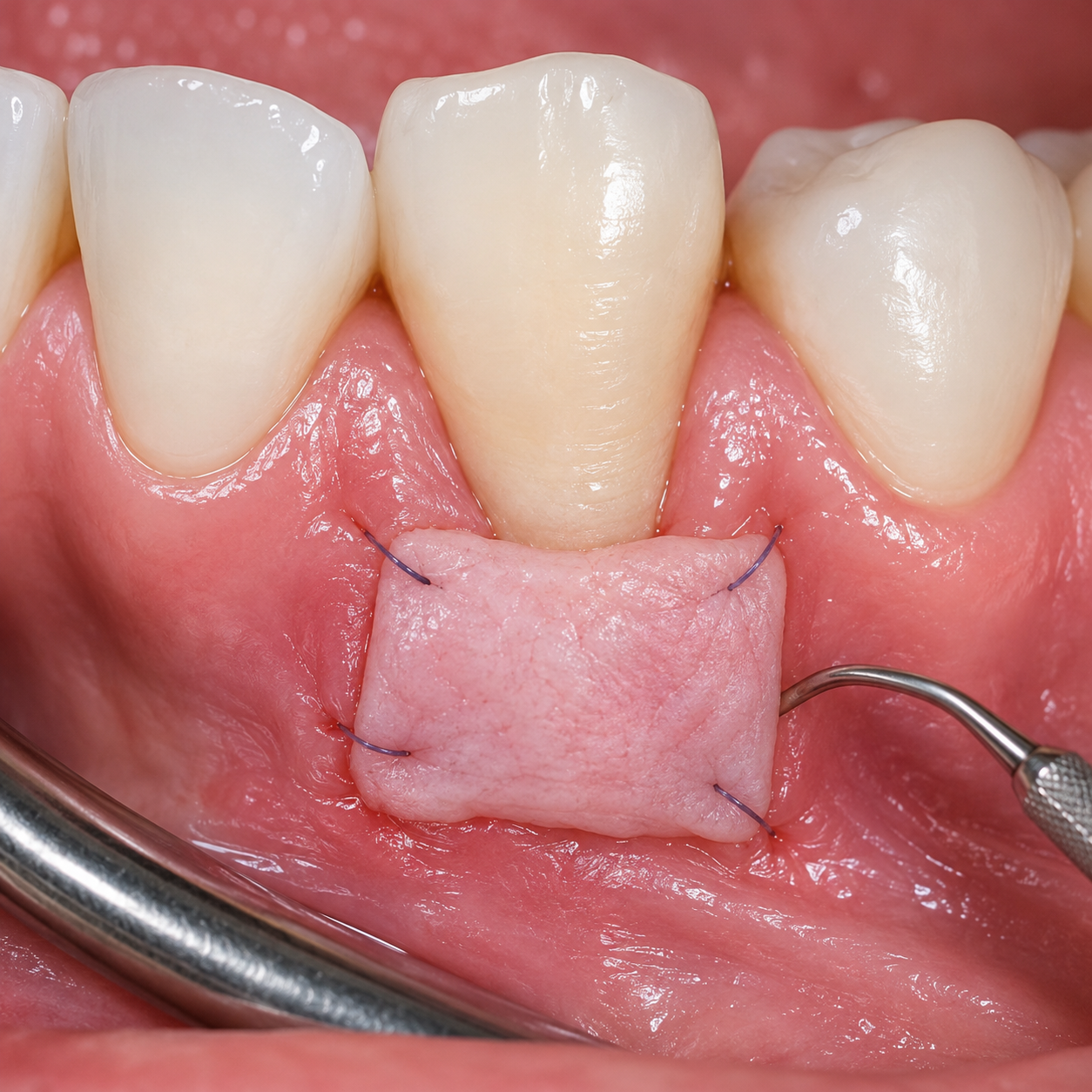
Used when the problem is thin, fragile gum tissue rather than root coverage alone. A small piece of tissue from the palate surface thickens the gum band so it can resist further recession — the standard choice for patients with a naturally thin gum type.
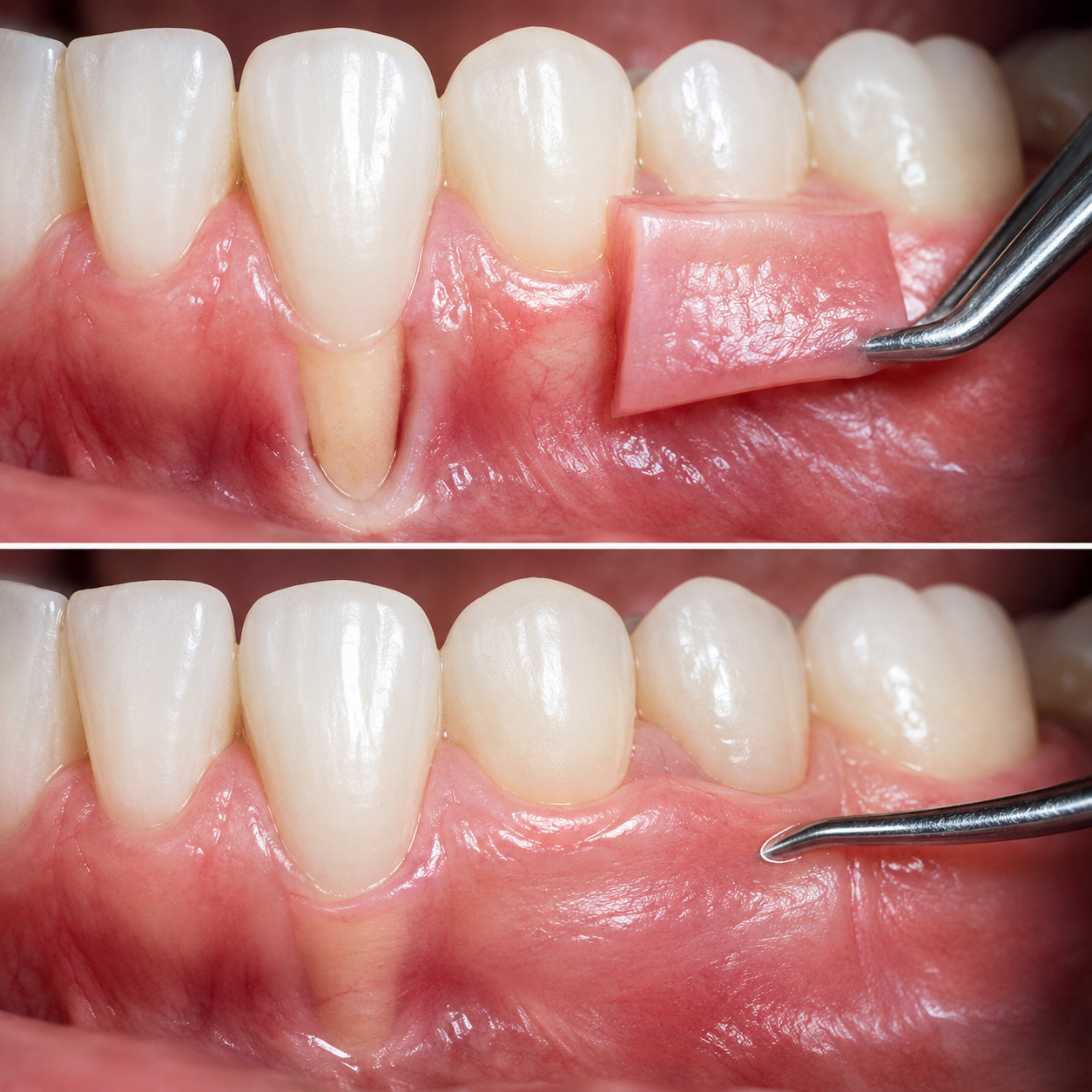
Where you have healthy gum tissue right next to the recession, we can rotate a flap of it across without a separate donor site — it keeps its own blood supply, which helps it integrate quickly.
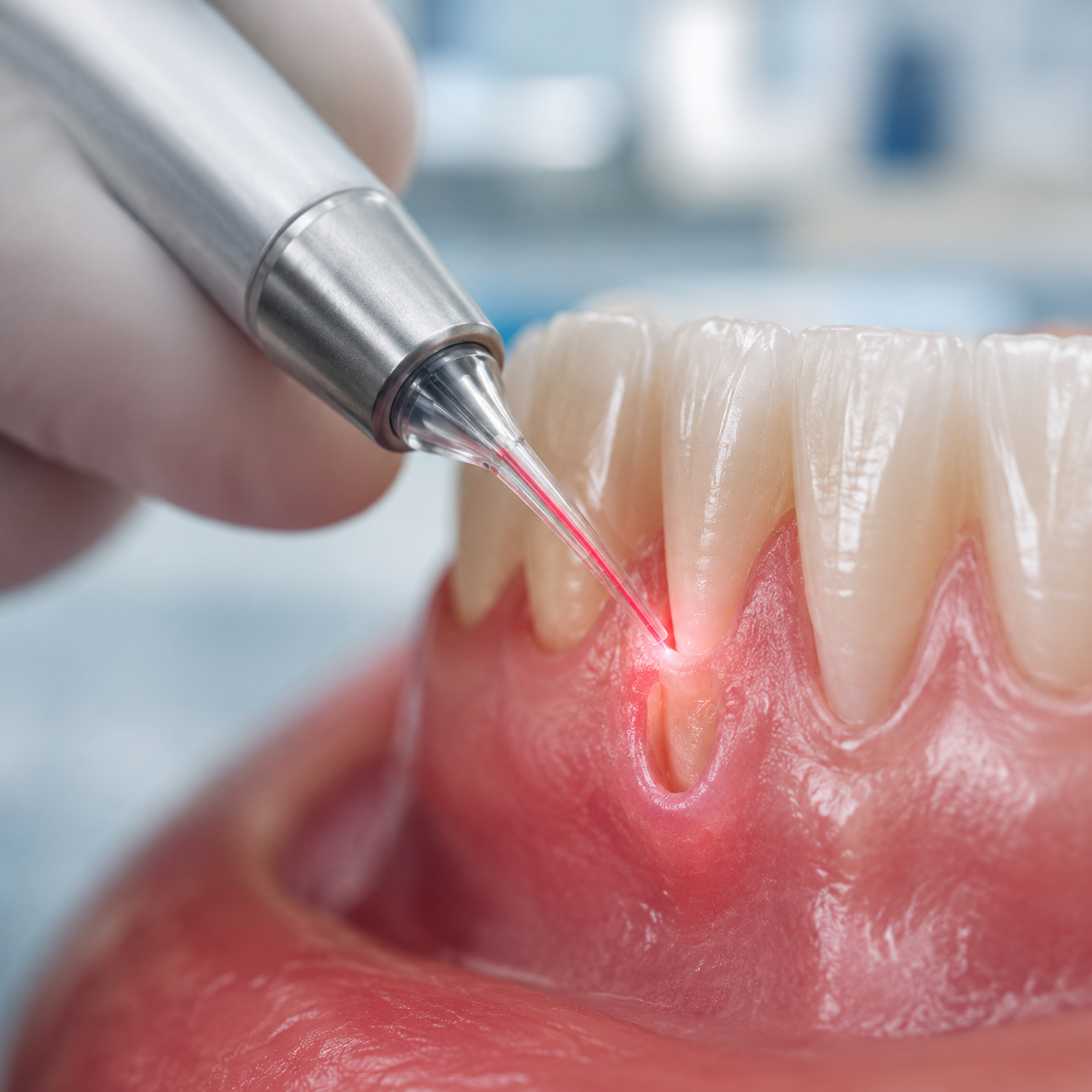
Where the case suits it, we place grafts through tunnel-style approaches that avoid large incisions, and use laser support during treatment — the area our periodontist trained in with the WCLI. For patients, that typically means less post-operative soreness and faster early healing.
The Procedure
First, we make sure your gums are ready. A graft placed over active gum disease fails — so we examine your pocket depths, take an X-ray where needed, and treat any active infection before we graft. The procedure itself is done under local anaesthesia and typically takes 60–90 minutes depending on how many teeth we're treating. You'll be comfortable throughout — numb, awake, and free to go home the same day.
Step 1
We check pocket depths and X-rays. If there's active infection, we treat it first — usually with scaling & deep cleaning, occasionally flap surgery in advanced cases. Grafting comes once the foundation is stable.
Step 2
The area is fully numbed with local anaesthesia so you stay comfortable throughout. Our periodontist prepares the recipient site around the exposed root so the new tissue has a clean, healthy bed to attach to.
Step 3
The graft tissue is harvested from the palate or an adjacent site — or placed via a tunnel technique — positioned over the root, and secured with fine sutures. Any donor area used is dressed to protect it.
Step 4
You leave with clear written aftercare instructions and a review appointment booked at whichever branch suits you — so we can confirm the graft is integrating as it should.
Afterwards
Gum grafting is a same-day procedure and most people are back to routine within a day or two. Here's an honest timeline.
Swelling and tenderness peak. Cold compresses, prescribed pain relief and rest handle it — most patients describe it as manageable soreness rather than pain.
Soft, cool foods; no brushing over the surgical site — we'll give you an antiseptic rinse instead. Most people are back at work within a day or two.
Sutures are removed or dissolve; normal eating gradually returns. The donor site on the palate, if used, feels like a scald and settles in about a week.
The graft integrates and the gumline takes its final shape. Complete maturation continues quietly for a few months.
Straight Answers
Success depends heavily on how far recession has progressed. In a long-term review, root coverage succeeded in about 98% of early-stage (Miller Class I) cases, but only around 74% once recession had advanced between the teeth. Treating it while contained is the single biggest thing you control.
If periodontitis caused your recession, that disease is controlled, not cured. Without regular maintenance cleanings and good home care, recession can return around the graft. We'll be clear about the maintenance plan before we operate.
With palate-harvested grafts, the roof of the mouth is tender for around a week. Tunnel techniques and pedicle grafts reduce or avoid this where your case allows.
Smokers heal slower and show lower graft success rates. If you smoke, we'll talk frankly about pausing around surgery — it materially changes your result.
Tissue thickness, bite forces, hygiene and general health all influence the outcome. At your consultation we'll assess your specific case rather than quote you an average.
Some patients need a graft, some need laser gum therapy, some both in sequence. Your assessment decides — and if monitoring is the honest answer, that's what we'll say.
Cost
What you'll pay depends on four things: how many teeth need coverage, the graft technique chosen, whether donor material is used in place of your own tissue, and whether gum disease has to be treated first. Across India, gum grafting is typically quoted in the range of ₹5,000–₹15,000 per tooth (market estimate from published clinic pricing — not an Arasu quote).
| Service | Fee at Arasu | Notes |
|---|---|---|
| Gum grafting (per tooth) | Quoted after examination | Depends on graft type & number of teeth |
| Consultation | ₹300 – ₹500 | Includes periodontal assessment |
| IOPA X-ray | ₹200 – ₹300 | If needed for diagnosis |
| OPG (full-mouth X-ray) | ₹400 – ₹600 | For multi-site or complex cases |
| Deep cleaning (scaling & root planing) | ₹12,000 – ₹15,000 | Only if active gum disease must be treated first |
Wondering what your case would cost?Book a consultation at either branch and leave with a clear, itemised estimate — R.S. Puram +91 88380 22157 or Saibaba Colony +91 74491 88777.
Get Started
Tell us a little about your gums and pick a time that suits you. We start by assessing your recession and gum health, because that decides whether you need a graft — and which type — or whether monitoring and better technique is the honest answer. You'll leave with a written, itemised estimate before anything begins.
Take the first step toward repairing your gumline.
Why Arasu
Gum grafting is a periodontist's procedure — and here it's done by one, in a multispecialty clinic where the causes behind your recession get handled too.
Your graft is performed by , whose surgical work spans grafting, flap surgery and laser-assisted therapy, with an Associate Fellowship from the WCLI, USA.
Her focus is the smallest intervention that solves your problem properly — tunnel and laser-assisted techniques where your case allows, for gentler healing.
If crowded teeth are driving your recession, our orthodontists are in the same clinic; if an exposed root needs restorative protection, that's in-house too — the causes get handled, not just the symptom.
Our full periodontal range — from routine scaling to advanced surgery — means your graft is followed by the maintenance care that protects it. Open 10 AM – 8:30 PM, all seven days at both branches.
Patient Reviews
My lower front teeth had started looking long and were sensitive to anything cold. The periodontist explained the graft options clearly and did a connective tissue graft. The sensitivity is gone and the gumline looks even again.
They didn't rush me into surgery — my recession on one tooth was mild so they said monitor it, and only grafted the two that needed it. Honest, and a written estimate before starting.
Was told to fix my receding gums before starting aligners. The tunnel technique meant less soreness than I expected and I was back at work in two days. The palate was the tender part, as they'd warned.
They treated my gum infection with deep cleaning first, then did the graft once things were stable. Clear about what it could and couldn't fix, and the maintenance plan was explained up front.
FAQs
The procedure itself is done under local anaesthesia, so you won't feel it being done. Afterwards, expect manageable soreness for a few days — the palate donor site, when one is used, is usually the tender spot, and it settles in about a week with the medication we prescribe.
With good hygiene and regular maintenance visits, grafts are a long-term repair. One long-term study found 83% of grafted sites maintained their improvement when followed up over decades. What shortens a graft's life is the same thing that caused the recession — uncontrolled gum disease or aggressive brushing — which is why maintenance is part of our plan, not an afterthought.
No — gum tissue that has receded does not regenerate on its own. What we can do without surgery is stop mild recession from progressing: correcting brushing technique, treating gum infection and protecting sensitive root surfaces. Grafting is for recession that has already gone too far to leave alone. More on the causes of receding gums.
Most patients are back at work in one to two days. You'll be on soft foods for the first week or two and avoiding the surgical site while brushing, but normal life resumes quickly.
Not immediately — and any clinic that offers to skip this step should worry you. Active infection has to be treated first, usually with deep cleaning, so the graft has a healthy foundation. We stage the two treatments properly, then place the graft once your gums are stable.
They do different jobs. Laser gum therapy treats infection and inflammation in the gums; grafting rebuilds tissue that's already lost. Some patients need one, some the other, some both in sequence — your assessment will tell us which, and we'll recommend only what your case actually needs.
Published clinic pricing across India typically runs ₹5,000–₹15,000 per tooth, varying with graft type and case complexity. Your exact fee at Arasu Dental Care is confirmed at consultation with a full written estimate — including any preparatory treatment — before anything begins.
Book your gum grafting consultation
We'll assess your recession and gum health, then tell you plainly whether a graft is what you need — and which type — with a written estimate before anything starts. Open 10 AM – 8:30 PM, all seven days · WhatsApp +91 96007 56297.