Laser or minor surgery · only when it's genuinely restricting function
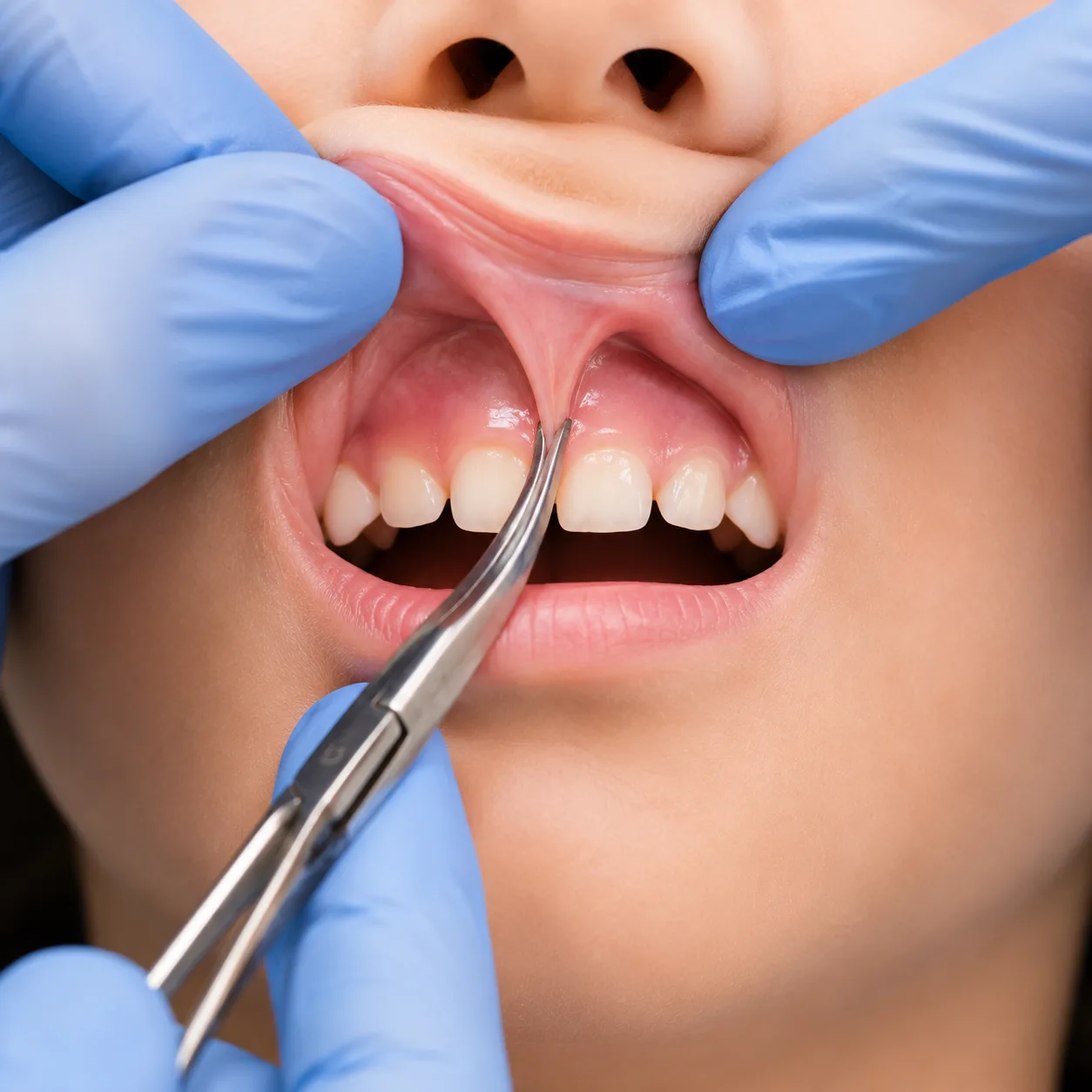
A frenectomy releases the tight band of tissue — under the tongue or behind the lip — that's restricting how you or your child moves the tongue, feeds, speaks, or keeps the gums healthy. At Arasu Dental Care, we first check whether that band (the frenum) is genuinely causing a problem, and when it is, we release it in a short procedure — usually with a dental laser, sometimes with minor surgery — so the tongue or lip can move freely again.
It's the right step for a baby struggling to latch and feed, a child whose speech or eating is held back by a tight tongue (tongue-tie), an adult with a gap between the front teeth or gums being pulled away from a tooth, or a lower denture that won't sit because of a high lip attachment (lip-tie). It isn't needed for every tight frenum — and part of our job is telling you honestly when it isn't.
Open all seven days, 10:00 AM – 8:30 PM · R.S. Puram +91 88380 22157 · Saibaba Colony +91 74491 88777
Not sure whether a tongue-tie or lip-tie needs releasing? A single consultation will tell you clearly. Call R.S. Puram +91 88380 22157 or Saibaba Colony +91 74491 88777 to book an assessment. Open every day, 10:00 AM to 8:30 PM.
The honest answer
A frenum only needs releasing when it's actually limiting function. These are the situations where we most often recommend it — see which one fits.
A baby who can't latch or feed wellA tight band under the tongue — tongue-tie, or ankyloglossia — can stop a newborn latching deeply, showing up as very long feeds, poor weight gain, clicking sounds while feeding, and sore, cracked nipples for the mother. Tongue-tie is estimated to affect roughly 4% to 11% of newborns, and research suggests tongue-tied babies are around three times more likely to have breastfeeding difficulty. When feeding is genuinely affected, an early release is quick and usually well tolerated.
A child with speech or eating difficultyIn older children, a restricted tongue can make certain sounds hard to form and can make eating slow or messy — trouble licking, clearing food from the teeth, or moving the tongue to the roof of the mouth. Where a paediatric assessment links this to a tight frenum, releasing it gives the tongue the range it needs. Our paediatric dentistry team handles children's cases gently and at their pace.
A gap between the upper front teethA low, thick lip band can hold the two upper front teeth apart, creating a midline diastema (a gap between the front teeth). Releasing the band removes the pull so the gap can be closed — usually alongside braces or aligners, since the frenectomy stops the gap reopening rather than closing it on its own.
Gums being pulled away from a toothA high frenum attachment can tug on the gum margin every time the lip moves, contributing to gum recession over time. Releasing the attachment takes the tension off the gum, which is often planned together with gum treatment where recession has already started.
An adult whose denture won't seatA prominent lip or tongue band can lift and unseat a lower denture. A small release can be the difference between a denture that stays put and one that never quite settles.
What's involved
The whole point of a frenum release is that it's small and quick. Here's how we approach it, from assessment to healing.
STEP 1
We confirm the frenum is the real cause — watching a baby feed, checking tongue movement and speech in a child, or looking at the gap or gum tension in an adult. Only if the release will genuinely help do we go ahead, because not every tight frenum is the problem it looks like.
USUAL APPROACH
For most cases we use a dental laser. Under local anaesthetic it releases the band with very little bleeding, seals the tissue as it works, and usually needs no stitches — which is why healing tends to be quicker and more comfortable than with a blade. Carried out by , who holds an Associate Fellowship in Laser Dentistry (WCLI, USA).
WHEN IT SUITS
A thicker band, a revision of a previous release, or a case that needs the tissue repositioned is done as a small surgical procedure — again under local anaesthetic, with fine dissolvable stitches. Handled by our oral and maxillofacial surgeon, Dr. P.R. Gouthaman (MDS, OMFS).
How long it takes, and recovery. The release itself is typically over in about 10 to 15 minutes. For a baby, feeding can often resume straight away. Adults and older children may notice mild soreness for a few days, eased with simple pain relief and soft foods. Whichever route fits your case, it's a day procedure — you or your child go home the same day.
Aftercare we'll walk you through. You'll leave knowing exactly what to do: keeping the area clean, the gentle stretches or tongue exercises for your case, what's normal in the first few days, and when to call us. Doing the stretching movements matters — skipping them is the main reason a release tightens up again. For speech or feeding cases, we coordinate with a speech therapist or lactation support where that will help the result hold.
Who treats you
A frenum release can be needed at any age, and each case needs a slightly different pair of hands. We match the technique to the case rather than the case to the technique — with the right specialist already in the building.

Straight talk
A frenectomy is a small procedure, but it's still worth going in with clear expectations.
Individual results vary based on the type and thickness of the frenum, age, the reason for treatment, and how closely aftercare is followed. Consult our dentists for a personalised assessment.
Cost
A frenum release is one of the more affordable oral procedures, but the exact figure depends on your case. These are the factors that move the price.
| What affects the cost | Why it matters |
|---|---|
| Type of frenum | A simple lingual (tongue) or labial (lip) release differs from a thicker or revision case. |
| Technique | Laser vs surgical release differ in chair time and materials. |
| Age & cooperation | Infant releases are quick; an anxious child or a complex adult case may need more time. |
| Combined treatment | Cost changes if the release is planned alongside braces, gum treatment or a denture. |
| Diagnostics & review | Assessment, and any follow-up or aftercare review, may be part of the plan. |
Pricing subject to individual consultation. Figures are indicative and confirmed after clinical assessment.
Want a clear quote for your case?Book an assessment and we'll confirm whether a release is needed and exactly what it costs. R.S. Puram +91 88380 22157 · Saibaba Colony +91 74491 88777.
Get your estimateWhy Arasu
A frenum release can be needed for a newborn, a school-age child, or an adult — and each needs a slightly different pair of hands. What sets us apart is that all of them are under one roof.
Laser releases with (WCLI-USA laser fellowship) and surgical releases with our oral surgeon Dr. P.R. Gouthaman — so we match the technique to the case rather than the case to the technique.
Our paediatric team handles the youngest patients calmly, and we coordinate with feeding and speech support when it helps.
Monday to Sunday, 10:00 AM to 8:30 PM, across two central Coimbatore branches — useful when a feeding problem can't wait for a weekday.
If a release isn't needed, we say so. Our transparent, assessment-first approach is the point — we treat what needs treating, and nothing that doesn't.
Book a frenectomy assessment at Arasu Dental Care
Bring your questions about feeding, speech, a front-tooth gap or a denture that won't settle — we'll tell you honestly whether a release will help. R.S. Puram: 129, W Sambandam Road, Coimbatore 641002 · +91 88380 22157 · Saibaba Colony: 160, NSR Road, Coimbatore 641011 · +91 74491 88777. Open 10:00 AM – 8:30 PM · WhatsApp +91 96007 56297.
Patient Reviews
FAQs
The release is done under local anaesthetic, so you or your child feel little during it. With the laser, there's usually very little bleeding and no stitches, and any soreness afterward is mild and settles within a few days with simple pain relief and soft foods.
It can be done at almost any age — from newborns whose feeding is affected, through children with speech or eating difficulty, to adults. In babies the release is very quick and feeding can often resume straight away. We assess each case on function rather than age alone.
Many babies latch more deeply soon after, but not always immediately — the tongue has to learn a new range of movement, and some babies benefit from lactation support alongside the release. We'll help you set realistic expectations for your baby.
For most cases the laser is our preferred approach because it means little bleeding, usually no stitches, and quicker healing. A thicker band or a revision is sometimes better handled surgically. We recommend whichever suits your case and explain why.
Releasing the tie gives the tongue the movement it needs, which is a necessary first step. Where speech is already affected, some children also benefit from speech therapy to build on that new range. The release makes improvement possible; therapy helps it along where needed.
The area typically heals over one to two weeks. Most discomfort is in the first few days. The gentle stretches or tongue exercises we show you are important during this window — they keep the released tissue from reattaching as it heals.
Cost depends on the type of frenum, the technique, and whether the release is combined with other treatment. We confirm the full figure in writing after your assessment, before anything is scheduled, and we offer cash, UPI, card, net banking and EMI options.
Medical disclaimer: this page is general information, not a diagnosis. Individual results vary. Please consult our dentists for a personalised assessment.
Book your frenectomy assessment at Arasu Dental Care
Whether it's a baby's feeding, a child's speech, a front-tooth gap or a denture that won't settle, the first step is a simple assessment. We'll check whether the frenum is genuinely the cause and tell you honestly whether a release will help. Open 10 AM – 8:30 PM, all week · WhatsApp +91 96007 56297.
More From Arasu