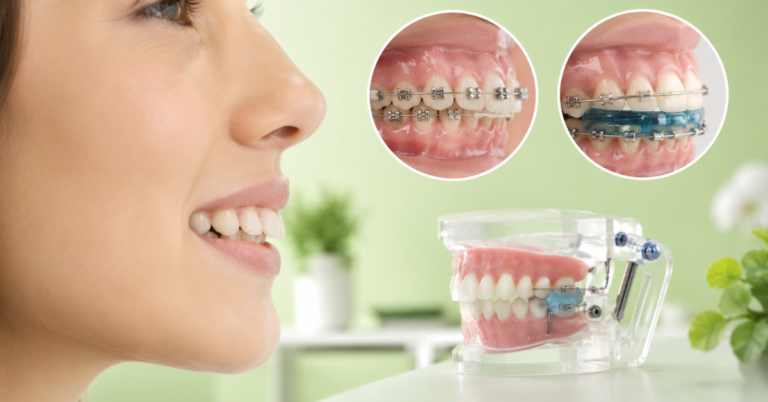
Who Needs Jaw & Skeletal Orthodontic Treatment?
If you have been told that braces alone may not fix your bite, you are not alone. Many teens and adults need jaw orthodontic treatment to correct problems that go deeper than crooked teeth — issues rooted in the actual position and growth of the upper and lower jaws.
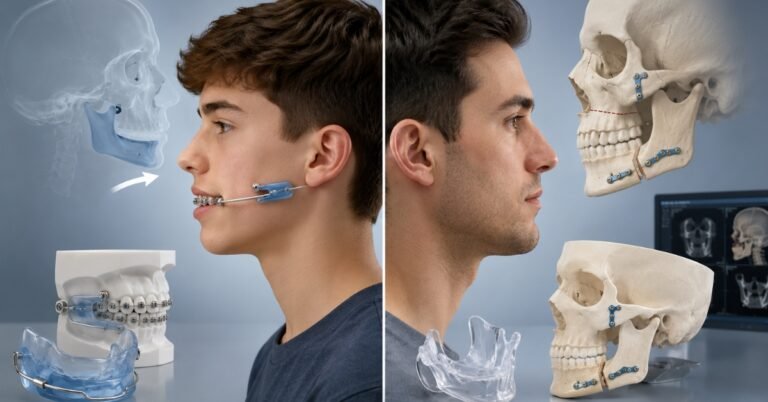
Unlike routine braces that move teeth, skeletal orthodontic treatment addresses how your jawbones are aligned. When the jaws don’t fit together properly, it can affect your bite, chewing, speech, breathing, and even facial balance.
In this guide, our specialists explain who genuinely needs jaw and skeletal orthodontic treatment, the warning signs to watch for, and the options available — so you can make a confident, well-informed decision about your oral health.
What Is Jaw & Skeletal Orthodontic Treatment?
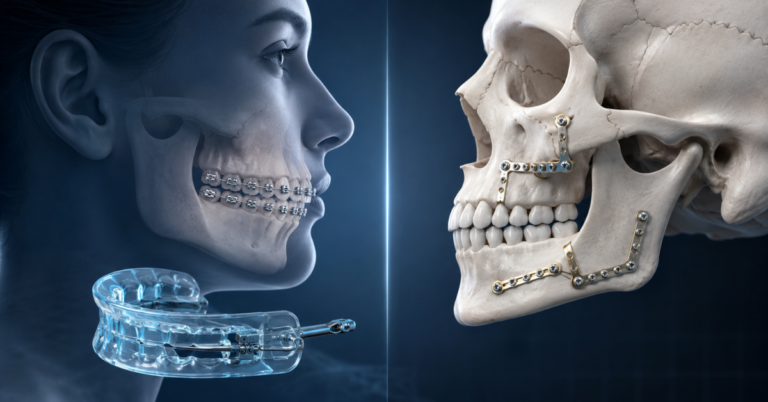
Standard orthodontics moves teeth within the jawbone. Skeletal orthodontic treatment, on the other hand, focuses on correcting the position of the jawbones themselves — the underlying foundation that determines how your teeth meet.
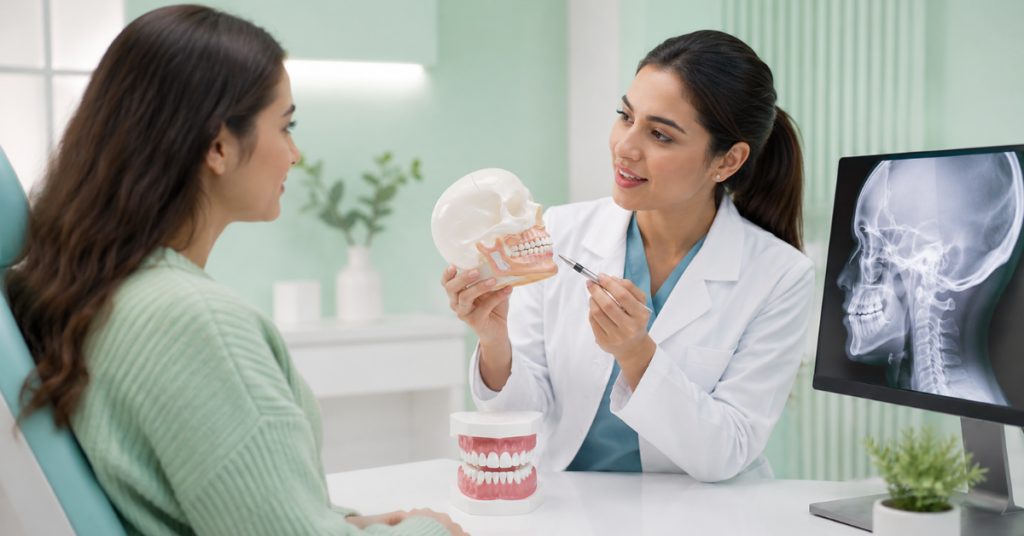
This distinction matters. A bite problem can be dental (tooth-based) or skeletal (bone-based). An experienced orthodontist uses examination, X-rays, and 3D imaging to identify which type you have. That diagnosis decides whether braces alone will work, or whether a combined orthodontic and surgical approach is needed.
Dental vs. Skeletal Problems — A Quick Comparison
|
Feature |
Dental Problem |
Skeletal Problem |
|
Cause |
Teeth out of position |
Jawbones misaligned |
|
Severity |
Mild to moderate |
Moderate to severe |
|
Treatment |
Braces / aligners |
Growth appliances or jaw surgery + braces |
|
Best timing |
Any age |
Often after growth completes (adults) |
|
Outcome |
Straighter teeth |
Corrected bite + facial balance |
Who Needs Jaw Orthodontic Treatment? The Key Signs
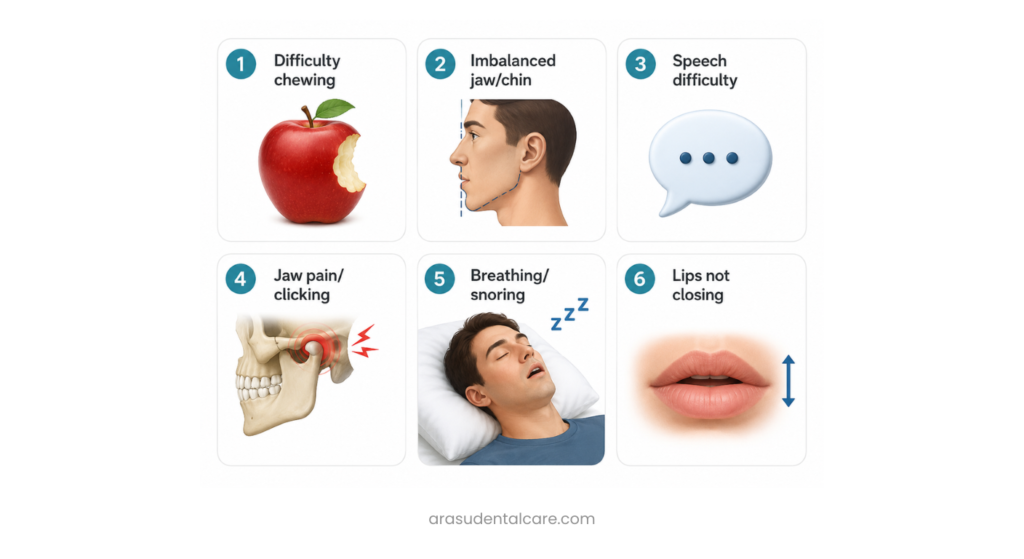
Jaw misalignment is rarely just cosmetic. It can quietly affect everyday function. Here are the most common signs that you may need skeletal correction rather than simple tooth alignment.
1. Difficulty Biting or Chewing
If you struggle to bite into foods like apples or sandwiches, or feel uneven pressure on your back teeth, your jaws may not be meeting correctly. Over time, this can cause premature enamel wear.
2. A Visibly Imbalanced Jaw or Chin
A receding chin, a protruding lower jaw, or a chin that shifts to one side can all point to a skeletal discrepancy that braces alone cannot correct.
3. Speech Difficulties
Lisping, whistling, or trouble forming certain sounds can sometimes be linked to how the jaws and teeth are positioned, which affects tongue placement.
4. Chronic Jaw Pain or Clicking
Jaw clicking, popping, headaches, and facial tension may be associated with bite problems and temporomandibular joint (TMJ) strain — an area where our founder specialises.
5. Breathing & Sleep Issues
Habitual mouth breathing, snoring, or symptoms of obstructive sleep apnoea can sometimes relate to jaw positioning and a restricted airway.
6. Lips That Don’t Close Comfortably
If your front teeth stick out or your lips strain to close, the upper jaw or teeth may be positioned too far forward.
Common Jaw Conditions That May Require Skeletal Treatment
Certain bite problems are skeletal in nature and often cannot be fully corrected with braces alone — especially once jaw growth is complete.
Severe Overbite (Class II)
The upper jaw significantly overlaps the lower jaw, often with a receding chin. When the lower jaw is underdeveloped in an adult, braces cannot stimulate the bone to grow, so jaw repositioning may be recommended.
Severe Underbite (Class III)
The lower teeth sit in front of the upper teeth, and the chin may appear prominent. If the lower jawbone is too large or set too far forward, surgical repositioning restores both bite and facial balance.
Open Bite
The upper and lower front teeth do not touch when the mouth is closed. Skeletal open bites usually require repositioning of the upper jaw for proper correction.
Crossbite
One or more upper teeth sit inside the lower teeth. Mild cases respond to orthodontics, but severe skeletal crossbites often need surgical widening of the upper jaw.
Facial Asymmetry
When one side of the jaw grows differently from the other — due to uneven growth, trauma, or specific conditions — the chin may deviate and the bite becomes uneven. Skeletal treatment helps restore symmetry and function.
Why Braces Alone Aren’t Always Enough
Here is the core principle to understand:
- Braces move teeth.
- Skeletal treatment moves bones.
If the underlying issue is in the jawbone, moving teeth alone can sometimes camouflage the appearance but won’t truly correct the structural problem. According to the American Association of Orthodontists, surgical orthodontics is reserved for skeletal discrepancies that braces cannot address.
This is why an accurate diagnosis is so valuable. We always evaluate whether your concern is dental or skeletal before recommending a path forward — never the other way around.
Age & Growth: Why Timing Matters
Timing plays a major role in skeletal orthodontic treatment.
Children & Teens
In growing children, the jawbones are still developing. This creates an opportunity to guide jaw growth using appliances such as palatal expanders or functional (myofunctional) appliances — often reducing the need for more complex treatment later.
This is why an early orthodontic evaluation is so valuable. Catching a developing skeletal concern early can make a meaningful difference.
Adults
In adults, jaw growth is complete. According to the Mayo Clinic, corrective jaw surgery is generally best performed after growth stops — usually ages 16–18 and older for females, and 18–21 and older for males. Adults can still achieve excellent, predictable outcomes; the approach is simply tailored differently.
How Skeletal Orthodontic Treatment Works
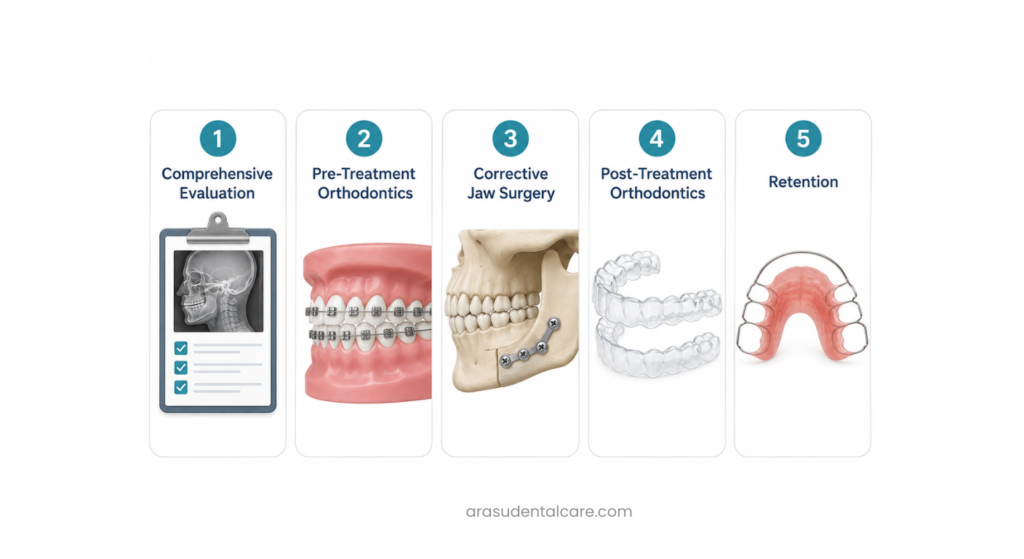
For genuine skeletal cases, treatment is typically a coordinated, team-based process between an orthodontist and an oral surgeon and maxillofacial surgeon.
Step-by-Step: The Treatment Journey
Step 1 — Comprehensive EvaluationDigital X-rays, 3D scans, photographs, and a detailed bite analysis help create a personalised treatment plan.
Step 2 — Pre-Treatment OrthodonticsBraces or aligners are placed to position the teeth correctly within each jaw. This phase usually lasts 12–18 months. The bite may temporarily look different — this is a normal, planned step.
Step 3 — Corrective Jaw Surgery (When Needed)Performed under appropriate anaesthesia, the surgeon repositions the jawbones and stabilises them with small plates and screws. Incisions are usually made inside the mouth, so there are no visible facial scars.
Step 4 — Post-Treatment OrthodonticsAfter initial healing (around six weeks), braces fine-tune the bite for optimal function. Total treatment time often ranges from 18 to 24 months.
Step 5 — RetentionOnce treatment is complete, a retainer holds your teeth in their new, stable positions.
Benefits of Correcting Jaw & Bite Alignment
Skeletal orthodontic treatment offers benefits that go well beyond appearance:
- Easier chewing and biting with even pressure across the teeth
- Improved speech where jaw position affected pronunciation
- Better breathing and sleep in cases linked to airway positioning
- Reduced TMJ strain and associated jaw discomfort
- Balanced facial appearance and renewed confidence
- Long-term protection against uneven enamel wear and bite-related problems
Research published via the National Library of Medicine reports that orthognathic (corrective jaw) surgery has a high success rate of around 94%, with most patients reporting an improved quality of life.
How Diagnosis Works at Our Clinic
We believe you deserve to understand why a treatment is recommended. Our diagnostic process includes:
- A thorough clinical examination of your teeth, bite, and jaw movement
- Digital X-rays and 3D imaging to assess the skeletal structure
- Photographs and scans for precise treatment planning
- A clear discussion of whether your concern is dental, skeletal, or both
From there, we explain all available options and help you choose the approach that best suits your needs — never a one-size-fits-all plan, and never pressure.
Frequently Asked Questions
1. How do I know if I need jaw orthodontic treatment or just braces?
Only a proper examination can confirm this. If your bite problem stems from the position of your jawbones rather than just your teeth, skeletal treatment may be recommended. X-rays and 3D imaging help us make this distinction accurately.
2. Can braces fix an underbite without surgery?
Mild to moderate underbites can often be corrected with braces alone, especially in younger patients whose jaws are still growing. Severe skeletal underbites in adults usually require a combined surgical approach.
3. Is jaw orthodontic treatment painful?
The surgical phase is performed under appropriate anaesthesia, so you won’t feel discomfort during the procedure. Some swelling and tenderness afterwards is normal and managed comfortably with prescribed medication.
4. What is the best age for jaw treatment?
Children benefit from early evaluation, as growth can sometimes be guided. For skeletal surgery, treatment is generally best after jaw growth is complete — typically the late teens. Adults of any age can still achieve excellent results.
5. How long does the full treatment take?
A complete skeletal orthodontic journey — including pre-treatment braces, surgery (if