The most common alignment problem we treat — planned by an MDS orthodontist
When your teeth overlap, twist or sit pushed out of line because there is not enough room in your jaw, straightening them does more than change how your smile looks. Properly aligned teeth are easier to clean, kinder to your gums, and wear more evenly when you bite. At Arasu Dental Care, crowded teeth treatment is planned by Dr. P.S. Sree Cumar, our founder and MDS orthodontist — a Fellow of the World Federation of Orthodontists (USA) and Dentist of the Year (South Region) at the Economic Times Healthcare Awards 2023 — using braces or clear aligners, at both our R.S. Puram and Saibaba Colony branches.
Open all seven days, 10:00 AM – 8:30 PM · R.S. Puram +91 88380 22157 · Saibaba Colony +91 74491 88777
Medically reviewed by Dr. P.S. Sree Cumar, MDS (Orthodontics & Dentofacial Orthopedics, FWFO) · Last reviewed July 2026
Whether the crowded teeth are yours or your child's, treatment starts the same way — an assessment that measures exactly how much space your teeth need, and the simplest reliable way to create it. Book a crowding assessment at R.S. Puram (+91 88380 22157) or Saibaba Colony (+91 74491 88777).
Severity decides the plan
The right treatment depends almost entirely on severity — which is really a question of how many millimetres of space your teeth are short. At your first visit we measure this precisely from scans and models, but you can place yourself roughly:
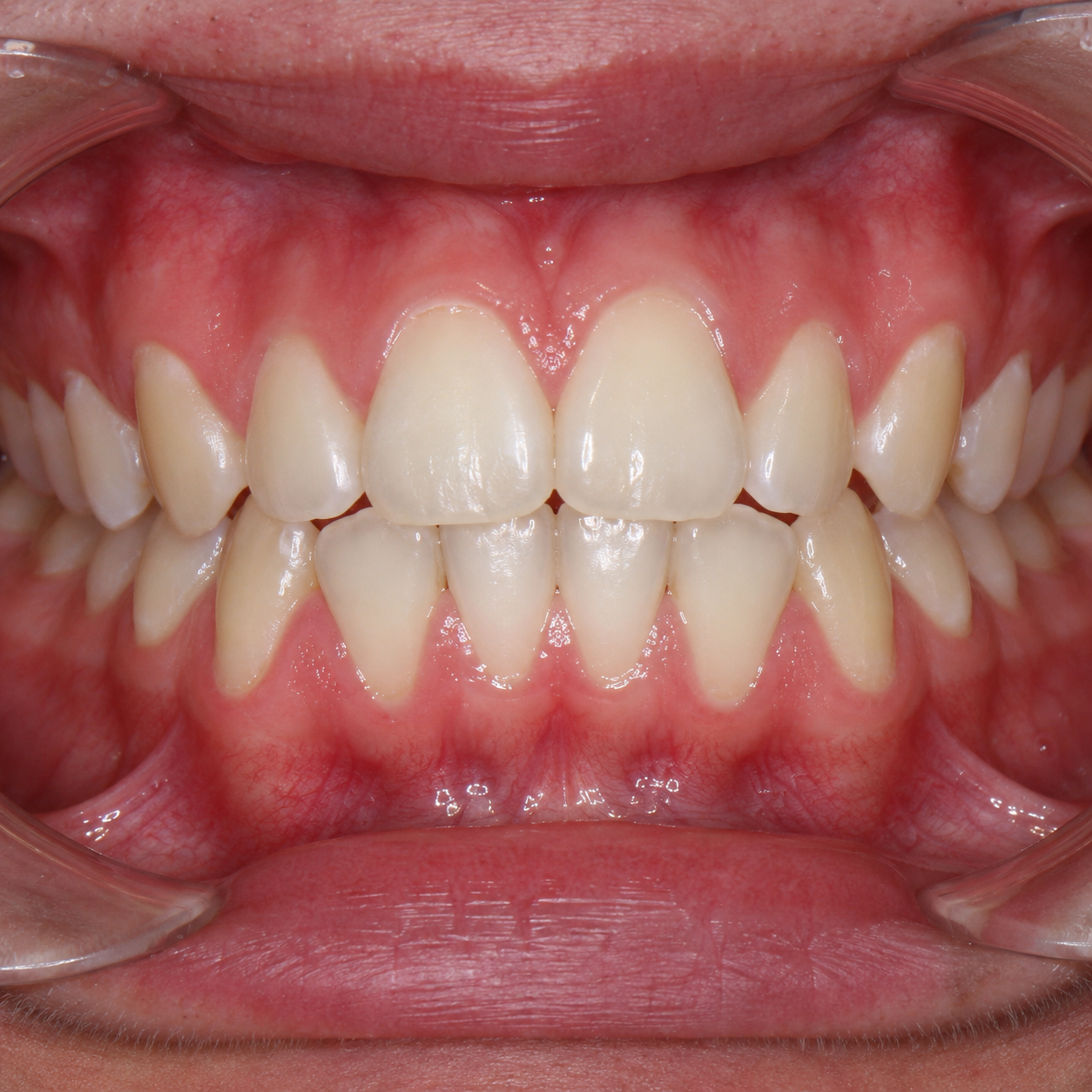
One or two front teeth slightly overlapped or rotated. Usually correctable with a short course of clear aligners, often within 6–12 months.
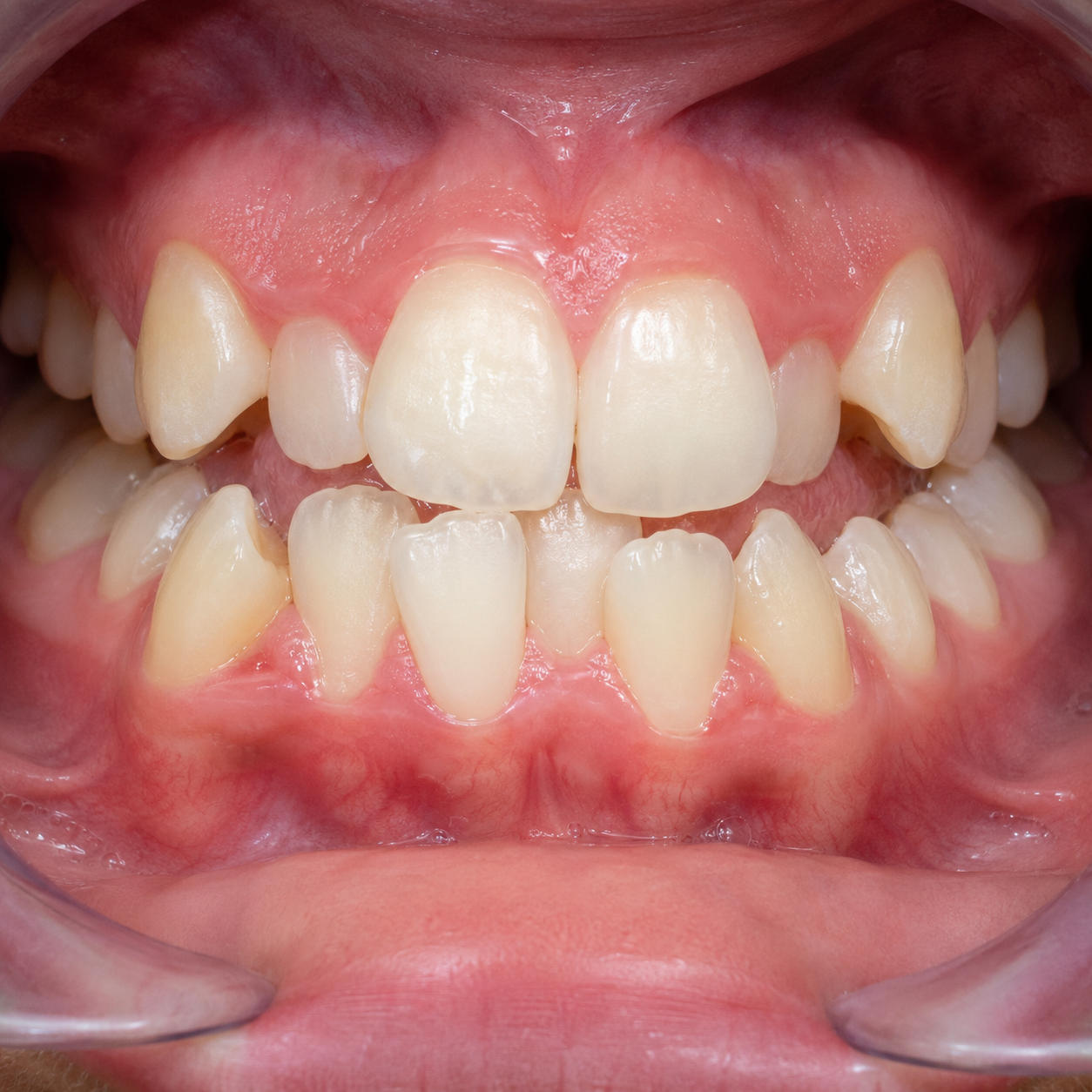
Several teeth visibly overlapping, or a tooth pushed noticeably in or out of the arch. Treated with aligners or braces; we create space with techniques like gentle enamel polishing between teeth (IPR) rather than removal wherever possible.
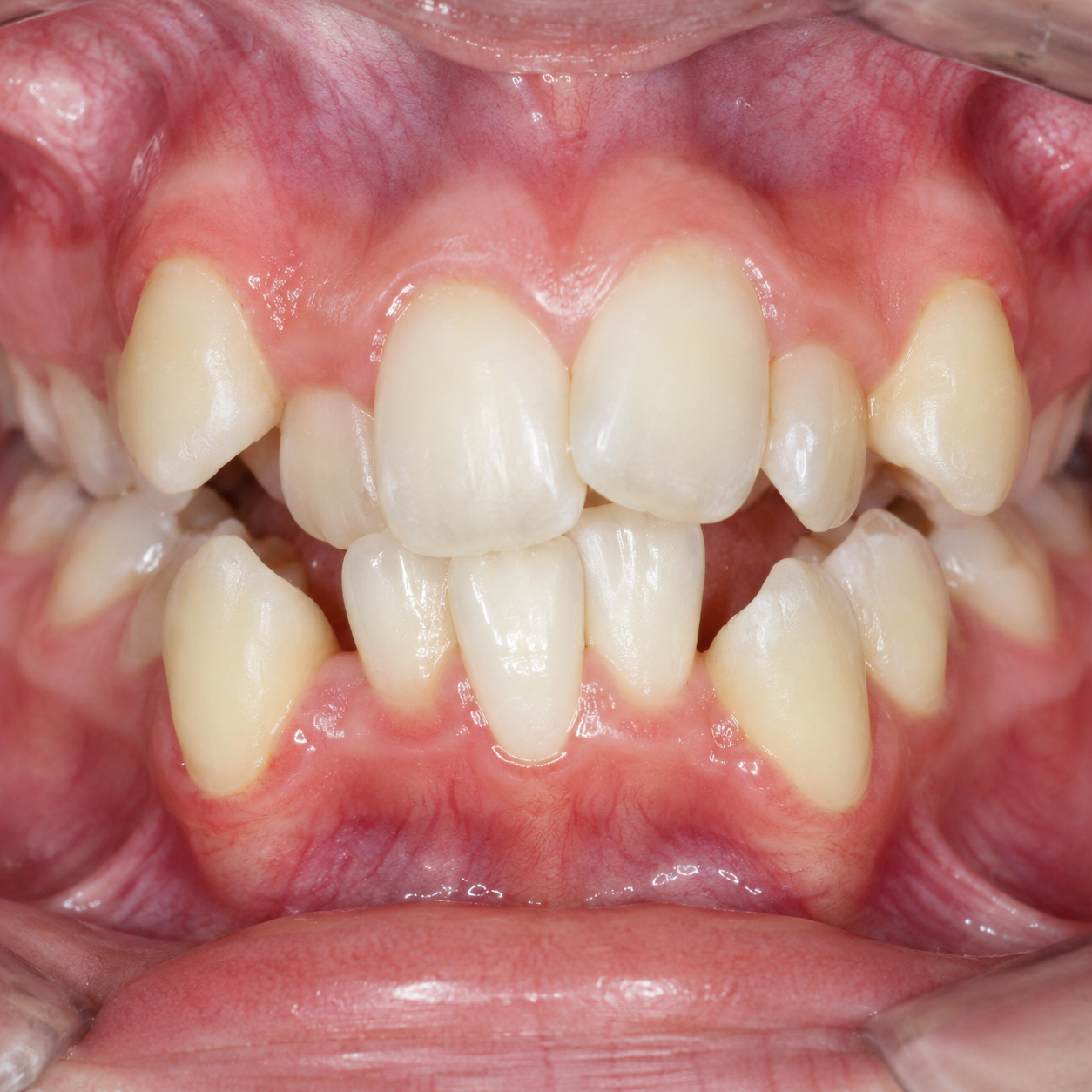
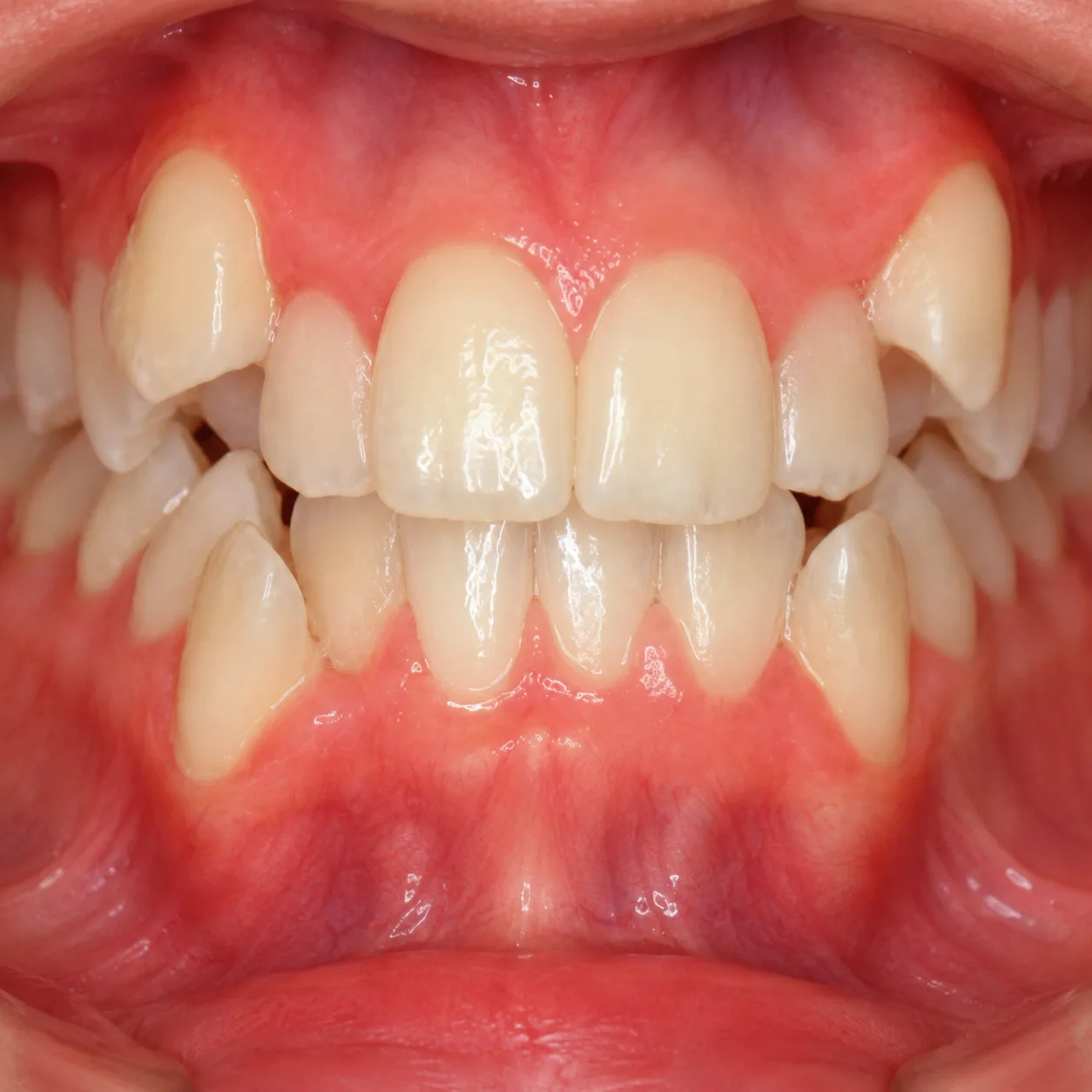
Teeth blocked out of the arch entirely, significant rotation, or a canine erupting high in the gum. Braces are usually the more predictable choice here, and treatment planning may include removing a tooth to create the space the rest need.
Crowding also rarely travels alone — it often comes with a bite problem such as a deep bite or crossbite, which is one more reason an orthodontist, rather than a general checklist, should plan the correction.
Crowding is the most frequent malocclusion trait recorded in Indian studies — a Karnataka survey of 2,400 adolescents found crowding in about 58% of those examined — and roughly one in three orthodontic patients today is an adult. General research figures; individual cases vary.
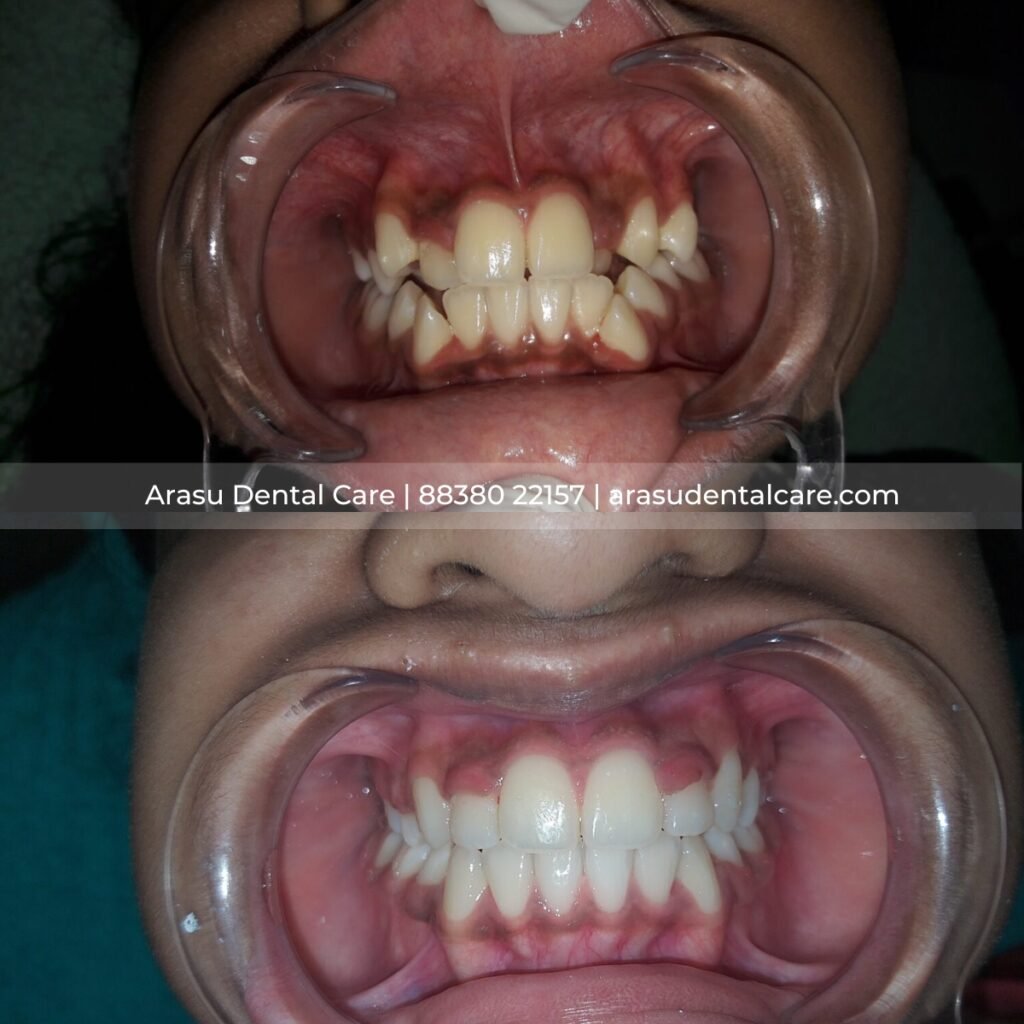
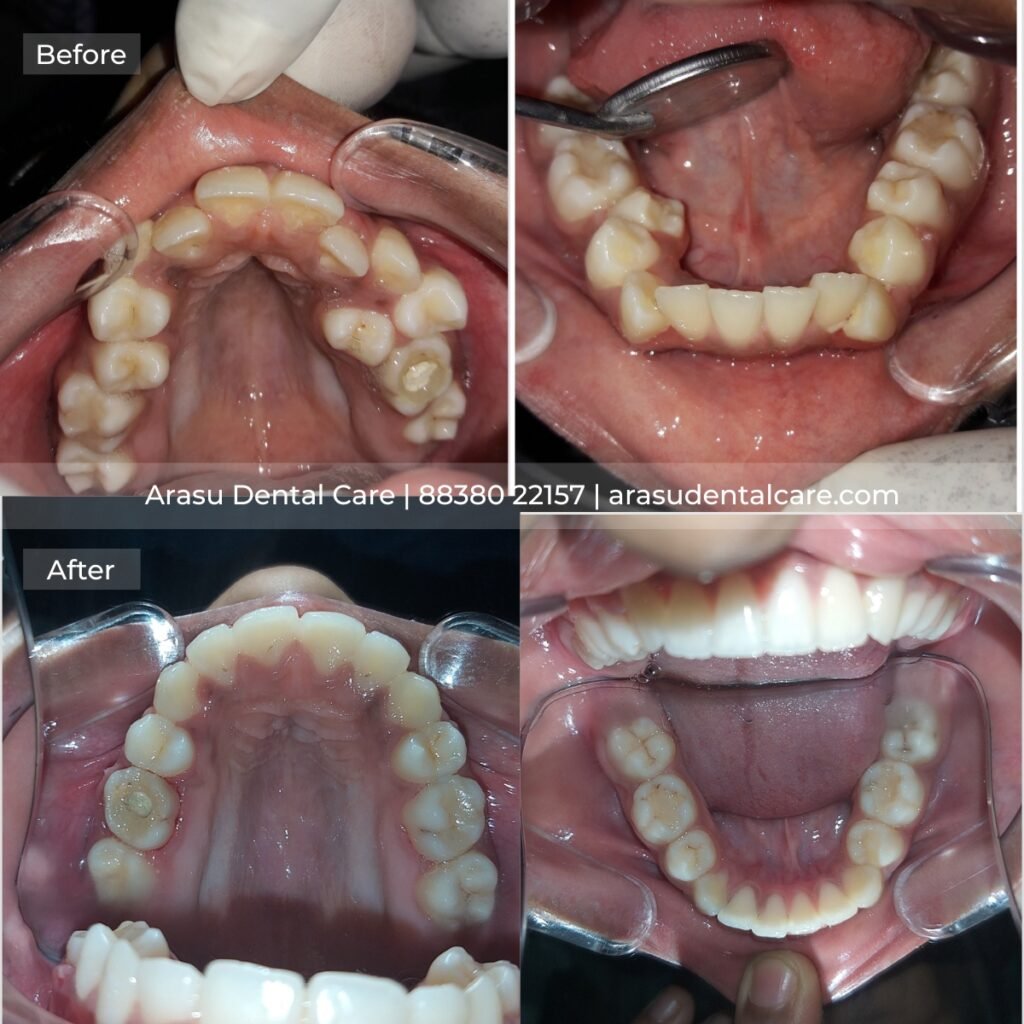
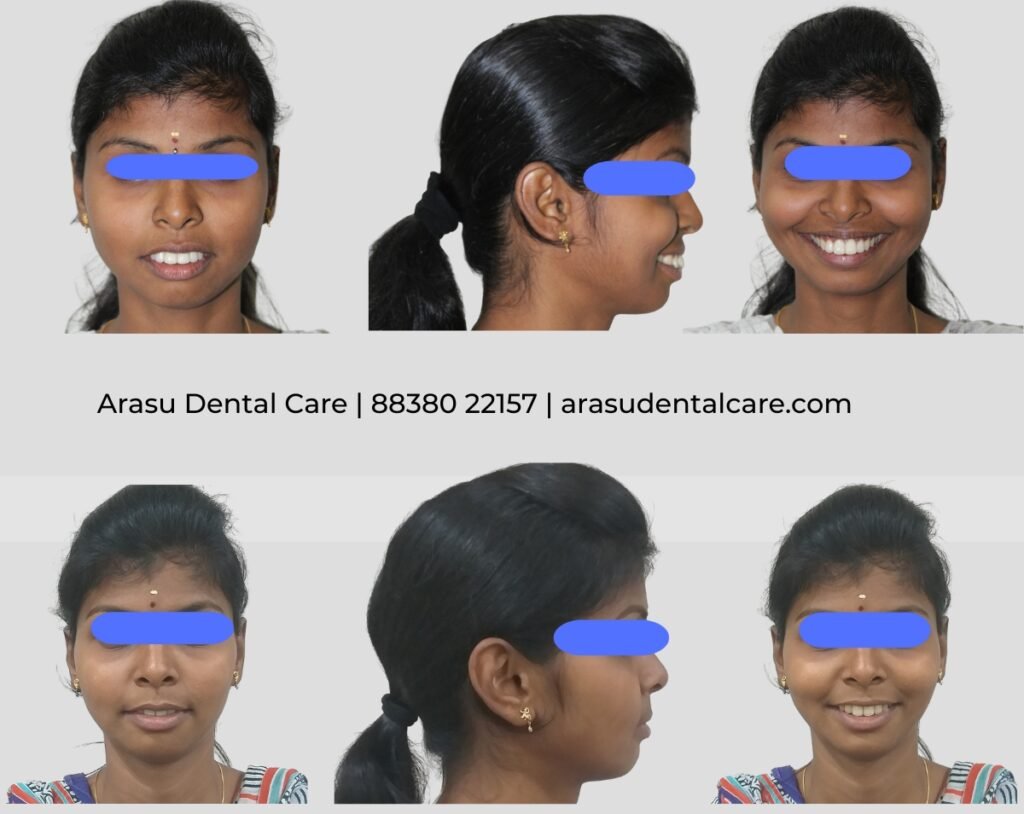
Real Arasu cases


Causes
In most cases the cause is simple arithmetic you inherited: teeth that are slightly large for the jaw that holds them. A few other factors add to it — losing milk teeth too early (which lets neighbouring teeth drift into the gap before the adult tooth arrives), prolonged childhood habits like thumb-sucking, and the slow forward drift of teeth that happens naturally as we age. That last one matters: the lower front teeth tend to crowd gradually through adult life whether or not wisdom teeth are present, which is why alignment you were happy with at 20 can look different at 40.
Knowing the cause changes the plan. A child with early milk-tooth loss may only need a space maintainer to prevent crowding from developing at all — one of the reasons we recommend a first orthodontic assessment by around age seven. An adult with slowly returning lower-front crowding may need far less treatment than they fear.
Why timing helps
Crowding is not just cosmetic, and it does not stay still. The overlaps between crowded teeth trap plaque in places a brush and floss physically cannot reach well, which over time raises the risk of decay and gum disease precisely where you can least see it starting. Teeth that meet at the wrong angles also wear each other unevenly, and a tooth pushed out of the arch takes biting forces it was never shaped for.
Because adult teeth keep drifting forward slowly throughout life, mild crowding tends to become moderate crowding if nothing holds it back. None of this means every crowded smile needs urgent treatment — but it does mean the honest comparison is not "treatment vs. nothing," it is "treatment now vs. usually a longer treatment later."
Space analysis first
Every case starts with a space analysis: we measure your teeth and arches from digital scans and X-rays to calculate, in millimetres, how much room is missing. That number — not a sales preference — determines which of two appliance routes we recommend, and whether any space needs to be created first.
Mild to moderate crowding · nearly invisible · digitally planned
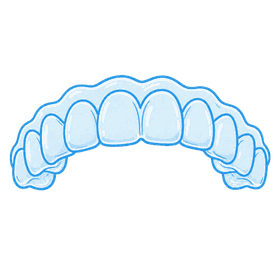
For mild to moderate crowding, clear aligners straighten your teeth with a sequence of nearly invisible removable trays, each moving your teeth a fraction closer to plan. You can eat normally and clean your teeth as usual — the trade-off is discipline, because they only work worn 20–22 hours a day. Dr. Sree Cumar plans every aligner case personally, including Invisalign.
The most predictable tool at every severity
Braces remain the most predictable tool for crowding at every severity, and the clear choice for severe cases — rotated teeth, blocked-out canines and combined bite corrections respond to fixed brackets in ways aligners cannot always match. We offer metal, ceramic (tooth-coloured), self-ligating and lingual (behind-the-teeth) options, all planned and adjusted by our orthodontist as part of your orthodontic treatment at either branch.
IPR · arch expansion · extraction only when the arithmetic demands it
Crowded teeth need somewhere to go. Depending on how many millimetres are missing, we create space by gently polishing fractions of a millimetre of enamel from between teeth (interproximal reduction), by expanding a growing child's arch, or — only when the arithmetic genuinely demands it — by removing a tooth, usually a premolar. Extraction is a planning decision, not a default: if your case can be treated well without it, it will be, and we will show you the numbers either way.
| Approach | Suited for | Typical duration | Worth knowing |
|---|---|---|---|
| Clear aligners | Mild–moderate crowding; image-conscious adults and teens | 6–18 months | Removable; needs 20–22 hrs/day wear |
| Metal braces | All severities, including severe crowding | 12–24 months | Most economical fixed option |
| Ceramic braces | All severities, less visible than metal | 12–24 months | Tooth-coloured brackets |
| Self-ligating braces | Moderate–severe crowding | 12–24 months | Fewer adjustment visits for many cases |
| Lingual braces | Adults who want a fixed but hidden option | 15–24 months | Fitted behind the teeth |
| Early interception (children) | Developing crowding, around ages 7–11 | Case-dependent | Space maintainers, expansion; can prevent extraction later |
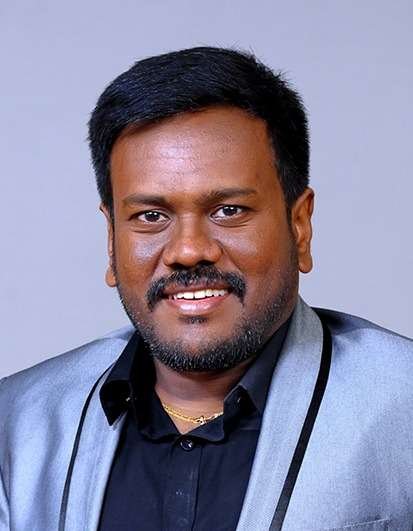
Founder · Orthodontics & Dentofacial Orthopedics · Fellow, World Federation of Orthodontists (USA)
Named Dentist of the Year – South Region at the 2023 Economic Times Healthcare Awards. Dr. Sree Cumar personally plans and supervises every braces and aligner case across both branches — including the space analysis that decides your route. View profile
Before you commit
Straightened teeth do not stay straight on their own — this is the part of orthodontics too many pages skip. Teeth carry a lifelong tendency to drift back, and long-term research suggests fewer than one in three patients keeps perfectly aligned lower front teeth ten years after stopping retainers. That is why we treat retention as part of the treatment, not an afterthought: you will finish with a retainer plan, and wearing it as advised is what protects your investment.
Transparent pricing
Your cost depends on the appliance you choose and the severity of the crowding — a mild aligner case and a two-year severe correction sit at very different points of the range. These are our current fee ranges; you will receive a fixed, written estimate for your specific case after assessment, before any treatment begins.
| Treatment | Fee range at Arasu Dental Care |
|---|---|
| Consultation & assessment | ₹300 – ₹500 |
| Metal braces | ₹30,000 – ₹50,000 |
| Ceramic braces | ₹35,000 – ₹70,000 |
| Self-ligating braces | ₹50,000 – ₹80,000 |
| Lingual braces | ₹70,000 – ₹1,00,000 |
| Clear aligners — mild crowding | ₹50,000 – ₹70,000 |
| Clear aligners — moderate to complex | ₹1,50,000 – ₹3,00,000 |
| Invisalign | From ₹80,000 |
| Tooth removal, if the plan requires it | Quoted case-by-case at consultation |
Prices are subject to individual consultation and cover the treatment as planned for your case; we will tell you exactly what your quote includes. We accept cash, UPI, cards and net banking, and EMI options are available for orthodontic treatment. For a fuller breakdown of what moves the price, see our braces cost and clear aligners cost pages.
Not sure which range you fall in? A consultation and scan will tell you precisely.Book at R.S. Puram: +91 88380 22157 or Saibaba Colony: +91 74491 88777 — open 10 AM to 8:30 PM, all seven days.
Book a consultationWhy Arasu
Crowding correction is orthodontics, and at Arasu Dental Care it is planned by an orthodontist — not delegated to a general checklist. Our multispecialty team means the related needs crowding often brings are handled under the same roof rather than referred around the city.
Dr. P.S. Sree Cumar, MDS (Orthodontics and Dentofacial Orthopedics) — Fellow of the World Federation of Orthodontists (USA) — personally plans and supervises braces and aligner cases across both branches.
Your route is decided by a millimetre-precise space analysis from scans and X-rays — and if the less expensive option is the right one for your case, that is the one we will recommend.
A professional cleaning before brackets go on, gum care where overlaps have caused inflammation, or a surgical extraction where the plan requires one — all in-house. Meet the team on our doctors page.
We are open every day of the week from 10:00 AM to 8:30 PM, which matters over a treatment measured in monthly visits: adjustments fit around your work or your child's school, not the other way round.
Book your crowding assessment today
R.S. Puram — 129, W Sambandam Road, +91 88380 22157 · Saibaba Colony — 160, NSR Road, +91 74491 88777 · Open Monday–Sunday, 10:00 AM – 8:30 PM · WhatsApp +91 96007 56297.
FAQs
Often, yes. Mild to moderate crowding responds well to clear aligners, which are removable and nearly invisible. Severe crowding — blocked-out teeth, heavy rotation, or crowding combined with a significant bite problem — is usually more predictable with braces. Our assessment measures your exact space shortfall and tells you honestly which route fits your case.
Not in most cases. We first look at gentler ways to create space, such as light enamel polishing between teeth (IPR) or arch expansion in growing children. A tooth is removed only when the measurements show the remaining teeth genuinely cannot be aligned without that space — and we will show you those measurements before deciding together.
Mild aligner cases can finish in around 6–12 months. Moderate cases typically run 12–18 months, and severe crowding with bite correction can take two years or more. Timelines vary with age, biology and how consistently appliances are worn, so treat these as ranges — your written plan will carry a case-specific estimate.
At Arasu Dental Care, braces for crowding range from ₹30,000 (metal) to ₹1,00,000 (lingual), and clear aligners from ₹50,000 for mild cases up to ₹3,00,000 for complex corrections, with Invisalign starting from ₹80,000. The consultation that fixes your exact quote costs ₹300–₹500, and EMI options are available.
Yes — gradually. Teeth drift forward slowly throughout adult life, and the lower front teeth in particular tend to crowd more over the decades, whether or not wisdom teeth are present. Mild crowding you are managing today generally becomes harder to clean, and slower to treat, if left for years.
No. Teeth move at any age provided your gums and bone are healthy — roughly one in three orthodontic patients today is an adult. For adult cases we check gum health first and often recommend the less visible options: ceramic braces, lingual braces or clear aligners.
The crowding itself does not decay teeth — but the overlaps trap plaque where brushing and flossing cannot reach it properly, and that trapped plaque is what drives decay and gum inflammation over time. Straightening crowded teeth removes those traps, which is why we describe alignment as protective, not just cosmetic.
Medical disclaimer: this page is general information, not a diagnosis. Statistics reflect published dental research, not a promise of individual outcomes — results vary. Please consult our dentists for a personalised assessment.
Treatment now beats a longer treatment later
Examination, digital scans and X-rays, and a written plan with the full cost — before anything begins. Open Monday to Sunday, 10:00 AM – 8:30 PM · WhatsApp +91 96007 56297.
More From Arasu