Pediatric dentistry · holding the gap after early tooth loss
When your child loses a baby tooth earlier than nature intended, the gap doesn't just sit and wait — the teeth on either side slowly lean in and start to close it. At Arasu Dental Care, a space maintainer holds that gap open so the permanent tooth underneath has room to come through in the right place. For many children, this one small appliance is what prevents crowded, crooked adult teeth and a longer round of braces later on.
It's the right step when a back baby tooth has been lost early to decay, injury, or an extraction, and the permanent replacement is still months or years away. Our pediatric dentist checks your child's mouth and an X-ray first, then fits a custom appliance that's comfortable to wear and simple to look after. And if your child doesn't need one, we'll tell you that just as plainly.
Open all seven days, 10:00 AM – 8:30 PM · R.S. Puram +91 88380 22157 · Saibaba Colony +91 74491 88777
Noticed a gap after an early tooth loss? A short check tells you whether your child needs a space maintainer — book at our R.S. Puram branch on +91 88380 22157 or Saibaba Colony on +91 74491 88777. We're open every day, 10:00 AM to 8:30 PM.
When it's the right call
Not every early tooth loss needs an appliance. Early loss of a back baby molar is common — it shows up in around a third of children in clinical studies — but whether your child needs a space maintainer comes down to a few things we weigh up together.
Which tooth was lost. Losing a back molar usually calls for space maintenance more often than losing a front tooth, because molars hold more of the arch. Front-tooth loss is often managed for appearance and speech rather than for space.
Your child's age and how far off the permanent tooth is. We take an X-ray to see how much bone still covers the permanent tooth. If it's due within a few months, an appliance may not be needed; if it's a year or more away, holding the space matters.
How quickly the gap is closing. Most of the space loss after an early molar loss happens within the first six months of the tooth going — which is exactly why we like to check soon, rather than wait and watch the gap disappear.
Crowding and oral habits. If your child's teeth are already tight for room, or there's thumb-sucking or tongue-thrusting in the picture, protecting the space becomes more important.
Seen in the clinic
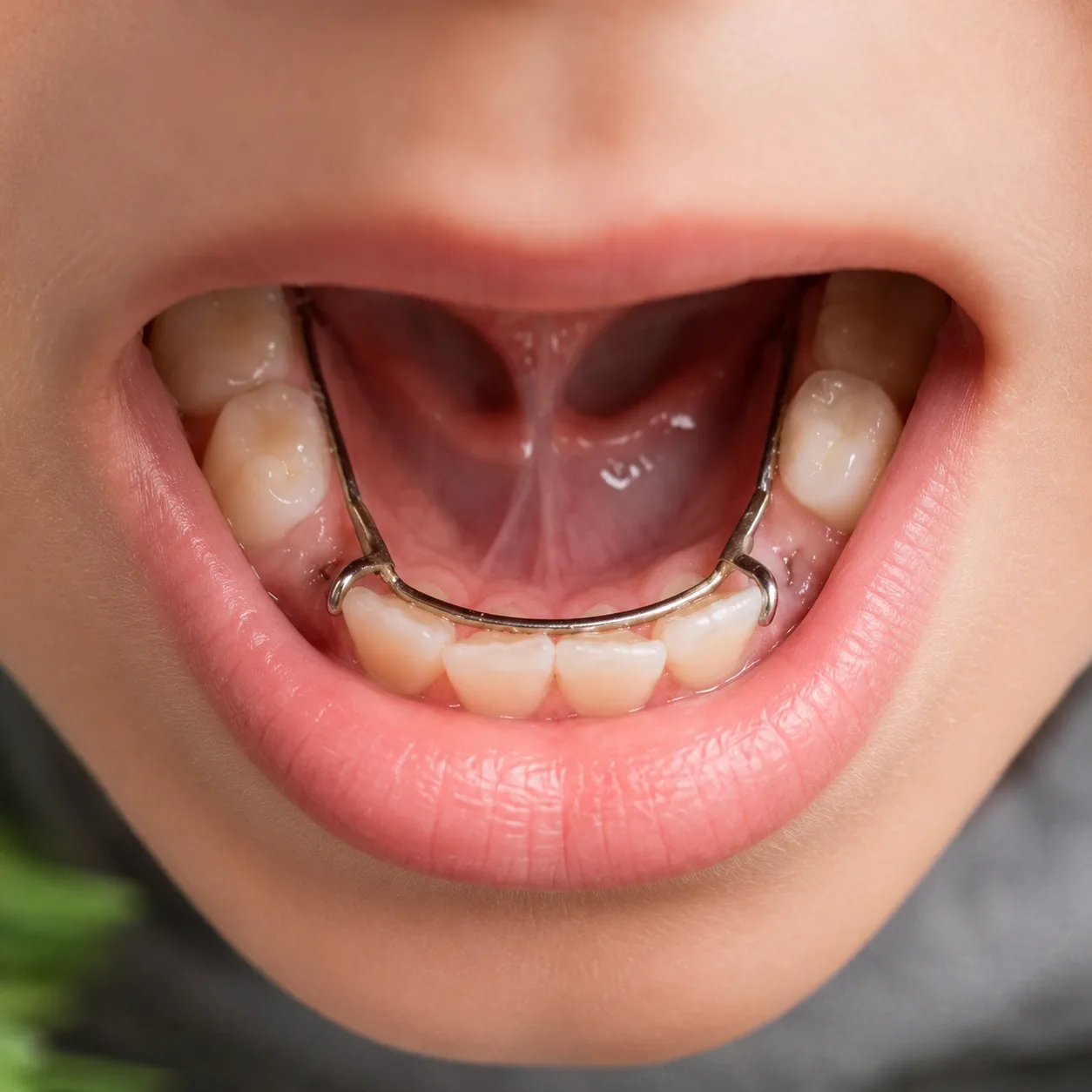
A space maintainer keeps the gap open so the permanent tooth erupts where it belongs. The images below are from cases treated at our clinics.
clinic-photo: gap after early loss
Clinic-supplied photo or X-ray showing the open gap after an early baby-tooth loss.
clinic-photo: fitted maintainer
Clinic-supplied photo of the fitted appliance holding the space open.
What it is
A space maintainer is a small, custom-made appliance — usually metal, sometimes acrylic — that sits quietly in the gap and stops the neighbouring teeth from drifting in. There are two broad kinds, and we choose based on your child's age, which teeth are involved, and how well they'll manage the appliance day to day.
Cemented onto a tooth next to the gap and left in place until the permanent tooth is ready — our usual choice for younger children, because there's nothing to remember to wear.
The band-and-loop is the most common of all: a small band around one tooth with a wire loop bridging a single-tooth gap. When more than one tooth is missing, or both sides of the arch are affected, we use a wider design such as a lingual arch or a Nance appliance that anchors to the back teeth.
These look like a small retainer and can be taken out for cleaning. We tend to keep these for older children who can follow wear-and-care instructions.
A removable design can also carry a tooth-coloured replacement where a visible front tooth is missing, so appearance and speech are looked after while the space is held.
What to expect
Fitting a space maintainer is a short, comfortable process, usually across two easy appointments. Here's the sequence, so you can prepare your child honestly.
STEP 1
We examine your child and take an X-ray to confirm the permanent tooth's position and how far off it is.
STEP 2
We take a mould or a digital scan so the appliance is made to fit your child's mouth exactly.
STEP 3
At the fitting visit, a fixed maintainer is gently cemented in place — a short, comfortable appointment.
STEP 4
Your child settles in over a few days; mild tongue awareness is normal and passes quickly.
STEP 5
We see your child for brief check-ups and remove the appliance at the right time, once the permanent tooth is on its way through.
We do this routinely as part of our pediatric dentistry care, and because both branches are open every day, fitting the appliance promptly after a tooth is lost is rarely a scheduling problem. For anxious or very young children, sedation options are available — ask us at the consultation.
Who treats your child
Children's dentistry at our clinics is led by our dentist (BDS, FAD), who treats children every day in a setting built to keep the visit calm rather than clinical — and because space maintenance sits at the edge of orthodontics, the developing bite is reviewed by our orthodontist Dr. Sneha K Achuthan (MDS), so if your child later needs braces or aligners, that care continues under the same roof.

Straight answers
A space maintainer is a genuinely useful, low-cost piece of prevention — but being straight with you matters more than fitting one, so here's the fair picture.
Cost
What a space maintainer costs mainly depends on the type of appliance your child needs, how many teeth are involved, and whether the design is fixed or removable. The X-ray, the impression or scan, and the follow-up visits are part of the picture too. As a general guide:
| Appliance type | What's involved | Typical range |
|---|---|---|
| Band-and-loop / crown-and-loop | Fixed · single space | ₹2,500 – ₹5,000 |
| Lingual arch / Nance | Fixed · multiple teeth or both sides | ₹4,000 – ₹7,000 |
| Distal shoe | Guides an erupting molar | ₹5,000 – ₹8,000 |
| Removable acrylic maintainer | For older children · takes out to clean | ₹3,000 – ₹6,000 |
For an exact figure for your child, book a consultation.Every case is a little different, and a short examination is the surest way to the right appliance and the right cost. R.S. Puram +91 88380 22157 · Saibaba Colony +91 74491 88777.
Get Started
Tell us a little about your child and pick a time that suits their routine. A recently lost baby tooth, a gap that's starting to close, and anxious little ones are all welcome — at whichever branch is closer.
Holding the space early is simpler and gentler than crowding later.
Why Arasu
Space maintenance sits inside our wider pediatric dentistry care, so your child is seen by a team that treats children every day — and if they later need braces or aligners, that care is under the same roof.
Children's care led by our dentist (BDS, FAD), in a setting built to keep the visit calm and child-friendly.
Sedation options for anxious or very young children, and we talk you through each step so nothing feels like a surprise.
We fit an appliance only when the X-ray and your child's bite say it's warranted — preventing more invasive orthodontics later.
A clear, itemised estimate before any treatment starts — and we'll never fit an appliance your child doesn't need.
Until 8:30 PM, so a prompt fitting after an early tooth loss is rarely a scheduling problem.
R.S. Puram and Saibaba Colony, so care is close to home — and your child's records move with them between clinics.
Book your child's space-maintainer assessment
R.S. Puram: 129, W Sambandam Road, Coimbatore 641002 · +91 88380 22157 · Saibaba Colony: 160, NSR Road, Coimbatore 641011 · +91 74491 88777. Open 10:00 AM – 8:30 PM · WhatsApp +91 96007 56297.
Patient Reviews
My son lost a back milk tooth after an extraction and I had no idea the gap could close. They took an X-ray, explained why a band-and-loop was worth it, and fitted it in a short visit. He forgot it was even there within a week.
Refreshingly honest — after the X-ray they said my daughter's permanent tooth was close and she only needed monitoring, not an appliance. No upselling. We go back for her check-ups now.
They were lovely with my nervous 6-year-old, walked me through every step, and the cost was clear before anything started. The maintainer stayed put until her new tooth came through.
Sunday appointment, no waiting. The appliance came loose once and they sorted it the same day. Good to have the ortho and kids' dentist in the same clinic.

FAQs
Usually between about ages 3 and 10, depending on when the baby tooth is lost and how far along the permanent tooth's development is. Your child's X-ray guides the timing.
No — it's a short procedure carried out comfortably. Some children feel mild tongue awareness or slight irritation for a few days as they get used to the appliance, and that settles quickly.
It depends on when the permanent tooth is ready to come through. Some children wear it for a few months, others for a couple of years. We remove it at the right time during a routine check-up.
Yes — most children adjust within a few days. We simply ask them to avoid sticky sweets and hard foods that could bend or loosen the appliance.
There may be slight changes for the first few days, especially with an appliance near the front teeth. This usually improves quickly as your child adapts.
Call us promptly. A loose or broken maintainer can't do its job, so we'll check it and adjust or replace it as needed.
No. We look at which tooth was lost, your child's age, the X-ray, and whether the teeth are crowded before recommending one. Sometimes monitoring is enough.
Yes. When we spot early tooth loss at a check-up we assess whether space maintenance is needed, and we monitor an existing appliance at each visit.
Book your child's consultation at Arasu Dental Care
Bring your child in and we'll examine the mouth, take an X-ray, and tell you honestly whether a space maintainer or simply monitoring is right — with a clear cost before anything begins. Open 10 AM – 8:30 PM, all seven days · WhatsApp +91 96007 56297.