Which Braces Are Least Visible?
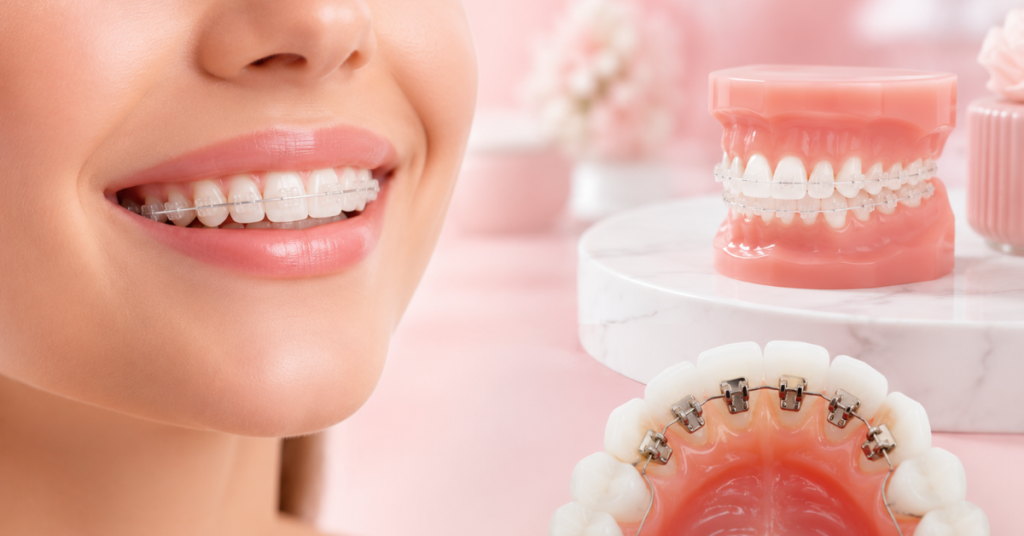
If you’ve been putting off straightening your teeth because you worry about a mouth full of metal, you’re not alone. One of the most common questions we hear at Arasu Dental Care is simple: which are the least visible braces? The good news is that modern orthodontics offers several discreet options that let you improve your smile without drawing attention — from lingual braces hidden behind your teeth to nearly invisible clear aligners.
In this guide, our orthodontic team explains each option clearly, compares how visible they really are, and helps you understand which choice might suit your lifestyle, so you can make a confident, informed decision.
Why Visibility Matters in Orthodontic Treatment
Straightening your teeth is a long-term commitment — often 12 to 36 months. For working professionals, brides and grooms, teachers, and anyone who speaks in public regularly, how braces look during that time genuinely matters.
According to the American Association of Orthodontists, roughly one in three orthodontic patients today is an adult. Many of these patients seek treatment specifically because discreet options now exist — options that simply weren’t available a generation ago.
The encouraging reality is this: you no longer have to choose between an effective result and a natural appearance during treatment. You can usually have both.
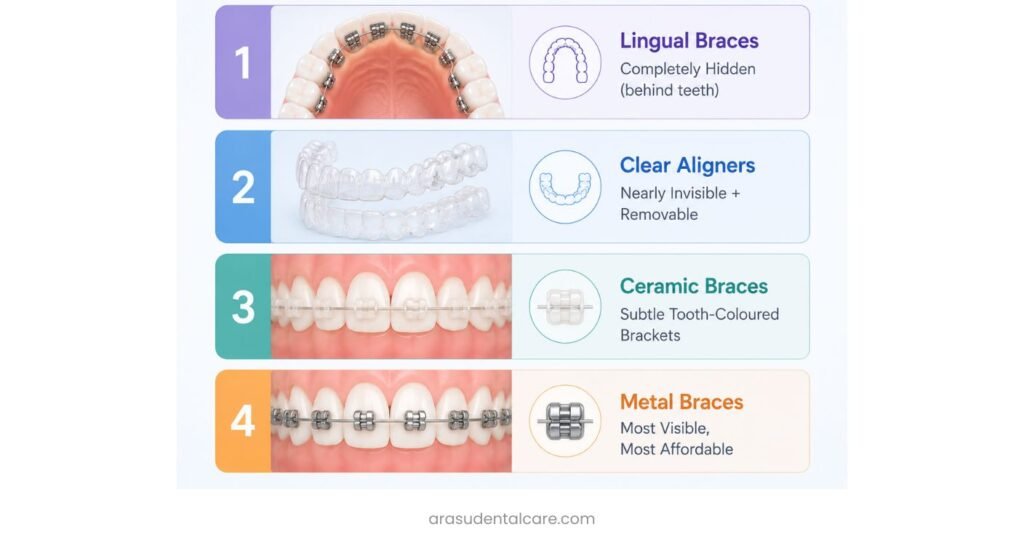
The 4 Least Visible Braces Options (Ranked by Discretion)
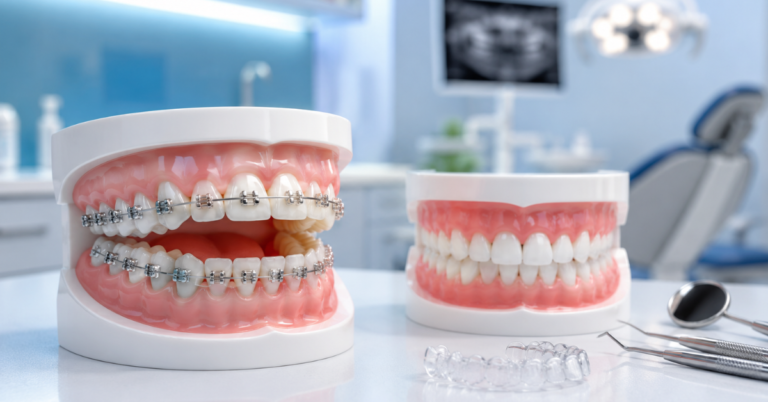
Let’s look at each option in order of how noticeable it is — from completely hidden to slightly visible. Remember, the least visible choice isn’t always the best choice for your specific case. The right option depends on your alignment needs, lifestyle, and budget.
1. Lingual Braces — The Most Invisible Fixed Option
Lingual braces are the most discreet fixed braces available. Instead of attaching to the front of your teeth, the brackets and wires are fixed to the back (tongue-side) surfaces — making them virtually impossible to see from the front.
Even in close conversation or photos, others usually won’t notice them at all.
Best for: Patients who want completely hidden treatment and can adjust to a short tongue-comfort period.
Worth knowing: Because they sit close to the tongue, lingual braces may feel different for the first few weeks and can briefly affect speech. They also require specialised orthodontic training to fit and adjust correctly.
2. Clear Aligners (Invisalign-Style) — Nearly Invisible & Removable
Clear aligners are thin, transparent, custom-made trays that fit snugly over your teeth and gradually shift them into position. They are widely considered among the least visible braces because the plastic is nearly invisible at conversational distance.
The biggest advantage? They’re removable. You take them out to eat, brush, and floss — which makes maintaining oral hygiene far easier than with fixed braces.
Best for: Mild to moderate crowding, spacing, and certain bite corrections in disciplined patients.
Worth knowing: Aligners only work if you wear them. Most plans require 20–22 hours per day, and you’ll switch to a new set every one to two weeks. Small tooth-coloured “attachments” may be added to a few teeth to guide movement — these are usually subtle but not entirely invisible.
Important: Always pursue clear aligner treatment through a qualified orthodontist who monitors your progress in person — not through unsupervised mail-order services. Professional oversight ensures both safety and predictable outcomes.
3. Ceramic (Clear) Braces — Subtle Fixed Brackets
Ceramic braces work exactly like traditional metal braces, but the brackets are made from tooth-coloured ceramic that blends with your natural enamel. Some patients also choose tooth-coloured wires for added subtlety.
According to Cleveland Clinic, ceramic braces are just as effective as metal braces — they simply use less noticeable materials. They’re a strong choice for moderate to complex cases where fixed brackets give the orthodontist precise control.
Best for: Patients who need fixed braces but want a more discreet front-of-tooth appearance.
Worth knowing: The clear or white elastic ties can pick up staining from coffee, tea, curry, and red sauces. Good hygiene and mindful eating help keep them looking their best between visits.
4. Traditional Metal Braces — Most Visible, but Most Affordable
Metal braces are the most visible option, but modern brackets are much smaller and sleeker than older versions. They remain highly effective, durable, and the most budget-friendly choice for nearly all orthodontic problems.
If discretion is a priority but metal braces suit your case best, the elastic colour you choose makes a real difference. Silver and grey elastics blend with the brackets and draw the least attention, while clear bands look subtle initially but stain more easily.
Best for: Complex cases, younger patients, and those prioritising effectiveness and affordability.
Comparison Table: Which Braces Are Least Visible?
|
Feature |
Lingual Braces |
Clear Aligners |
Ceramic Braces |
Metal Braces |
|
Visibility |
Completely hidden |
Nearly invisible |
Low (tooth-coloured) |
Most visible |
|
Removable |
No |
Yes |
No |
No |
|
Best for |
Most cases |
Mild–moderate cases |
Moderate–complex cases |
All cases |
|
Comfort note |
Tongue adjustment |
Smooth, minimal irritation |
Mild lip/cheek irritation |
Mild lip/cheek irritation |
|
Staining risk |
Hidden if present |
Low (removed to eat) |
Elastic ties may stain |
Elastics may stain |
|
Typical treatment time |
18–24 months |
12–18 months |
18–24 months |
18–24 months |
Note: Treatment times vary by individual case and should be confirmed during your consultation.
How to Choose the Least Visible Braces for You
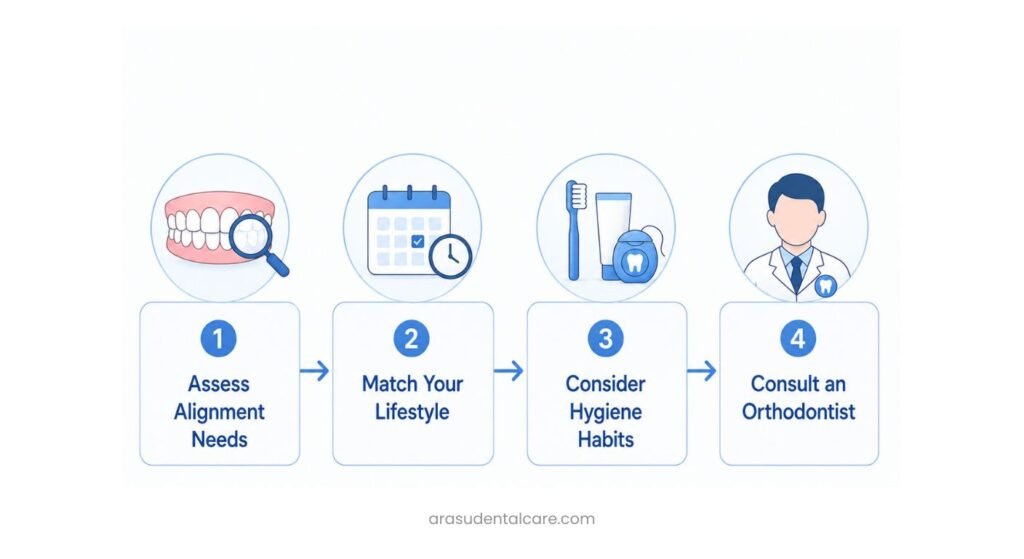
Choosing the right discreet option isn’t only about appearance. Here’s a simple, step-by-step way to think it through.
Step 1: Understand Your Alignment Needs
Mild crowding or spacing may be well-suited to clear aligners in coimbatore. Complex bite issues often respond better to fixed ceramic or lingual braces, which give the orthodontist more control.
Step 2: Consider Your Lifestyle
If you can commit to wearing trays 20–22 hours a day, clear aligners offer flexibility. If you’d rather “fit and forget,” a fixed option may suit you better.
Step 3: Factor in Oral Hygiene Habits
Removable aligners make brushing and flossing easy. Fixed braces require more careful cleaning around brackets and wires.
Step 4: Discuss Your Goals With a Specialist
Only a qualified best orthodontist in coimbatore can assess your teeth, take scans, and recommend the option that balances discretion with a predictable outcome.
A Note on Comfort and Care
Whatever option you choose, the early days of treatment may bring mild tenderness as your teeth begin to move — this is normal and usually settles within a few days. At Arasu Dental Care, treatment is always performed comfortably, with clear guidance on what to expect at every stage.
One important point on oral health: if you have untreated gum disease or active cavities, these should be addressed before starting orthodontics. Moving teeth with unhealthy supporting structures can cause more harm than good. Our multispecialty team can manage gum care, restorations, and orthodontics under one roof, so your treatment is coordinated and safe.
Frequently Asked Questions
Which braces are the least visible overall?
Lingual braces are the least visible because they’re fixed behind your teeth and hidden from view. Clear aligners are a close second — they’re nearly invisible and removable, making them a popular discreet choice for adults.
Are clear aligners really invisible?
Clear aligners are nearly invisible at conversational distance. The trays themselves are transparent, though small tooth-coloured attachments may be added to certain teeth to guide movement. Most people won’t notice you’re wearing them.
Do ceramic braces stain easily?
The ceramic brackets themselves resist staining well. However, the clear or white elastic ties can pick up colour from coffee, tea, curry, and red sauces. Good oral hygiene and mindful eating help keep them looking clear between appointments.
Which elastic colour is least noticeable on metal braces?
Silver and grey elastics usually blend with the brackets and draw the least attention. Clear bands look subtle at first but tend to stain more easily over time.
Can adults get discreet braces?
Absolutely. A significant share of orthodontic patients are now adults, and modern discreet options — clear aligners, ceramic braces, and lingual braces — are specifically popular among professionals who want a natural look during treatment.
Are the least visible braces as effective as metal braces?
For many cases, yes. Ceramic and lingual braces are highly effective, and clear aligners work well for mild to moderate issues. Very complex cases may still be best treated with fixed braces. Your orthodontist will recommend the option that delivers a predictable outcome for your specific situation.
Do discreet braces cost more than metal braces?
Generally, yes. Lingual braces and clear aligners typically cost more than traditional metal braces due to the materials and technology involved. Your orthodontist can explain all available options and costs so you can choose what suits your needs.
Can I straighten my teeth if I have gum disease?
Active gum disease should be treated and stabilised before starting orthodontic treatment. Once your gum health is stable, treatment can usually proceed safely. A multispecialty clinic can coordinate gum care and orthodontics together.
Making Your Decision With Confidence
There’s no single “best” answer to which braces are least visible — only the option that’s best for your teeth, your lifestyle, and your goals. Lingual braces and clear aligners offer the most discretion, while ceramic braces strike a balance between subtlety and control for more complex cases.
What matters most is choos