Can Clear Aligners Correct Underbite?
If you have noticed your lower teeth sitting in front of your upper teeth, you are likely wondering whether clear aligners for underbite correction can help you avoid braces or surgery. The short, honest answer is: yes, clear aligners can correct many underbites — but not all of them. It depends entirely on why your underbite developed.
As an orthodontist-led practice, we want you to understand your condition clearly before you make any decision. This guide explains how underbites form, which types respond well to clear aligners, what realistic results look like, and when a different approach is the safer choice. No hype — just the information you need to feel confident about your next step.
What Is an Underbite, Exactly?
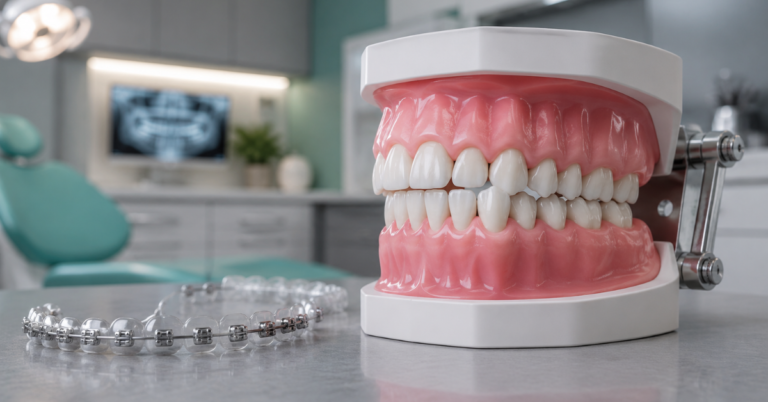
An underbite (clinically known as a Class III malocclusion) occurs when your lower front teeth overlap or sit in front of your upper front teeth when your mouth is closed.
In a healthy bite, the upper teeth rest slightly over the lower teeth. With an underbite, that relationship is reversed — and depending on severity, it can affect how you chew, speak, and feel about your smile.
According to the American Association of Orthodontists, correcting a misaligned bite is about far more than appearance — it supports long-term oral health and comfortable jaw function.
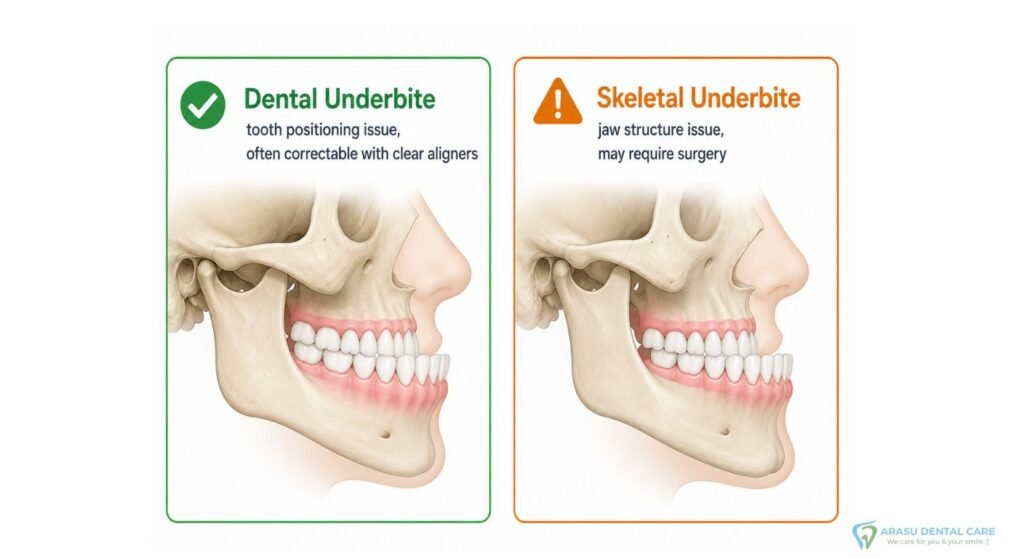
The Two Types of Underbite (This Is the Most Important Section)
Understanding your underbite type is the single most important factor in whether clear aligners will work for you.
|
Type |
What Causes It |
Can Clear Aligners Help? |
|
Dental Underbite |
Tooth positioning — the teeth are tilted or misaligned, but the jaws are normal |
Yes — often very effectively |
|
Skeletal Underbite |
The lower jaw is structurally too far forward or the upper jaw is underdeveloped |
Partially or not alone — may need surgery |
A dental underbite is a tooth-positioning problem. Here, clear aligners can guide the teeth into a corrected bite relationship with predictable outcomes.
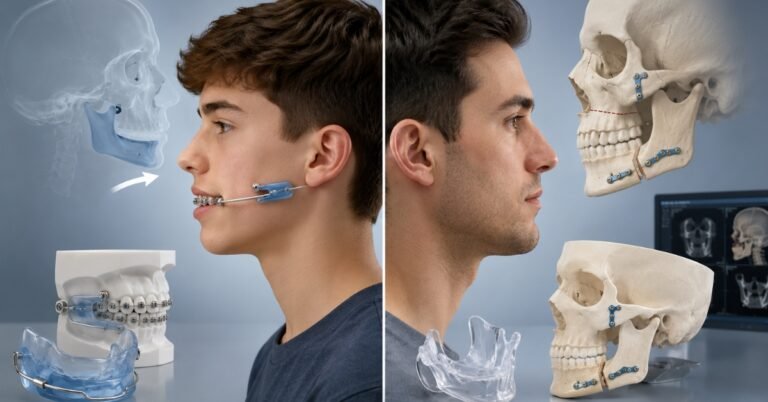
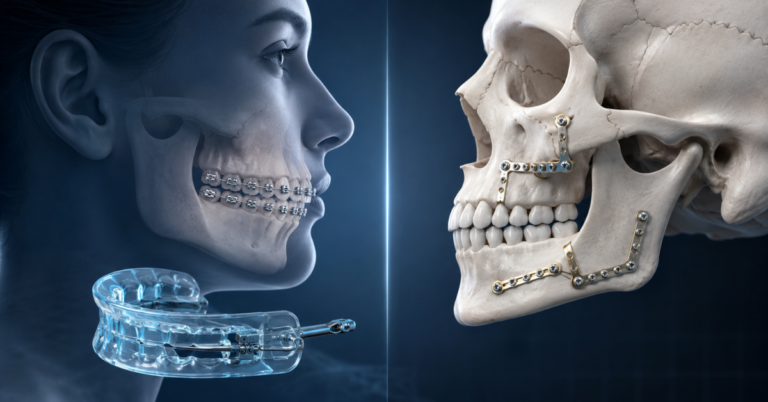
A skeletal underbite is a jaw-structure problem. Aligners move teeth, not jawbones — so severe skeletal cases usually need orthodontics combined with jaw surgery.
This is why a proper diagnosis comes first. We never recommend a treatment until we understand exactly what is causing your underbite.
What Causes an Underbite?
Underbites rarely have a single cause. Understanding the origin helps your orthodontist plan the right treatment.
Common contributing factors include:
- Genetics — the most frequent cause; underbites often run in families
- Prolonged thumb-sucking in early childhood
- Extended pacifier or bottle use beyond toddler years
- Tongue thrusting (pushing the tongue against the lower teeth)
- Jaw injury that alters how the jaw sits
- Mouth breathing linked to abnormal jaw development
In children, early evaluation matters. Research published by the National Library of Medicine supports early orthodontic treatment assessment, because guiding jaw growth is far easier before growth is complete.
Why an Underbite Is Worth Treating
Many patients first notice an underbite because of how it looks. But the functional reasons to treat it are just as important.
An untreated underbite can lead to:
- Difficulty chewing food properly
- Speech challenges with certain sounds
- Accelerated tooth wear, as enamel grinds unevenly
- Jaw strain and TMJ discomfort, since the joint works harder than it should
- Increased decay risk, as misaligned teeth are harder to clean
The good news is that addressing an underbite early often prevents these problems from worsening — and supports your long-term oral health.
Can Clear Aligners for Underbite Actually Work?
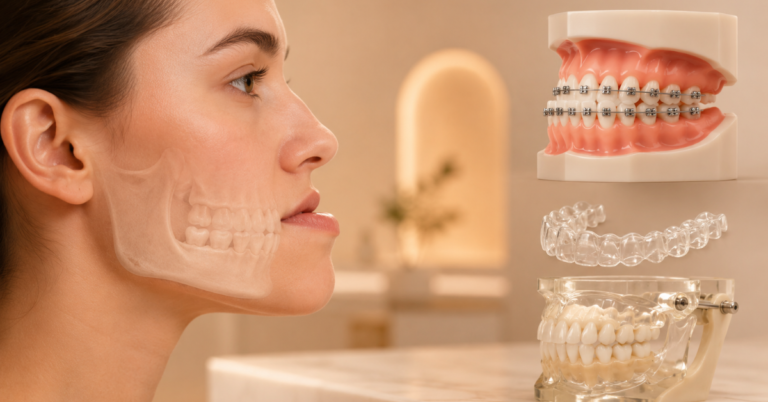
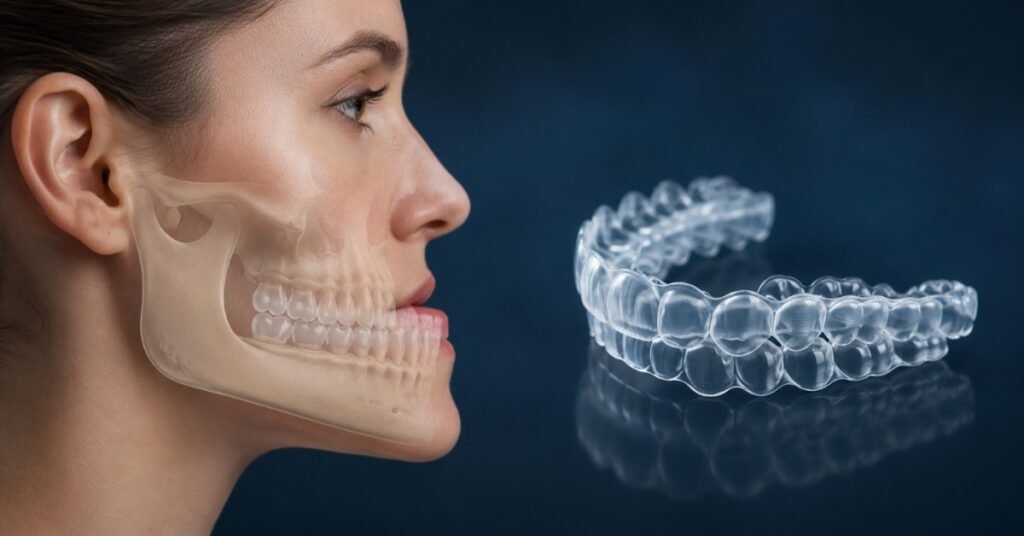
Yes — for mild to moderate dental underbites, clear aligners are a genuinely effective, evidence-based option. They work by applying gentle, controlled pressure that gradually shifts your teeth into a corrected bite relationship.
Here’s what makes modern clear aligner treatment effective for the right candidates:
1. Precise digital planning. A 3D scan maps every tooth movement before treatment begins, so your plan is built around your specific bite.
2. Custom-fit aligner trays. Each set is made for your teeth and worn 20–22 hours a day, switching to the next set every one to two weeks.
3. Attachments. Small, tooth-coloured “grips” are bonded to certain teeth to help the aligners perform more complex movements.
4. Elastics. In many underbite cases, tiny elastic bands work alongside the aligners to adjust the bite relationship — not just the teeth.
In our clinical experience, patients who wear their aligners consistently and follow elastic instructions see noticeably better bite correction. Compliance is the single biggest factor in a successful outcome.
Where Clear Aligners Reach Their Limit
We believe in being transparent about what aligners can and cannot do. Clear aligners alone may not be enough when:
- The underbite is severe and skeletal in origin
- The lower jaw is significantly forward due to bone structure
- Teeth are rotated more than about 20 degrees
- There are extensive bridges or multiple implants limiting movement
In these situations, we will explain the available options honestly — which may include traditional braces, a combined surgical-orthodontic approach, or early growth-guidance appliances for children.
Clear Aligners vs. Braces for Underbite Correction
Both work — the right choice depends on your case, lifestyle, and goals. Here’s an honest comparison:
|
Feature |
Clear Aligners |
Traditional Braces |
|
Appearance |
Nearly invisible |
Visible brackets and wires |
|
Comfort |
Smooth plastic, no sharp edges |
May irritate cheeks and lips |
|
Removable |
Yes — eat and clean normally |
No — fixed for full duration |
|
Oral hygiene |
Easy to maintain |
Requires extra effort |
|
Best for |
Mild to moderate dental underbites |
Complex or severe cases |
|
Discipline needed |
High (must wear 20–22 hrs/day) |
Lower (always on) |
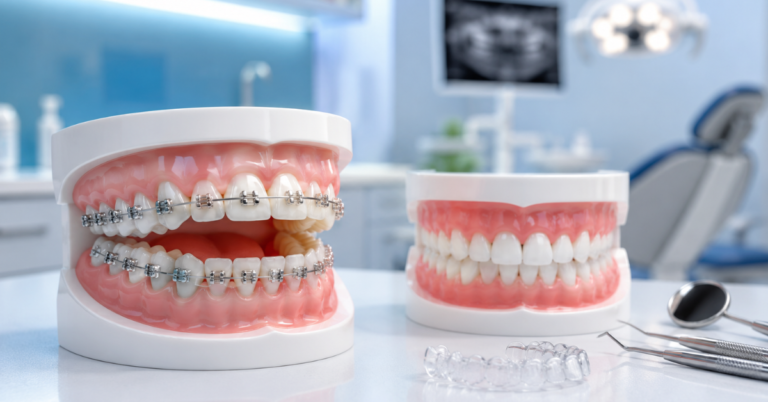
For adults and teens with active social or professional lives, aligners often feel more comfortable and convenient. But braces remain the more controlled choice for complex movements.
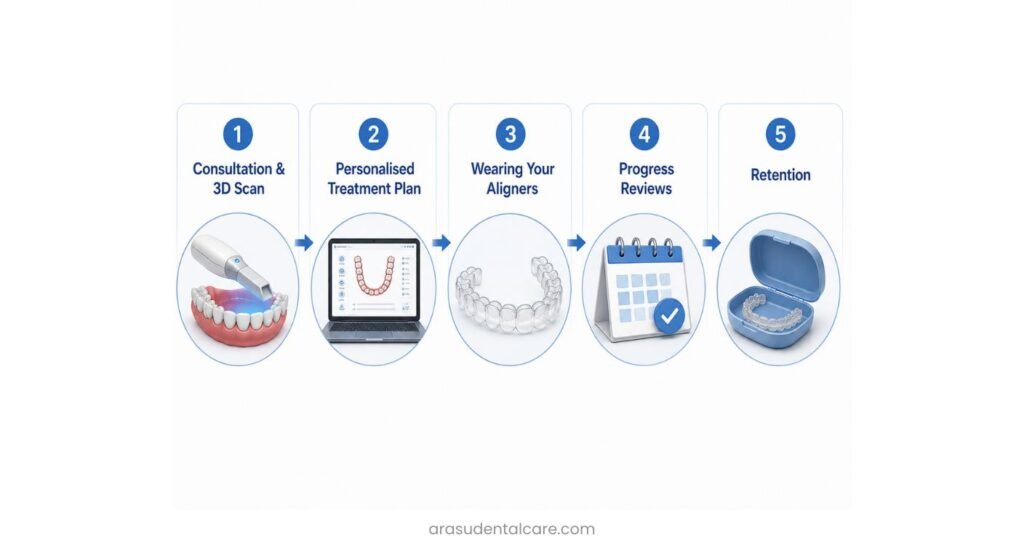
What to Expect: The Treatment Journey Step by Step
At our clinic, we keep the process clear and comfortable from your very first visit.
Step 1 — Consultation & 3D ScanWe examine your bite, take a digital scan, and determine whether your underbite is dental or skeletal. This is where honest planning begins.
Step 2 — Personalised Treatment PlanUsing advanced planning software, we map out every stage of tooth movement — and you can often preview your projected result before starting.
Step 3 — Wearing Your AlignersYou wear each set 20–22 hours daily, removing them only to eat, drink (anything but water), and clean youir teeth.
Step 4 — Progress ReviewsShort check-ups every few weeks ensure everything is tracking correctly. We provide new sets and make adjustments if needed.
Step 5 — RetentionOnce your bite is corrected, you’ll wear retainers to keep your new smile stable and prevent relapse.
How Long Does Underbite Correction With Clear Aligners Take?
Treatment time varies based on severity and how consistently you wear your aligners.
- Mild dental underbites: often around 6–12 months
- Moderate cases: typically 12–18 months
- Complex cases: may take longer or require combined treatment
Underbite corrections generally take slightly longer than simple straightening cases, because the bite relationship — not just tooth position — is being adjusted. Wearing your aligners the full 20–22 hours daily keeps you on schedule.
What Age Is Best to Treat an Underbite?
For children, the ideal window for early evaluation is often between ages 7 and 10, while the jaw is still developing. Early intervention can sometimes guide jaw growth and reduce the need for more complex treatment later.
For adults, an underbite can still be corrected — the jaws are fully developed, so treatment may take longer, and severe skeletal cases may need a combined approach. The encouraging news: it’s rarely “too late” to improve your bite and comfort.
Frequently Asked Questions
1. Can clear aligners fix an underbite without surgery?Yes — many mild to moderate dental underbites can be corrected with clear aligners alone, often combined with elastics. Severe skeletal underbites may still require surgery for full correction.
2. How do I know if my underbite is dental or skeletal?Only a clinical examination with digital scans can confirm this. An orthodontist will assess your teeth and jaw relationship to recommend the most suitable, predictable approach.
3. Do clear aligners hurt?They are not inherently painful. You may feel mild pressure or tightness for a day or two when switching to a new set — a normal sign your teeth are moving. This usually settles quickly.
4. Will my underbite get worse if I don’t treat it?It can, especially in children before a growth spurt. Once jaw growth completes, an underbite may become more noticeable and harder to correct, so early evaluation is wise.
5. How long will I need to wear aligners each day?For predictable results, aligners must be worn 20–22 hours daily — removed only for eating, drinking anything other than water, and oral hygiene. Consistency directly affects your outcome.
6. Will I need a retainer after treatment?Yes. Retainers are essential after any orthodontic treatment to hold your corrected bite in place and prevent teeth from drifting back.
7. Can adults fix an underbite with clear aligners?Absolutely. Adults with mild to moderate dental underbites are often excellent candidates. More severe skeletal cases may require additional treatment, which we will discuss transparently.
8. Are clear aligners as effective as braces for underbites?For suitable cases, yes — outcomes are often comparable. For very complex or severe underbites, braces or combined treatment may offer more control. The right choice depends on your individual diagnosis.
The Bottom