Ceramic Braces vs Self-Ligating Braces
Choosing between ceramic braces vs self-ligating braces is one of the most common questions we hear from patients exploring orthodontic treatment. Both straighten teeth effectively, but they work differently — and the right choice depends on your appearance goals, comfort needs, lifestyle, and budget.
At Arasu Dental Care, we believe the best decision is an informed one. So instead of pushing one option, this guide will help you genuinely understand how each system works, what the science actually says, and which factors should guide your choice. By the end, you’ll know exactly what to discuss with your orthodontist.
Let’s clear up the confusion together.
First, A Quick Clarification: These Aren’t Always Opposites
Here’s something most articles miss — and it causes real confusion.
“Ceramic” describes the material of the brackets (tooth-coloured, less visible). “Self-ligating” describes the mechanism (how the wire is held in place). These are two different categories.
In fact, you can have self-ligating ceramic braces that combine both features. So when comparing “ceramic braces vs self-ligating braces,” we’re usually comparing:
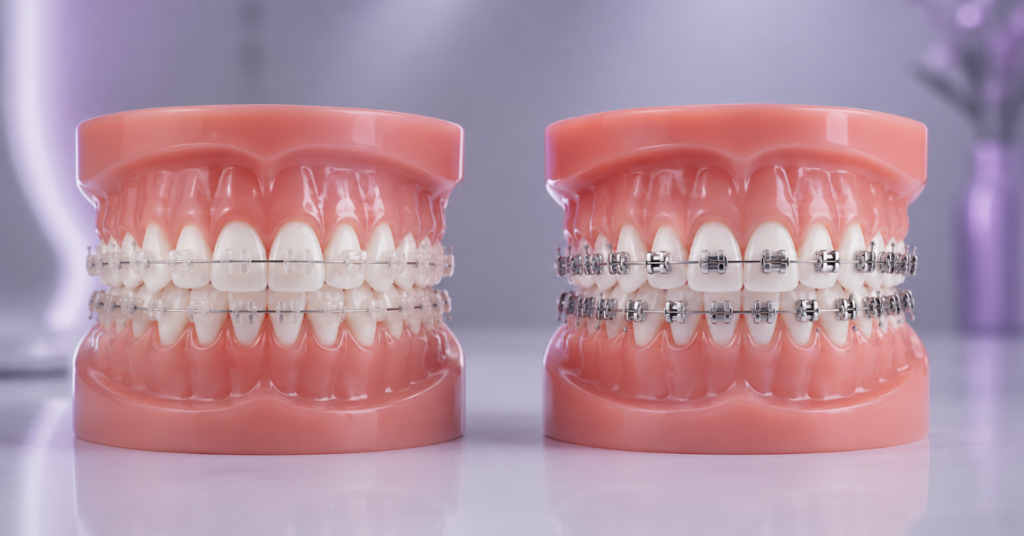
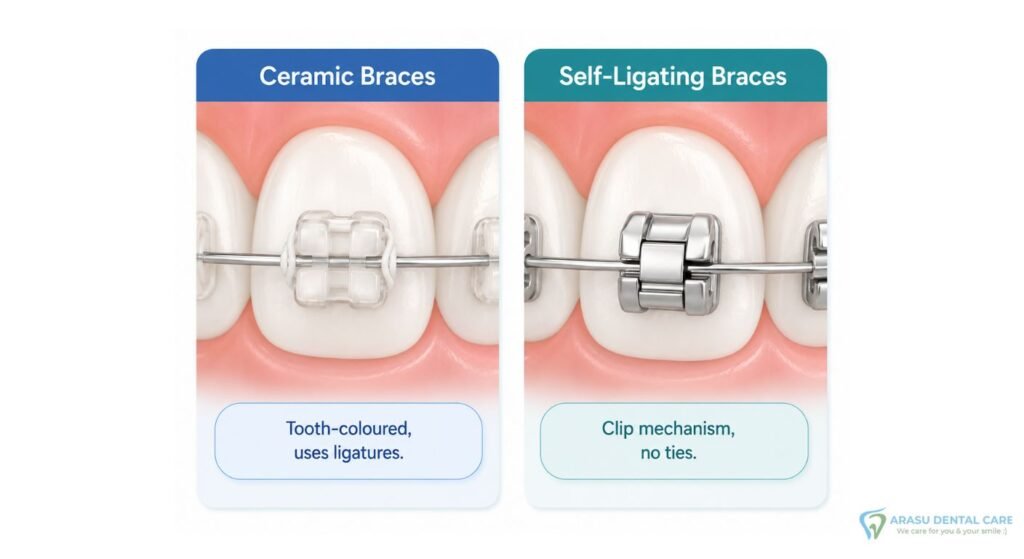
- Ceramic braces — tooth-coloured brackets that traditionally use elastic ties (ligatures)
- Self-ligating braces — brackets (metal or ceramic) with a built-in clip instead of ties
Understanding this distinction is the foundation for making a confident decision. Let’s explore each one.
What Are Ceramic Braces?
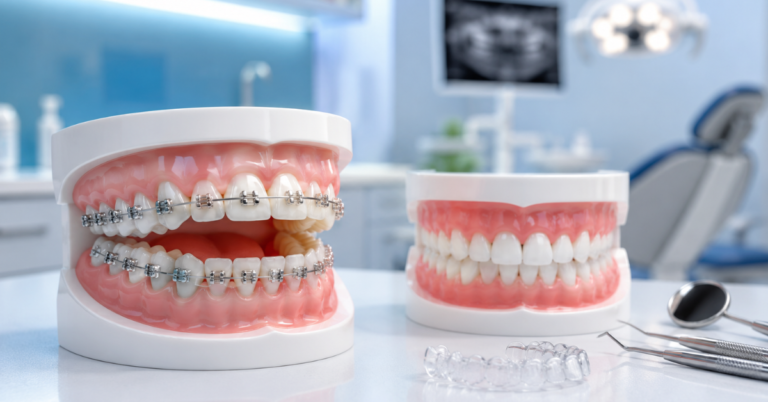
Ceramic braces use brackets made from clear or tooth-coloured ceramic material that blends with your natural teeth. They work exactly like traditional braces — brackets bonded to each tooth, connected by an archwire, secured with ligatures — but they’re far less noticeable.
This makes them a popular choice for adults, working professionals, and image-conscious teens who want effective correction without metal showing in every smile and photo.
Advantages of Ceramic Braces
- Discreet appearance — brackets blend naturally with tooth colour
- Highly effective — treats complex crowding, spacing, and bite issues
- Reliable and predictable — uses time-tested orthodontic mechanics
- Suitable for most cases, especially where aesthetics matter
Things to Consider
- Ligatures can stain — the clear elastic ties may discolour with coffee, tea, or turmeric (common in our Coimbatore diet)
- Slightly more delicate — brackets can chip under heavy impact
- Requires careful hygiene — to keep ties looking clean
A 2023 Cochrane Oral Health review consistently confirms that bracket material (ceramic vs metal) does not affect treatment effectiveness — only appearance and care needs differ.
What Are Self-Ligating Braces?
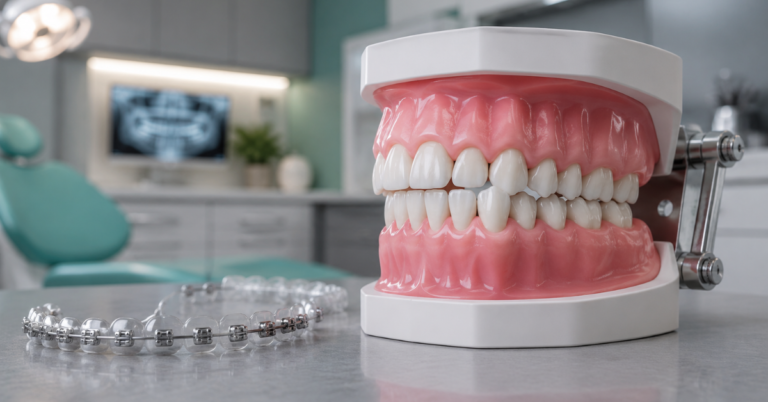
Self-ligating braces replace elastic ties with a small, built-in spring-loaded clip or “gate” that holds the archwire in place. This is the key structural difference — and it’s where most of the marketing claims come from.
Because there are no elastic ties, these braces are often promoted as having less friction, easier cleaning, and fewer appointments. They come in both metal and ceramic versions, so you can choose based on visibility too.
Advantages of Self-Ligating Braces
- No elastic ties — fewer plaque traps, easier to keep clean
- Smoother wire movement — reduced friction during alignment
- Potentially fewer adjustment visits — convenient for busy schedules
- Available in tooth-coloured options for discretion
Things to Consider
- Higher cost — generally more expensive than conventional braces
- Clip can need maintenance — the moving mechanism may occasionally require attention
- Marketing vs evidence — some claims aren’t fully backed by research (more on this below)
Ceramic Braces vs Self-Ligating Braces: Side-by-Side Comparison
|
Feature |
Ceramic Braces |
Self-Ligating Braces |
|
What it describes |
Bracket material |
Holding mechanism |
|
Appearance |
Tooth-coloured, discreet |
Metal (visible) or ceramic (discreet) |
|
How wire is held |
Elastic/metal ligatures |
Built-in clip |
|
Staining risk |
Ties may stain |
Fewer ties = less staining |
|
Hygiene |
Needs careful cleaning |
Easier around brackets |
|
Comfort |
Standard |
Often reported as gentler |
|
Adjustment visits |
Regular (4–6 weeks) |
Possibly fewer |
|
Cost |
Moderate |
Generally higher |
|
Best for |
Aesthetics-focused patients |
Convenience + hygiene-focused patients |
What Does the Science Actually Say?
This is where we want to be completely honest with you — because the marketing around self-ligating braces is often louder than the evidence.
A detailed 2025 narrative review published in Cureus examined dozens of studies comparing self-ligating and conventional brackets. The findings are worth knowing:
Treatment time: Despite popular claims, studies show no significant difference in overall treatment duration between self-ligating and conventional systems.
Pain and comfort: Evidence is mixed. Some patients report greater comfort with self-ligating braces, but high-quality reviews found insufficient evidence to confirm a consistent difference.
Oral hygiene: Self-ligating brackets do reduce plaque traps from elastic ties — a genuine benefit. However, your brushing habits matter far more than the bracket type.
Friction: Self-ligating brackets do show lower friction in lab studies. Whether this creates meaningful clinical advantages remains debated.
The honest takeaway? Both systems deliver excellent, predictable results when fitted by an experienced orthodontist. As the research repeatedly concludes — the skill of your orthodontist matters more than the bracket you choose.
The Australian Society of Orthodontists similarly notes that self-ligating braces have not been proven to make treatment significantly faster or better.
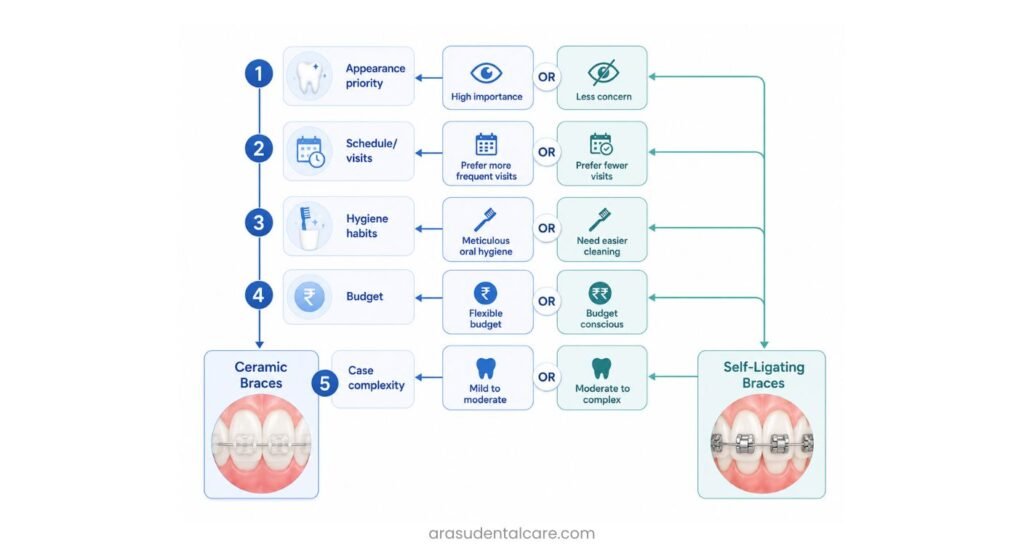
How to Choose: A Simple Decision Framework
In our experience treating patients across all age groups, the right choice usually comes down to a few practical questions. Here’s how to think it through.
Step 1: How Important Is Appearance to You?
If being discreet is your top priority — for client-facing work, public speaking, or weddings — choose ceramic (either conventional ceramic or self-ligating ceramic).
Step 2: How Busy Is Your Schedule?
If frequent clinic visits are difficult, self-ligating braces may offer the convenience of fewer appointments. We’ll assess whether your case suits this.
Step 3: How’s Your Hygiene Routine?
If you struggle with consistent brushing or have sensitive gums, the tie-free design of self-ligating braces can make daily cleaning a little easier.
Step 4: What’s Your Budget?
Ceramic braces are usually more affordable than self-ligating systems. We always discuss costs transparently so there are no surprises.
Step 5: How Complex Is Your Case?
For severe crowding or bite correction, your orthodontist’s recommendation should guide you — both systems can handle complex cases, but individual planning matters.
A Real-World Note From Our Clinic
In day-to-day practice, we find that the “perfect bracket” is rarely the deciding factor in a beautiful result. What truly matters is accurate diagnosis, careful treatment planning, regular reviews, and your own commitment to oral hygiene.
We’ve seen patients achieve stunning outcomes with both ceramic and self-ligating braces. The difference always came down to consistency and expert monitoring — not the marketing label on the brackets.
That’s why our orthodontic team focuses first on understanding your specific bite, lifestyle, and goals, then recommends the option that fits you — not a one-size-fits-all answer.
Frequently Asked Questions
1. Are self-ligating braces better than ceramic braces?Neither is universally “better.” Ceramic braces focus on appearance, while self-ligating braces focus on the holding mechanism. The best choice depends on your aesthetic goals, hygiene habits, schedule, and budget — which your orthodontist will assess.
2. Do self-ligating braces really straighten teeth faster?Research does not consistently support this. Studies show overall treatment time is similar between self-ligating and conventional braces. Treatment duration depends mainly on your case complexity and consistency.
3. Do ceramic braces stain?The ceramic brackets themselves resist staining, but the clear elastic ties can discolour from coffee, tea, or coloured foods. These ties are simply replaced at your regular visits.
4. Can I get self-ligating ceramic braces?Yes. Self-ligating ceramic braces combine the discreet, tooth-coloured look with the clip-based mechanism — offering both aesthetics and tie-free convenience.
5. Which option is more comfortable?Some patients report self-ligating braces feel gentler, but the evidence is mixed. Both are comfortable for most people, especially after the initial adjustment period.
6. Are ceramic or self-ligating braces more expensive?Self-ligating braces are generally more expensive than conventional ceramic braces. We provide transparent, personalized cost estimates during your consultation.
7. Which braces are easier to keep clean?Self-ligating braces have a slight edge because they don’t use elastic ties that trap plaque. However, thorough daily brushing and flossing matter far more than the bracket type.
8. How do I decide which is right for me?The best way is a professional evaluation. Your orthodontist will examine your teeth, discuss your priorities, and explain the suitable options so you can choose confidently.
The Bottom Line
When it comes to ceramic braces vs self-ligating braces, there’s no single winner — only the option that best fits your smile, lifestyle, and goals.
Ceramic braces excel at discreet appearance. Self-ligating braces offer tie-free convenience and easier cleaning. And remember — both can be combined as self-ligating ceramic braces. Most importantly, the evidence is clear that an experienced or