What to Expect During Orthodontic Treatment
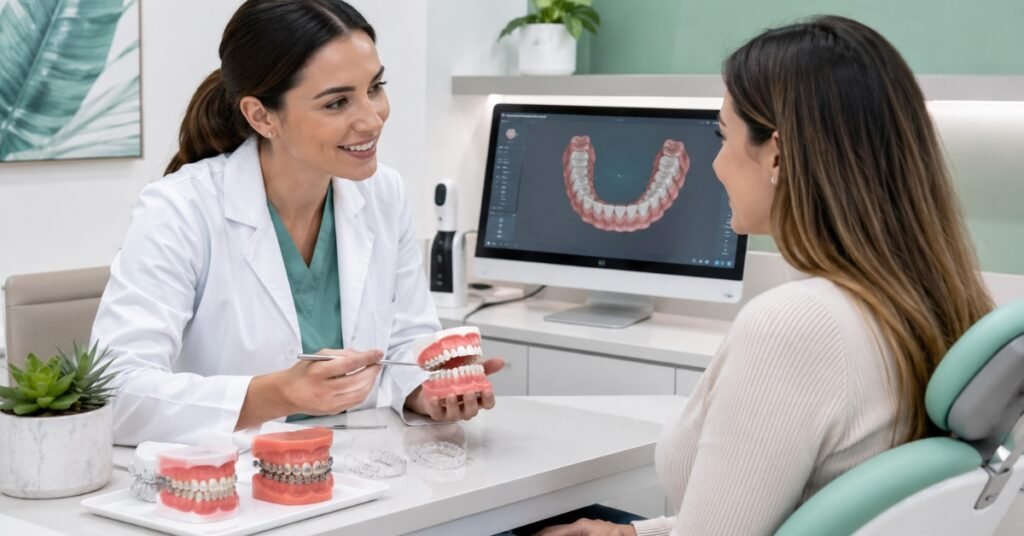
If you’re considering braces or aligners, understanding the orthodontic treatment process before you begin can ease a lot of uncertainty. Many patients picture treatment as simply “getting braces” — but the journey is a carefully planned sequence that usually spans 6 to 30 months. From your first consultation to the day your retainers protect your finished smile, each phase has a clear purpose.
At Arasu Dental Care, we believe informed patients make confident decisions. This guide walks you through every stage of orthodontic treatment, what actually happens at each appointment, and how to prepare — so you know exactly what to expect.
Understanding the Orthodontic Treatment Process: The Three Core Phases
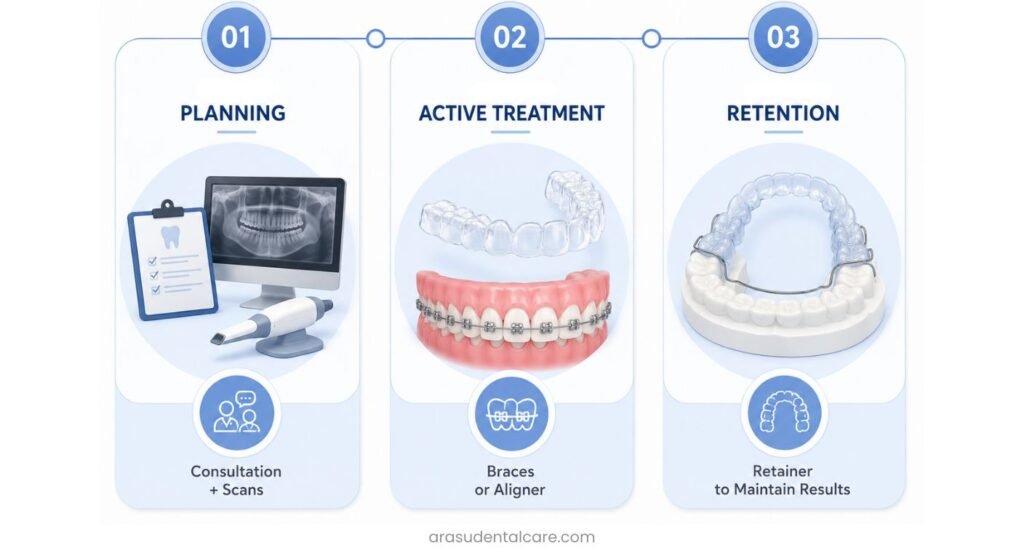
Orthodontic treatment moves teeth gradually and safely into healthier positions. While every patient’s case is unique, the journey follows three predictable phases:
|
Phase |
What Happens |
Typical Duration |
|
1. Planning |
Consultation, scans, X-rays, treatment design |
1–2 visits |
|
2. Active Treatment |
Braces/aligners placed and adjusted regularly |
6–30 months |
|
3. Retention |
Retainers maintain your new smile |
Lifelong (reducing wear) |
Understanding this structure helps set realistic expectations. The braces fitting itself is just one milestone — the planning beforehand and the retention afterward are equally important to your long-term result.
Phase 1: Initial Consultation and Treatment Planning
Your orthodontic journey begins with a detailed evaluation. This first appointment usually takes 20 minutes to an hour and lays the foundation for everything that follows.
Comprehensive Dental and Medical Evaluation
Your orthodontist starts by reviewing your medical and dental history. This helps identify any conditions that could affect tooth movement or treatment outcomes.
A thorough examination of your teeth, gums, and jaw follows. Healthy gums and supporting bone are essential before braces are placed — moving teeth on diseased gums can harm your oral health, as the Cleveland Clinic notes. If cavities or gum disease are present, these are treated first.
Digital X-Rays, Photos, and 3D Scans
Modern orthodontics relies on advanced imaging to see what a visual exam cannot. Your records may include:
- Digital and panoramic X-rays to view roots, bone density, and impacted teeth
- Clinical photographs of your teeth and face from multiple angles
- 3D intraoral scans for precise diagnosis and treatment simulation
These diagnostic tools allow your specialist to plan tooth movement accurately and show you predictable outcomes before treatment begins.
Creating Your Personalised Treatment Plan
Once all information is gathered, your orthodontist develops a treatment plan tailored to your facial proportions, bite, lifestyle, and goals.
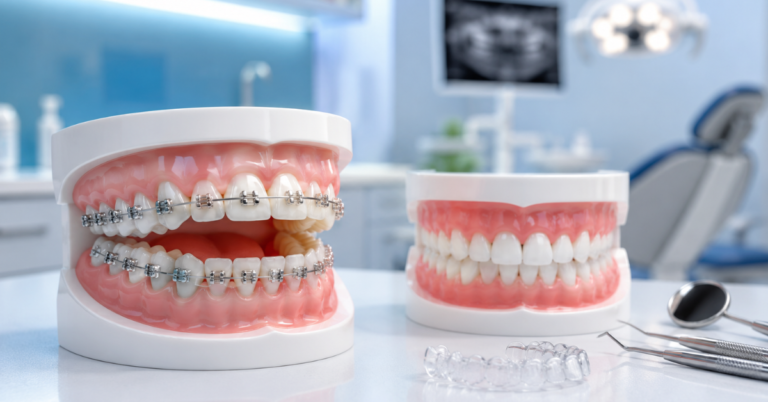
This is when you’ll discuss your options — traditional metal braces, ceramic braces, or clear aligners — along with an estimated timeline and expected results. At Arasu Dental Care, we explain every option clearly so you can make an informed decision that suits your needs, not a one-size-fits-all approach.
Choosing Your Orthodontic Appliance
Different appliances suit different needs. Here’s a clear comparison to help you understand your options.
|
Appliance Type |
Best For |
Visibility |
Key Note |
|
Metal Braces |
Complex cases, all ages |
Visible |
Effective and economical |
|
Ceramic Braces |
Patients wanting discretion |
Less noticeable |
Tooth-coloured brackets |
|
Self-Ligating Braces |
Fewer adjustment visits |
Visible/discreet |
Built-in clips, less friction |
|
Clear Aligners |
Mild to moderate cases |
Nearly invisible |
Removable for eating/cleaning |
According to the NHS, the best appliance depends on the exact problem being corrected. Aligners offer convenience and discretion but treat a narrower range of cases, while fixed braces handle more complex bite corrections.
Your orthodontist will guide you toward the option that delivers the most predictable outcome for your specific condition.
Phase 2: The Active Treatment Phase
This is when your appliances begin their work. Active treatment can last several months to a few years, depending on the complexity of your case.
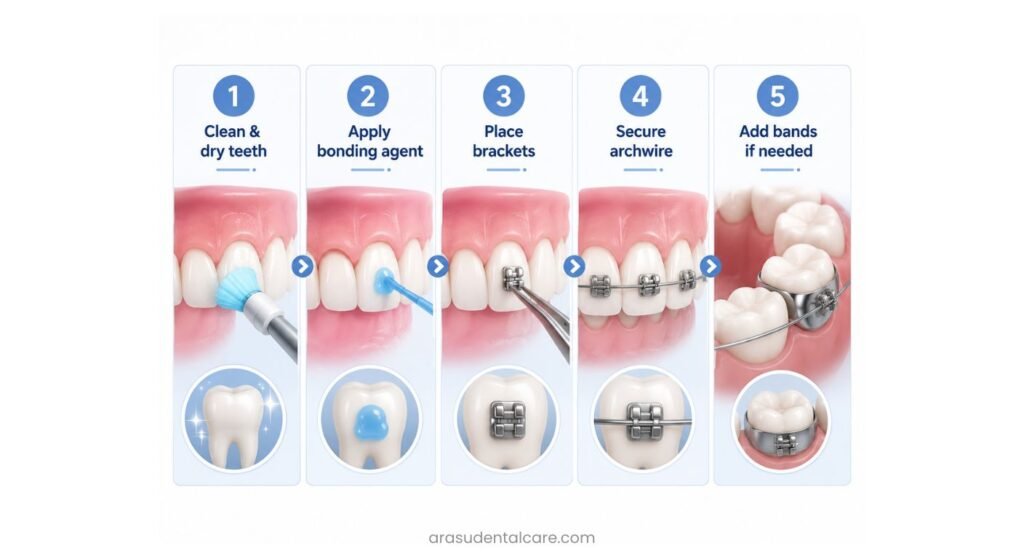
How Braces Are Fitted (Step-by-Step)
The fitting appointment is an exciting milestone and typically takes 60 to 90 minutes. The process is comfortable and involves no drilling or injections.
Here’s how braces are placed:
- Cleaning and preparation — Your teeth are cleaned, dried, and isolated to ensure a strong bond.
- Applying the bonding agent — A dental adhesive is applied and hardened with a curing light.
- Placing the brackets — Each bracket is carefully positioned. Accuracy here directly affects how your teeth move.
- Securing the archwire — The wire is threaded through the brackets to apply gentle, continuous pressure.
- Bands or spacers (if needed) — Some patients need molar bands, often placed at a prior visit.
For clear aligners, the process is different — you receive custom trays, and your orthodontist checks the fit and explains wear and care instructions.
Regular Adjustments and Monitoring
After fitting, you’ll return every 4 to 10 weeks (often every 6–8 weeks) for adjustments. These visits last about 15–30 minutes.
During each appointment your orthodontist will:
- Assess your treatment progress
- Replace or tighten the archwire
- Attach new ligatures (you can often choose the colours)
Consistent adjustments keep your teeth moving steadily. Skipping appointments can stall your progress, so regular visits are essential.
Managing Discomfort Comfortably
It’s normal to feel mild tenderness for a few days after fitting or adjustments. This is a dull ache — not sharp pain — that usually peaks within 24–48 hours.
To stay comfortable:
- Take over-the-counter pain relief if needed
- Eat soft foods temporarily
- Apply orthodontic wax to any bracket that irritates your cheek
- Use a cold compress to reduce soreness
Phase 3: The Retention Phase
Your treatment doesn’t end the day your braces come off. The retention phase is essential to protect your results.
Why Retainers Are Essential
After active treatment, your teeth need time to stabilise in their new positions. The bone and gums around them are still adjusting.
Without a retainer, teeth can begin drifting back within months. Wearing your retainer as directed is the single most important step in maintaining your new smile for life.
Types of Retainers
|
Retainer Type |
Description |
Best For |
|
Fixed (bonded) retainer |
Thin wire attached behind teeth, hidden |
Cases with severe prior crowding |
|
Removable retainer |
Clear (Essix) or wire-and-acrylic (Hawley) |
Easy cleaning and flexibility |
How Long You’ll Wear Retainers
Initially, you’ll wear retainers most of the day (around 22 hours) for the first 4–6 months. After your teeth stabilise, wear is usually reduced to nighttime only.
Because teeth naturally shift with age, nighttime retainer use is recommended long-term to keep your smile stable.
Common Problems Orthodontic Treatment Can Fix
Braces and aligners do far more than straighten crooked teeth. They correct bite and alignment issues that affect both function and oral health.
- Overbite — Upper teeth overlap lower teeth excessively
- Underbite — Lower teeth sit ahead of upper teeth
- Crossbite — Upper and lower teeth misalign sideways
- Open bite — Front teeth don’t meet when the mouth is closed
- Overcrowding — Insufficient space causes overlapping teeth
- Spacing/gaps — Excess space between teeth
Correcting these issues makes teeth easier to clean, improves chewing and speech, and reduces your risk of cavities and gum disease — benefits confirmed by the American Association of Orthodontists.
When Should Treatment Begin?
The American Association of Orthodontists recommends a child’s first orthodontic evaluation by age 7. At this age, an orthodontist can spot developing issues early — sometimes guiding jaw growth and reducing the need for more extensive treatment later.
That said, orthodontic treatment isn’t just for children. Adults can achieve excellent, predictable results too, as healthy teeth can be moved at any age.
Frequently Asked Questions
Q1. How long does orthodontic treatment take?Most treatments take 6 to 30 months. Mild cases may finish in under a year, while complex bite corrections can take two years or longer. Your orthodontist will give you a personalised estimate.
Q2. Does getting braces fitted hurt?No. The fitting itself is comfortable and involves no drilling or injections. You may feel mild soreness for a few days afterward as your teeth begin to respond, which is easily managed with soft foods and over-the-counter pain relief.
Q3. How often will I visit the orthodontist?During active treatment, adjustment visits are usually every 4 to 10 weeks. Each visit takes around 15–30 minutes.
Q4. Are braces or clear aligners better?It depends on your case. Aligners are discreet and removable but suit milder issues. Braces handle a wider range of complex corrections. Your orthodontist will recommend the most suitable option for predictable results.
Q5. Do I really need to wear a retainer afterward?Yes. Teeth can shift back within months without retention. Retainers protect your investment and keep your new smile stable for life.
Q6. Can adults get orthodontic treatment?Absolutely. Healthy teeth can be moved at any age. Adult treatment may take slightly longer due to denser bone, but the results are equally effective.
Q7. How do I keep my teeth clean with braces?Brush gently around brackets and the gumline at least twice daily, use interdental brushes or floss threaders, and rinse with fluoride mouthwash. Thorough cleaning prevents cavities and protects your final result.
Q8. What should I do if a bracket or wire breaks?Don’t panic. Cover any sharp edge with orthodontic