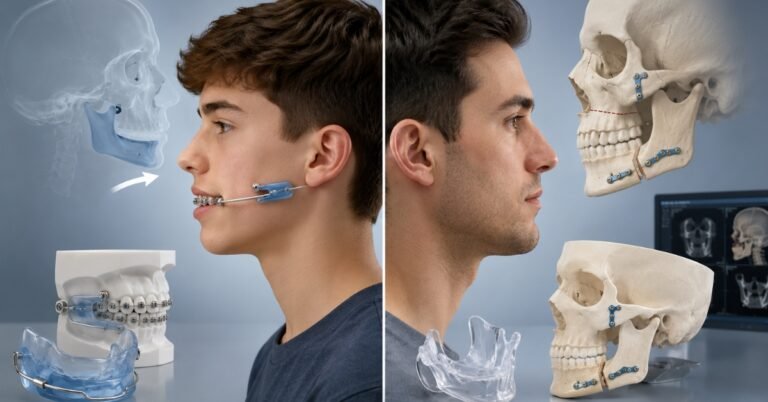
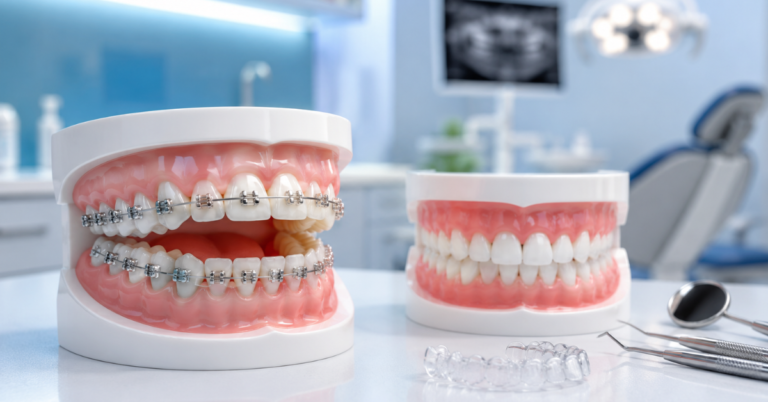
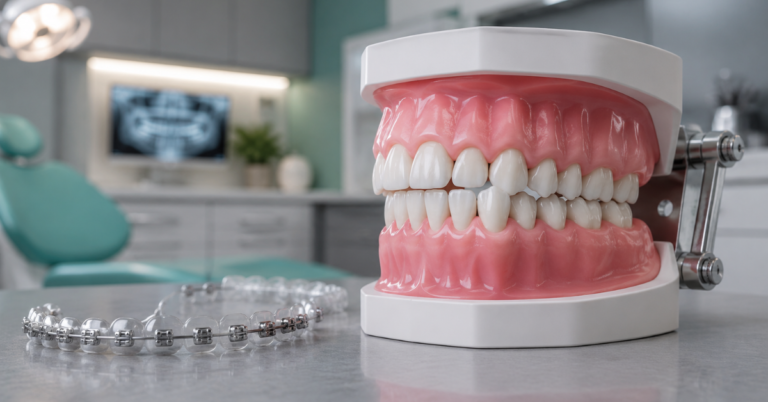
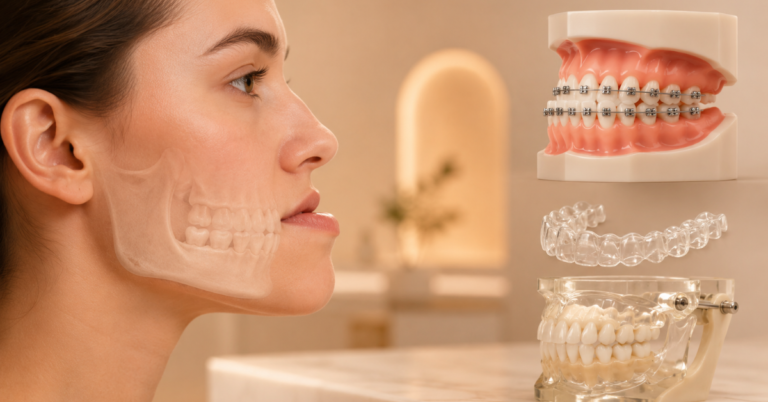
Understanding Teeth Alignment Options
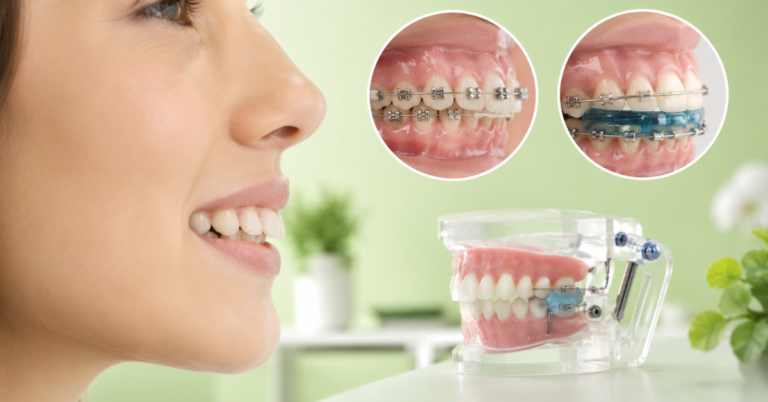
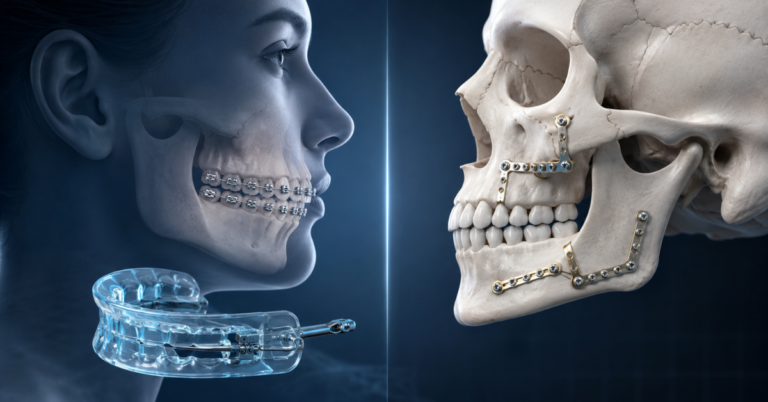
If you’ve been thinking about straightening your smile, you’re not alone — and you have more teeth alignment options today than at any point in dental history. Whether you have crowded teeth, a noticeable gap, or a bite that doesn’t quite feel right, modern orthodontics offers solutions that are more discreet, more comfortable, and often faster than the metal braces of the past.
At Arasu Dental Care, our founder Dr. P.S. Sree Cumar is a qualified Orthodontist (MDS in Orthodontics and Dentofacial Orthopedics) and a Fellow of the World Federation of Orthodontists. In this guide, we’ll walk you through every available option so you can make a confident, informed decision about your smile.
What Does Teeth Alignment Actually Mean?
Teeth alignment refers to how your teeth fit together when your mouth is closed and how evenly they sit within your jaw. When teeth or jaws don’t align properly, dentists call this malocclusion — a clinical term simply meaning “bad bite.”
All teeth-straightening methods work on the same principle: applying gentle, controlled pressure over time to guide teeth into their correct position. The difference lies in how that pressure is delivered.
Proper alignment isn’t only about appearance. According to the American Association of Orthodontists, well-aligned teeth are easier to clean, reducing your long-term risk of decay and gum disease.
Common Types of Teeth Misalignment
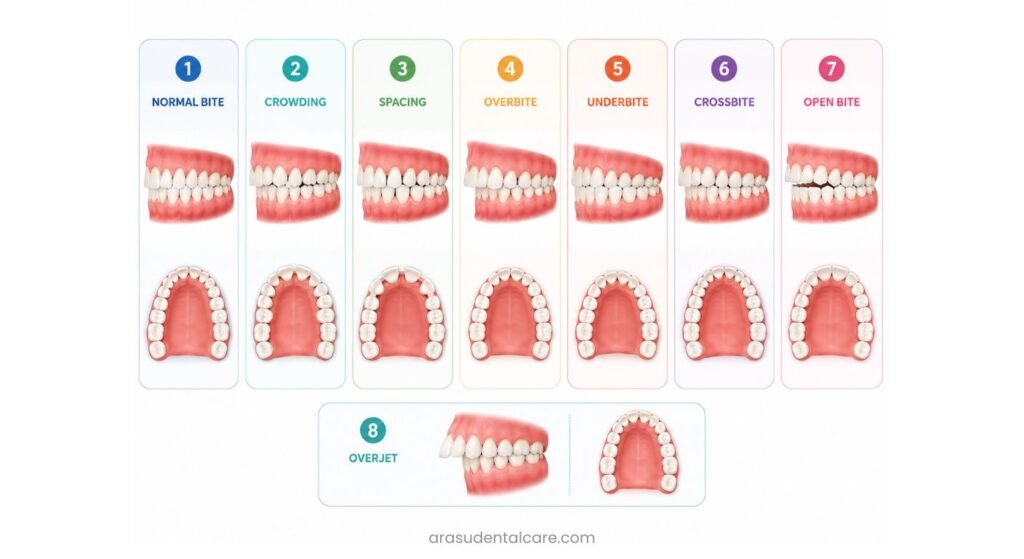
Before exploring treatment, it helps to understand what you may be correcting. Here are the most common alignment concerns we see in our Coimbatore clinics:
|
Type of Misalignment |
What It Means |
|
Crowding |
Not enough space, causing teeth to overlap |
|
Spacing / Diastema |
Visible gaps between teeth |
|
Overbite |
Upper front teeth excessively overlap the lower |
|
Underbite |
Lower teeth or jaw sit ahead of the upper |
|
Crossbite |
Upper teeth fit inside the lower teeth |
|
Open bite |
Front teeth don’t touch when the mouth closes |
|
Overjet |
Upper front teeth protrude forward |
It’s also common to have more than one of these at the same time, which is exactly why a personalized orthodontic treatment evaluation matters.
Top Teeth Alignment Options Explained
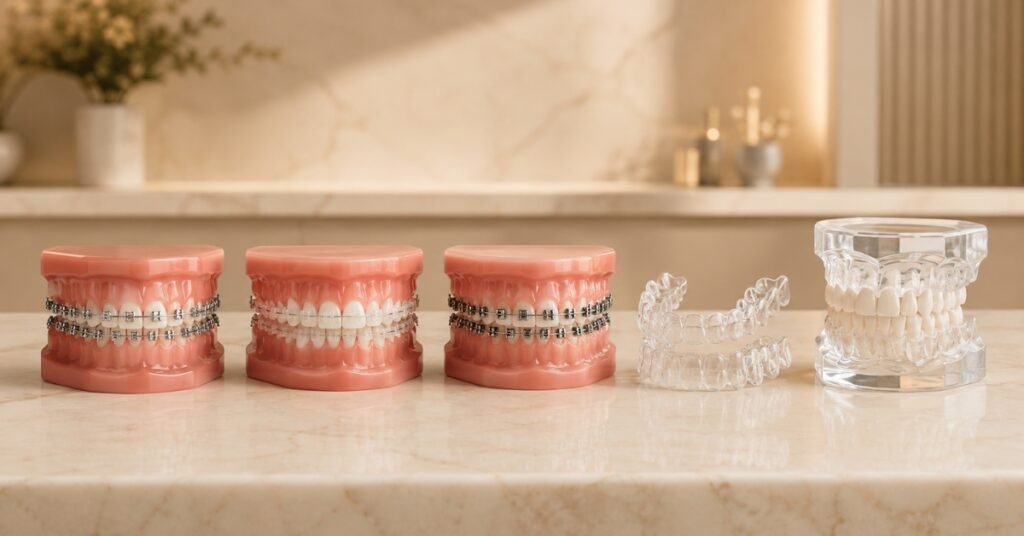
Let’s look at the main treatment options available today, along with how they work and who they suit best. Costs vary widely by case complexity, so we’ve included general market ranges — your actual investment is best confirmed during a consultation.
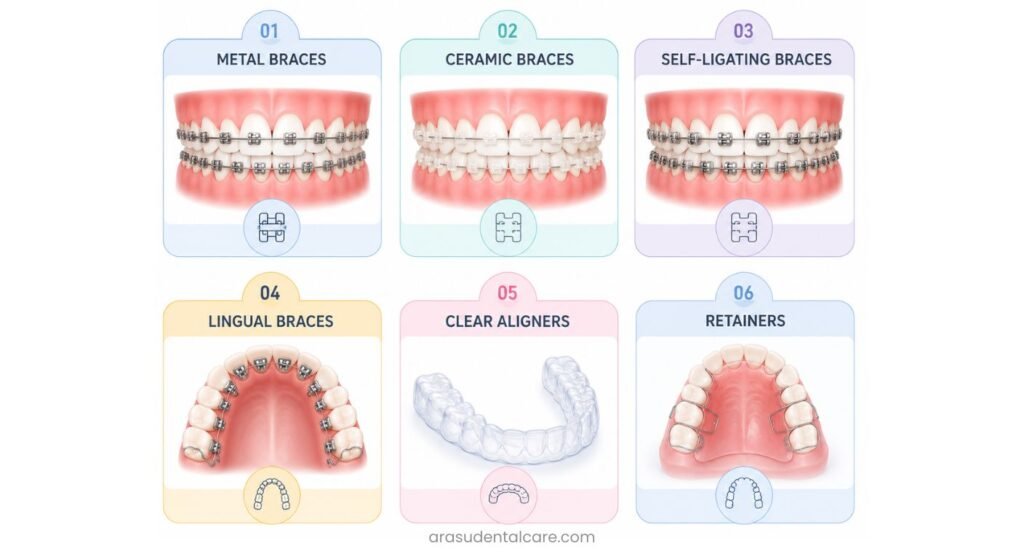
1. Traditional Metal Braces
Metal braces use brackets bonded to each tooth, connected by wires and elastic bands that gradually shift teeth into place.
They remain the most reliable option for complex cases — significant crowding, large gaps, or substantial bite correction. Today’s braces are smaller and more comfortable than older versions, and many patients enjoy choosing coloured bands.
Best for: Moderate to severe alignment and bite issues, children, teens, and adults.
2. Ceramic Braces
These work exactly like metal braces, but the brackets are tooth-coloured or clear, making them far less noticeable.
Best for: Patients wanting effective correction with more discreet appearance.
3. Self-Ligating Braces
Instead of elastic bands, these use a built-in sliding mechanism to hold the wire. This can mean fewer adjustment visits and easier cleaning.
Best for: Those who prefer a lower-maintenance fixed option.
4. Lingual Braces
Lingual braces are fixed to the back surfaces of your teeth, making them virtually invisible from the front.
Best for: Adults and professionals who want completely hidden treatment. They require an adjustment period for speech and are a more specialised option.
5. Clear Aligners (Including Invisalign)
Clear aligners in coimbatore are removable, custom-made transparent trays worn over the teeth. You switch to a new set every one to two weeks as your teeth gradually move.
Clinical research, including a systematic review published on PubMed, confirms that clear aligners are effective for mild to moderate malocclusions. They’re removable for eating, brushing, and flossing — and discreet enough that most people won’t notice them.
Best for: Image-conscious teens and adults with mild to moderate alignment needs and the discipline to wear them 20–22 hours a day.
6. Retainers (For Minor Correction)
While retainers are primarily used to hold teeth in place after treatment, they can sometimes address very minor movements on their own.
Best for: Extremely mild cases or post-treatment maintenance.
Comparing Your Teeth Alignment Options
Here’s a side-by-side view to help you weigh up the choices:
|
Option |
Visibility |
Removable |
Best For |
Typical Treatment Time |
|
Metal Braces |
Visible |
No |
Complex cases |
18–24 months |
|
Ceramic Braces |
Low |
No |
Moderate cases |
18–24 months |
|
Self-Ligating |
Visible/Low |
No |
Moderate cases |
12–18 months |
|
Lingual Braces |
Hidden |
No |
Discreet correction |
18–24 months |
|
Clear Aligners |
Nearly invisible |
Yes |
Mild–moderate cases |
12–18 months |
|
Retainers |
Low |
Yes |
Very minor cases |
Varies |
How Long Does Teeth Straightening Take?
Treatment time depends on your specific condition and the method chosen. As a general guide:
- Traditional braces: 18–24 months
- Self-ligating braces: 12–18 months
- Clear aligners: 12–18 months (with consistent wear)
For mild cases, you may begin seeing changes within a few weeks. Only a qualified orthodontist can give you an accurate timeline after evaluating your teeth and bite.
Benefits of Straightening Your Teeth
Aligning your smile delivers benefits well beyond appearance:
- Easier cleaning — straight teeth have fewer hidden pockets where plaque collects.
- Healthier gums — reducing crowding lowers the risk of inflammation and gum disease.
- More comfortable chewing — a balanced bite distributes pressure evenly.
- Reduced jaw strain — correcting an uneven bite can ease related discomfort.
- Clearer speech — alignment can resolve certain lisps and whistling sounds.
- Greater confidence — a smile you feel good about supports both personal and professional life.
The Centers for Disease Control and Prevention emphasises that good oral health is closely linked to overall wellbeing — making alignment a worthwhile long-term investment, not just a cosmetic one.
A Note on Safety: Avoid DIY Straightening
You may have seen online “hacks” for straightening teeth at home using rubber bands or improvised devices. Please don’t.
Moving teeth without professional supervision can damage roots, weaken enamel, and in severe cases cause tooth loss. Teeth movement involves delicate ligaments and bone — it must be guided by a trained professional using proper diagnostics.
This is one area where the safest path is always evidence-based care from a qualified orthodontist.
How to Choose the Right Option: A Simple Step-by-Step
Step 1 — Book a professional evaluation. An orthodontist examines your teeth, bite, and jaw, often using 3D imaging.
Step 2 — Understand your diagnosis. Ask exactly what’s being corrected and why.
Step 3 — Review all suitable options. A trustworthy clinic explains every appropriate path, not just one.
Step 4 — Consider your lifestyle. Think about visibility, comfort, and how disciplined you can be with removable aligners.
Step 5 — Discuss timeline and cost transparently. No hidden surprises.
Step 6 — Begin treatment with confidence. Once you choose, your orthodontist creates a tailored plan.
Frequently Asked Questions
1. At what age can teeth alignment treatment begin?Children can be evaluated as early as age 7, though most active treatment starts around 12–14. That said, it’s never too late — many of our adult patients straighten their teeth successfully.
2. Are clear aligners as effective as braces?For mild to moderate cases, clear aligners can deliver excellent results. For complex bite or crowding issues, fixed braces are often more predictable. Your orthodontist will advise what suits your case.
3. Does teeth straightening hurt?You may feel mild pressure or tenderness for a few days after starting treatment or changing aligners. This is normal, temporary, and manageable — we ensure your treatment stays comfortable throughout.
4. Will I need to wear a retainer afterwards?Yes. Teeth naturally tend to shift back, so a retainer protects your results. Think of it as the final step that keeps your investment secure.
5. Can adults get their teeth straightened?Absolutely. A growing share of orthodontic patients are adults, and discreet options like clear aligners and lingual braces make adult treatment more appealing than ever.
6. How much do teeth alignment options cost?Costs depend on your case complexity, treatment type, and duration. We believe in transparent pricing — we’ll explain your exact investment clearly during your consultation, with no hidden charges.
7. Which option is most discreet?Lingual braces (hidden behind the teeth) and clear aligners are the least visible choices. Ceramic braces are also a low-visibility fixed option.
8. Can I eat normally during treatment?With clear aligners, you simply remove them before eating. With braces, you can eat most foods but should avoid very sticky or hard items.
Ready to Explore Your Options? Let’s Talk.
Choosing how to straighten your teeth is an important decision — and you deserve clear, honest guidance rather than pressure. At Arasu Dental Care, our experienced orthodontic team, led by award-winning specialist Dr. P.S. Sree Cumar, will evaluate your smile and explain every suitable option so you can choose with confidence.
We’re open all seven days, 10 AM – 8:30 PM, with branches in R.S. Puram and Saibaba Colony, Coimbatore.
📞 Call us at +91 88380 22157 or WhatsApp +91 96007 56297 to book your consultation today.
*Let’s help you understand your teeth alignment options — and take the first step toward a smile you’ll feel proud of.