Preventive dentistry · the simplest thing that saves you bigger dentistry later
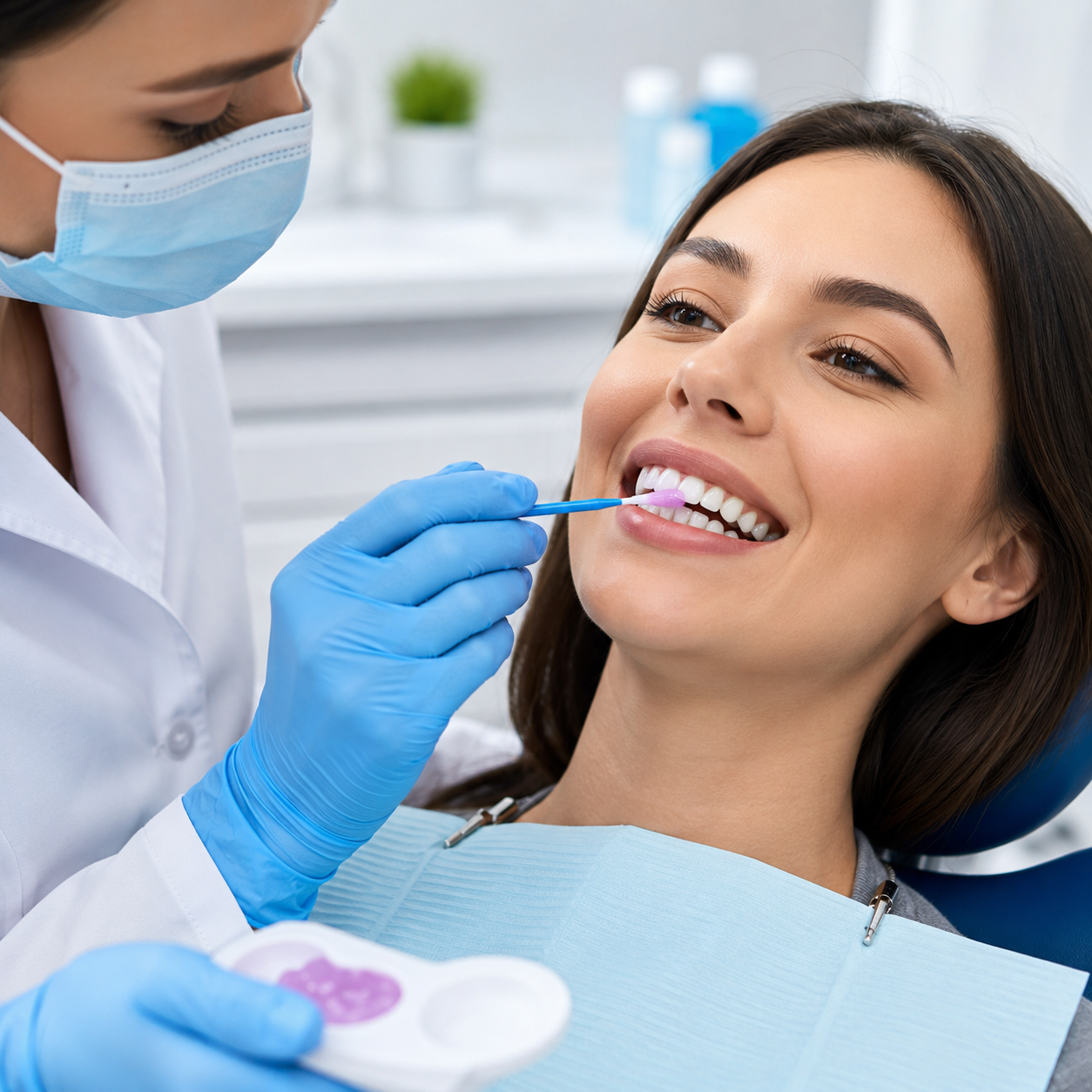
At Arasu Dental Care, a fluoride treatment is a five-minute application that coats your teeth with a concentrated varnish — hardening the enamel, slowing the bacteria that cause decay, and even reversing the earliest stage of a cavity before it ever needs drilling or a filling. Research on children and adolescents found those who received professional fluoride treatments over a year were around 43% less likely to develop tooth decay. It's one of the most useful appointments for kids with newly erupted teeth — and one of the most overlooked for cavity-prone adults.
Open all seven days, 10:00 AM – 8:30 PM · R.S. Puram +91 88380 22157 · Saibaba Colony +91 74491 88777
Due for a check-up anyway? A fluoride application takes only a few extra minutes at the end of a routine cleaning — the cheapest reinforcement your enamel will ever get. Book today, open all 7 days. R.S. Puram: +91 88380 22157 · Saibaba Colony: +91 74491 88777
Where To Start
Fluoride toothpaste already protects most healthy adults reasonably well — and we'll tell you plainly if that's all you need. A professional in-clinic treatment uses a far more concentrated fluoride, and it earns its place when your decay risk is higher than average. In our experience, that usually means one of these:
Children & teenagers — newly erupted teeth have softer enamel that fluoride strengthens as it matures. Applied 2–4 times a year, varnish prevents roughly a third of cavities in baby teeth.
A history of cavities — if you've needed fillings in the last two or three years, your decay risk is demonstrably real, and fluoride is the cheapest way to lower it.
Receding gums or exposed roots — root surfaces have no enamel and decay faster; fluoride protects them and calms the sensitivity that comes with recession.
Dry mouth — from medications, diabetes or age. Less saliva means less natural repair of enamel, so decay accelerates without added protection.
Braces or aligner attachments — brackets create plaque traps; fluoride guards the enamel around them so treatment doesn't finish with white spots.
Early white-spot lesions — the first visible stage of decay. Caught here, fluoride can remineralise the spot and the tooth may never need a filling.
If none of these describes you, a fluoride treatment won't harm you — but we'd rather you spend that money on a routine dental check-up and a professional cleaning, which do more for a low-risk mouth. We assess your risk honestly at your visit and recommend accordingly — that's the point of prevention done right.
What To Expect
This is among the gentlest procedures in dentistry — no injections, no drilling, no recovery time. Here is the whole visit.
STEP 1
Fluoride bonds most effectively to a clean, dry surface, so we usually pair the application with scaling and polishing — or apply it right after your regular cleaning.
STEP 2
For most patients — and for every child — we use a fluoride varnish, brushed onto each tooth in under five minutes. Varnish sets on contact with saliva, which is why it has the strongest safety record for children: there's nothing to swallow. Gel or foam in a soft tray is an option for some adults.
STEP 3
The varnish keeps working on the enamel for the next several hours. You'll feel a slightly sticky coating and may notice a temporary dull tint — both disappear within a day.
Aftercare
Your Recall
It depends entirely on your cavity risk — there is no one-size answer, and anyone selling you a fixed schedule without examining you is guessing. Professional guidelines, including the American Dental Association's, recommend an application every 3, 6, or 12 months based on individual risk.
Active decay, dry mouth, braces, or frequent snacking — usually timed with your cleaning visits.
Occasional cavities or early gum recession — the standard preventive rhythm for most at-risk adults.
No cavities in years and good home care — we'll tell you honestly if you genuinely don't need it.
For children, we typically recommend applications at the ages when new teeth are erupting — around 6, 9 and 12 — alongside their regular kids' dental check-ups, so freshly erupted permanent teeth get protected as they arrive. Our pediatric team folds fluoride into the routine visit so it never feels like an extra appointment.
Straight Answers
We'd rather give you the full picture than an inflated one — here's what fluoride can and can't do.
It can strengthen enamel and reverse the earliest white-spot stage of decay — it cannot fix an established cavity. If decay has already broken through the enamel, you need a filling, and fluoride afterwards helps protect the rest of your teeth. We'll always tell you which side of that line you're on.
A varnish four times a year cannot outwork poor daily habits. Twice-daily brushing with fluoride toothpaste and sensible snacking remain the foundation; professional fluoride is the reinforcement layer on top.
Fluorosis — faint white marking on teeth — is linked to chronic over-ingestion of fluoride in early childhood (typically swallowed toothpaste or high-fluoride water over years), not to measured, professionally applied varnish. The doses we use are set by age and applied to the teeth, not swallowed; varnish sets within seconds. Applied by a dentist, fluoride treatment is regarded by bodies worldwide — including the Indian Dental Association — as one of the safest preventive measures in dentistry. Mild, brief nausea is possible if gel is swallowed, one more reason we default to varnish for children.
How much fluoride helps depends on your diet, home care, saliva flow, and how consistently you return for applications — fluoride lowers risk, it does not eliminate it. We'll give you a realistic picture at your consultation.
Cost
Fluoride application is one of the least expensive procedures in dentistry — deliberately so, because its whole point is to save you the cost of fillings, root canals and crowns later. What you pay depends mainly on the form used (varnish, gel or foam), whether it's applied on its own or added to a cleaning visit, the number of sittings your risk calls for, and whether it's part of a child's routine preventive visit.
| Service | Price at Arasu Dental Care | Notes |
|---|---|---|
| Fluoride varnish application (per sitting) | ₹[to be verified] | Most common option; default for children |
| Fluoride application added to a cleaning visit | ₹[to be verified] | Applied after scaling & polishing — costs less overall |
| Child fluoride application (with kids' check-up) | ₹[to be verified] | Part of routine pediatric preventive care |
Want an exact figure for your case?Call and we'll tell you the price over the phone. R.S. Puram +91 88380 22157 · Saibaba Colony +91 74491 88777.
Get Started
Tell us a little about who it's for and pick a time that suits you. A fluoride application is a five-minute add-on to a check-up or cleaning — evening and weekend slots are available at both branches.
Prevention today is the cheapest dentistry there is.
Why Arasu
Prevention is where our all-under-one-roof model quietly pays off. The dentist applying your fluoride is part of the same team that sees the consequences of skipping it — our endodontist handles the root canals, our pediatric team sees children from their first tooth, and our periodontist treats the receding gums that make adult fluoride worthwhile. That means our recommendations come from your actual risk assessment, not from a package we're trying to sell.
Flavoured varnish, a few minutes in the chair, and a positive early experience of the dentist that pays off for years.
Fluoride is advised from your risk assessment, not a package — low-risk patients are told when they don't need it.
Endodontist, periodontist and pediatric team on one team — prevention informed by the people who treat what it prevents.
10:00 AM – 8:30 PM at both branches, so a fluoride visit fits around school and work instead of interrupting them.
Confirmed before treatment begins — every figure is agreed with you first, part of our broader preventive dentistry practice.
A trusted unit of the Arasu Medicals Group, caring for Coimbatore families across two central branches.
Book a fluoride treatment in Coimbatore
R.S. Puram: 129, W Sambandam Road, Coimbatore 641002 · +91 88380 22157 · Saibaba Colony: 160, NSR Road, Coimbatore 641011 · +91 74491 88777. Open 10:00 AM – 8:30 PM · WhatsApp +91 96007 56297.
Patient Reviews
Took my 7-year-old for his first fluoride varnish. The flavour won him over and it was done in minutes — no fuss, no tears. They explained the 4-6 hour no-brushing bit clearly.
I'm cavity-prone and have some gum recession. They actually talked me through why fluoride made sense for me rather than just adding it. Sensitivity on my exposed roots has eased.
Honest clinic. I asked for fluoride and the dentist said with my record I didn't really need it and to just keep up my cleanings. Rare to be talked out of spending money.
Added the fluoride at the end of my regular scaling on a Sunday evening. Whole thing quick and the price was told upfront. My braces make cleaning hard so this gives peace of mind.

FAQs
No. There are no injections and no drilling — the fluoride is simply painted onto the teeth or held briefly in a soft tray. Most children find the flavoured varnish completely unremarkable, which is exactly what we want their early dental visits to be.
Yes, when applied by a dentist in measured, age-appropriate doses. We use varnish for children because it sets on the teeth within seconds, so there is virtually nothing to swallow. The fluorosis parents worry about is linked to years of over-ingestion in early childhood — not to supervised clinical application.
For a low-risk adult with no recent cavities — often not, and we'll say so. Professional fluoride is many times more concentrated than toothpaste and earns its place when your decay risk is elevated: recent fillings, dry mouth, receding gums, braces, or early white spots.
You can eat soft foods and drink cool liquids straight away. Avoid brushing and flossing for 4–6 hours, and skip very hot drinks, hard or sticky foods, and alcohol-based mouthwash for the rest of the day so the varnish can do its work.
Every 3, 6, or 12 months depending on your cavity risk — professional guidelines tie the interval to individual risk rather than a fixed schedule. We'll assess yours at a check-up and time applications with your regular cleaning visits.
Only at the earliest stage. A white-spot lesion — decay that hasn't yet broken the enamel surface — can often be remineralised with fluoride. Once a true cavity has formed, the tooth needs a filling; fluoride then helps protect your remaining teeth.
Book a fluoride treatment at Arasu Dental Care
A concentrated fluoride varnish and an honest read on whether you need it, from a multispecialty team that treats what prevention protects. Open 10 AM – 8:30 PM, all seven days · WhatsApp +91 96007 56297.