Caught early, decay is a small fix — we treat it at every stage
Tooth Decay and Cavity Treatment in Coimbatore
At Arasu Dental Care, we stop tooth decay at whatever stage we find it — and the earlier that is, the more of your natural tooth you keep. A chalky white spot can often be strengthened without drilling at all; a small cavity is closed with a tooth-coloured filling in a single visit; and even a tooth where decay has reached the nerve can usually still be saved by our endodontist rather than removed. What we treat depends entirely on how far the decay has travelled, which is why the first step is always a proper examination, not a fixed procedure.
Decay is not a rare problem or a hygiene failure to be embarrassed about: research across India finds that more than half the population has dental caries, and by the 35–44 age group that rises to nearly eight in ten adults. What sets outcomes apart is not whether decay happens — it's how early it gets treated. Most cavities in India go untreated until they hurt, and by then the simple, inexpensive fix has usually become a bigger one.
Open all seven days, 10:00 AM – 8:30 PM · R.S. Puram +91 88380 22157 · Saibaba Colony +91 74491 88777
Medically reviewed by Dr. L.S. Priyanka (General Dentistry) · Last reviewed July 2026
Noticed a dark spot, sensitivity, or food catching in a tooth? Call our R.S. Puram branch on +91 88380 22157 or Saibaba Colony on +91 74491 88777 — we're open every day, 10:00 AM to 8:30 PM.
Spot it before it hurts
How do I know if I have tooth decay?
Decay is quiet in its early stages — the point at which treatment is simplest is also the point at which most people feel nothing. That's why we ask patients not to wait for pain. Which of these sounds like you?
The signs, from earliest to most urgent
- A chalky white or brown patch on a tooth that doesn't brush away — often the earliest visible stage, and frequently still reversible without drilling.
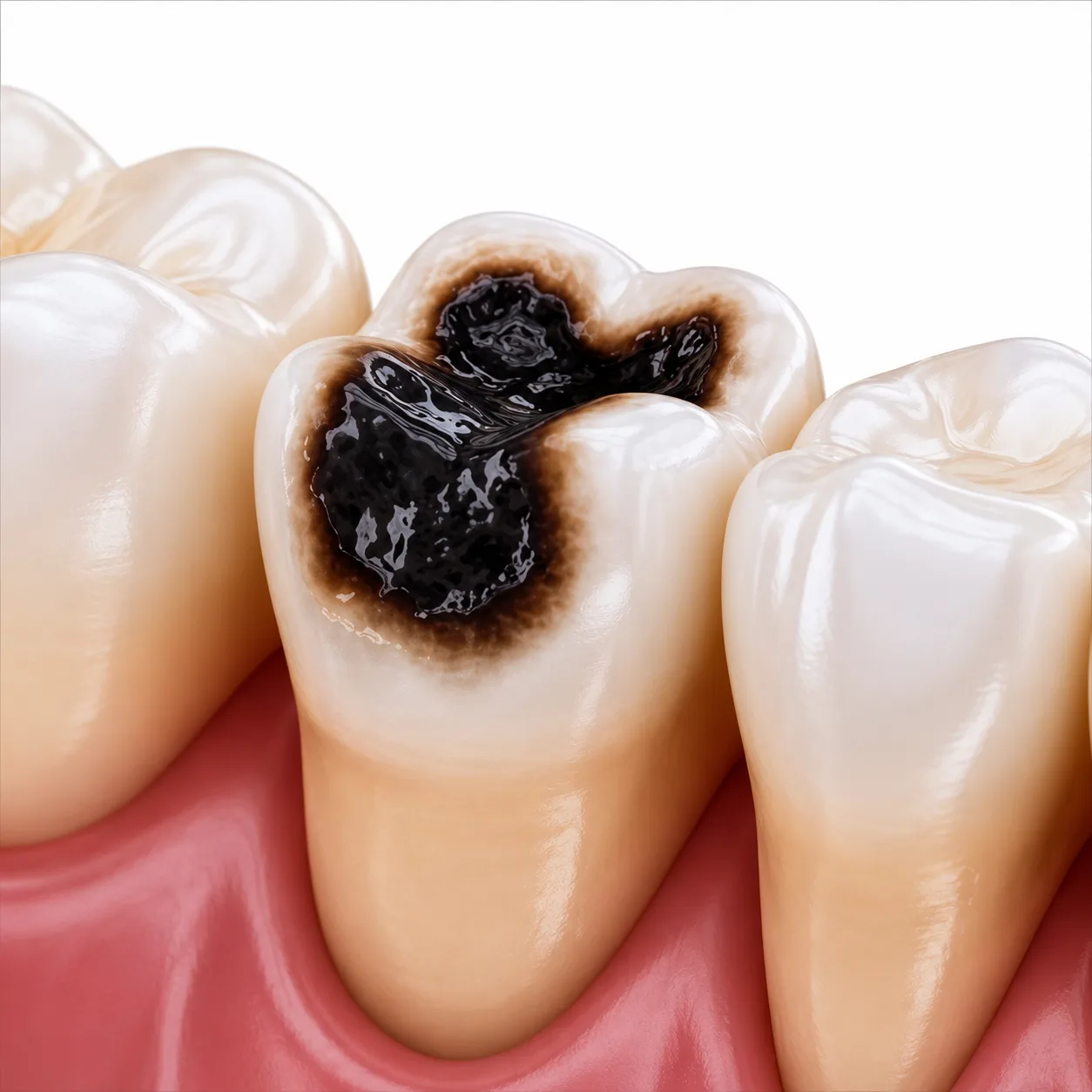
- A visible dark spot, pit, or hole, or a rough edge your tongue keeps finding — the enamel has broken and a cavity has formed.
- Sensitivity to sweets, cold, or hot — a sign the decay has passed the enamel into the softer dentin underneath.
- Food repeatedly catching in the same tooth, or floss shredding at one spot between two teeth.
- Throbbing or lingering pain, a bad taste, or swelling — decay has likely reached the nerve, and the tooth needs attention promptly if it's to be saved.
Cavity treatment in Coimbatore, matched to the stage
What we do about tooth decay — treatment at every stage
There is no single "cavity treatment." At Arasu Dental Care, the treatment is matched to the depth of the decay, and our aim at every stage is the same: remove the disease, keep the maximum natural tooth, and stop you from sliding to the next rung. Here's the full ladder, from least to most involved.
| Stage of decay | What you'd notice | Treatment at Arasu | Typical visits |
|---|---|---|---|
| Early enamel decay (white spot) | Chalky white/brown patch, no hole, no pain | Professional fluoride application + remineralisation plan — often no drilling | 1 |
| Cavity in enamel/dentin | Visible hole, food catching, sensitivity to sweets or cold | Tooth-coloured (composite/GIC) filling | 1 |
| Deep decay near or into the nerve | Lingering pain, hot/cold sensitivity that stays, night pain | Root canal treatment, usually followed by a crown | 1–3 |
| Tooth too broken down to restore | Fractured shell, abscess, loose remnant | Extraction — as the last resort — with replacement options planned before removal | 1+ |
Early decay: strengthening the tooth before it needs a filling
White-spot stage — often no drilling at all
When we catch decay at the white-spot stage, the enamel is demineralised but not yet broken. At this stage we can often arrest it entirely: a professional fluoride application concentrates minerals back into the weakened surface, and we pair it with specific home-care and diet guidance targeted at the spot we found. This is the one stage of decay that can genuinely be reversed — which is exactly why our dentists photograph and monitor these lesions at your routine dental check-ups rather than rushing to drill a tooth that may not need it.
A formed cavity: a tooth-coloured filling in one visit
Visible hole in enamel or dentin — one visit, roughly 30–45 minutes
Once the enamel has cavitated, no amount of fluoride or brushing will close the hole — the decayed portion has to be cleaned out and the tooth restored. Our dentists do this with a tooth-coloured filling matched to your tooth shade, placed under local anaesthesia in a single visit of roughly 30–45 minutes. You chew on it the same day. Composite fillings typically last around 7–10 years with normal care, and the smaller the cavity when we fill it, the longer the restoration tends to survive — one more reason early treatment is the economical choice, not just the comfortable one.
Decay at the nerve: root canal treatment instead of losing the tooth
Infection inside the root — the tooth can usually still be saved
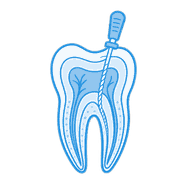
If decay reaches the pulp — the nerve and blood supply inside the tooth — a filling alone can't fix it, because the infection is now inside the root. This is where many patients assume the tooth is finished. Usually it isn't. Our endodontist, who has performed over 1,000 root canal procedures, cleans and seals the root canals so you keep the natural tooth; across modern practice, root canal treatment succeeds in around 95% of cases. A back tooth treated this way is then protected with a dental crown (a tooth cap), which restores full chewing strength and guards the treated tooth against fracture.
When a tooth truly can't be saved
Extraction as the last resort — with the replacement planned first
Occasionally decay is found so late that too little sound tooth remains to restore. We'll tell you that honestly rather than attempt a restoration we don't expect to last. In those cases the tooth is removed under appropriate anaesthesia, and — importantly — we plan the replacement before the extraction, so a gap doesn't quietly become a bite problem. Because Arasu is a multispecialty clinic, the implantologist or prosthodontist who will replace the tooth is under the same roof as the surgeon who removes it.
Dr. L.S. Priyanka
General Dentist
Handles the deep-decay end of the ladder — root canal treatment where decay has reached the nerve — with over 1,000 root canal procedures behind her. View profile
Children's Dentistry Lead
Leads children's cavity care across both branches — child-appropriate fillings, gentle behaviour management and pulp therapy for milk teeth. View profile
Straight talk
Can tooth decay be reversed or heal on its own?
This deserves a straight answer, because a lot of what you'll read online blurs it. Only the earliest stage of decay — before a hole forms — can be reversed. Demineralised enamel can re-harden with fluoride and disciplined home care. But once a cavity has physically formed, the tooth cannot regrow that structure, and no remedy, rinse, or supplement will close it. From that point the honest framing is: decay is removed and the tooth restored — and your future risk is then managed with prevention. Anyone promising to dissolve or heal an established cavity without treatment is selling you time for the decay to deepen.
Two more things we'd rather you hear from us plainly. First, a filled tooth is not immune — decay can start again at the margins of any restoration if the original habits continue, which is why we treat the cavity and the cause. Second, treatment gets more involved the longer you wait, on a fairly predictable path: a spot that needed fluoride becomes a filling, a filling-sized cavity becomes a root canal, and a root-canal-sized infection can end in extraction.
Untreated decay far outnumbers treated decay in India. Indian oral-health surveys consistently find that most cavities go untreated until they hurt — the pattern we're trying to break with every early appointment.
Milk teeth matter
Tooth decay in children — treat it, don't wait it out
Roughly half of Indian five-year-olds already have tooth decay, and milk teeth decay faster than adult teeth because their enamel is thinner. "It will fall out anyway" is the most expensive myth in children's dentistry: an untreated cavity in a milk tooth can cause pain, infection, and early loss that lets neighbouring teeth drift into the space meant for the adult tooth. Our pediatric dentistry team handles children's cavities with child-appropriate fillings, gentle behaviour management, and — where decay has reached the nerve of a milk tooth — pulp therapy that keeps the tooth in place until it's naturally ready to go.
About half of Indian five-year-olds already have decay — which is why we'd rather see a child for a small filling today than for a painful infection later. National pediatric caries data; individual risk varies.
Tooth decay treatment cost
What does tooth decay treatment cost in Coimbatore?
Because the treatment depends on the stage, so does the cost — which is the single strongest financial argument for coming in early. Here is how the ranges work at Arasu Dental Care. Every patient receives an exact written estimate after examination, before any treatment begins; prices are subject to individual consultation.
| Item | Range at Arasu Dental Care | Notes |
|---|---|---|
| Consultation | ₹300 – ₹500 | Adjusted against treatment where applicable |
| IOPA X-ray (single tooth) | ₹200 – ₹300 | Taken when depth of decay needs confirming |
| Fluoride application (early decay) | Quoted after assessment | Depends on the number of teeth being treated |
| Tooth-coloured filling (per tooth) | ₹800 – ₹5,000 | Varies by material and cavity size |
| Root canal treatment (per tooth) | ₹5,000 – ₹7,000 | Anterior/premolar/molar ₹5,000–₹6,500; wisdom tooth ₹5,500–₹7,000 |
| Crown after root canal | ₹4,000 – ₹15,000 | By material — confirmed in your written estimate |
| Children's filling / pulp therapy | Quoted after assessment | Depends on the tooth and the stage of decay |
Payment: we accept cash, UPI, cards and net banking, and EMI options are available for larger treatment plans. What you're quoted is what you pay — the estimate lists exactly what's included.
Want a firm number for your tooth?A consultation and X-ray will tell us the stage — and the estimate — in one short visit. Call +91 88380 22157 (R.S. Puram) or +91 74491 88777 (Saibaba Colony).
Book a consultationWhy Arasu
Why treat tooth decay at Arasu Dental Care?
Most clinics can fill a cavity. What matters is what happens when your case isn't the simple one — when the spot doesn't need drilling yet, or the decay has gone deeper than a filling can fix.
Monitored, not over-treated
Our dentists photograph and monitor early lesions rather than over-treat them — a spot that can still be arrested with fluoride isn't drilled just because it's visible.
An endodontist for the deep end
Where decay has reached the nerve, your tooth is treated by an endodontist with over 1,000 root canal procedures behind her — not passed to whoever is free.
A pediatric team for children's cavities
Children's decay is handled by our pediatric dentistry team with child-appropriate fillings and gentle behaviour management.
The full ladder in-house
Implant and prosthodontic specialists are on hand for the rare occasions a tooth can't be saved — you move between stages without changing clinics, and the specialist treating you is on our doctors page.
We've served Coimbatore families from our R.S. Puram and Saibaba Colony branches since 2017, and we're open every single day until 8:30 PM — because decay doesn't check your work schedule before it starts hurting.
Book your examination
Two branches, open all seven days
R.S. Puram — 129 W Sambandam Road, +91 88380 22157 · Saibaba Colony — 160 NSR Road, +91 74491 88777 · Open Monday to Sunday, 10:00 AM – 8:30 PM · WhatsApp +91 96007 56297.
FAQs
Frequently asked questions about tooth decay treatment
The area is numbed with local anaesthesia before we begin, so the filling itself is comfortable — most patients say the injection pinch is the only thing they feel. Any post-treatment sensitivity typically settles within a few days.
No. Better brushing and fluoride can reverse decay only at the earliest white-spot stage, before a hole forms. Once the enamel has cavitated, the tooth cannot regrow the lost structure — the decay must be removed and the tooth filled.
Yes — and sooner is genuinely better. Decay is usually painless until it nears the nerve, so "no pain" only means it hasn't gone deep yet. Treating a painless cavity means a small filling; waiting for pain often means a root canal.
It follows a predictable path: the cavity deepens into the dentin, sensitivity begins, the decay reaches the nerve and infects it, and the tooth may abscess. Each step makes treatment longer and more expensive — a filling becomes a root canal, and a root canal delayed can become an extraction.
Composite fillings typically last around 7–10 years with normal care; longevity varies with cavity size, tooth position, bite forces and home care. Small, early fillings generally outlast large, late ones.
At Arasu Dental Care, tooth-coloured fillings range from about ₹800 to ₹5,000 per tooth depending on material and cavity size, and root canal treatment ranges ₹5,000–₹7,000 where decay has reached the nerve, plus a ₹300–₹500 consultation. You receive an exact written estimate after examination.
Not unless the tooth is genuinely about to exfoliate. Decay progresses faster in milk teeth, and an untreated cavity risks pain, infection, and early loss that disturbs the alignment of the adult tooth coming behind it. Children's cavities are treated by our pediatric team.
Filled teeth can decay again at the edges if habits don't change, so we pair every restoration with targeted prevention: brushing technique, fluoride where your risk warrants it, diet timing (frequency of sugar matters more than quantity), and a check-up every six months so anything new is caught at the reversible stage.
Medical disclaimer: this page is general information, not a diagnosis. Statistics reflect published dental research, not a promise of individual outcomes — results vary. Please consult our dentists for a personalised assessment.
The earlier we see it, the smaller the fix
One consultation tells you the stage, the treatment and the exact cost
Examination, X-ray if needed, and a written estimate — before any treatment begins. Open Monday to Sunday, 10:00 AM – 8:30 PM · WhatsApp +91 96007 56297.
R.S. Puram (main branch)
Saibaba Colony
More From Arasu