Dental Bridge vs Dental Implant
Losing a tooth can feel unsettling — not just because of how it looks, but because of how it affects your eating, speaking, and confidence. If you’re weighing a dental bridge vs dental implant, you’re already taking the right first step: understanding your options before making a decision.
Both treatments are proven, reliable ways to replace a missing tooth. But they work very differently, suit different situations, and come with different timelines, costs, and long-term outcomes. At Arasu Dental Care, our specialists help patients understand all available options so they can choose the treatment that genuinely fits their needs — never the other way around.
In this guide, we’ll walk you through how each option works, their pros and cons, and the practical factors that help you and your dentist decide which is best for you.
What Is a Dental Bridge?
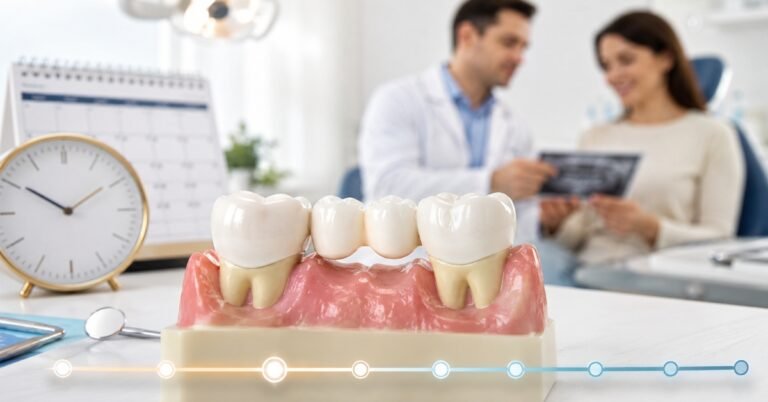
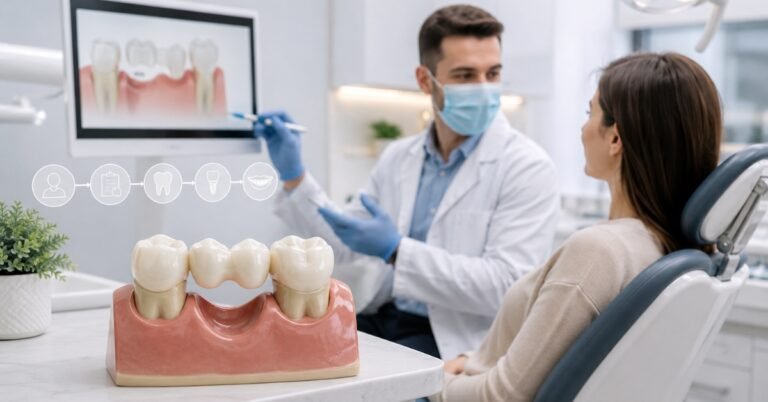
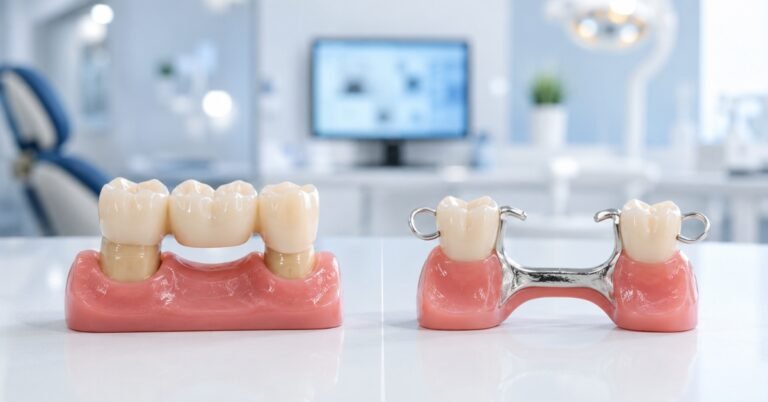
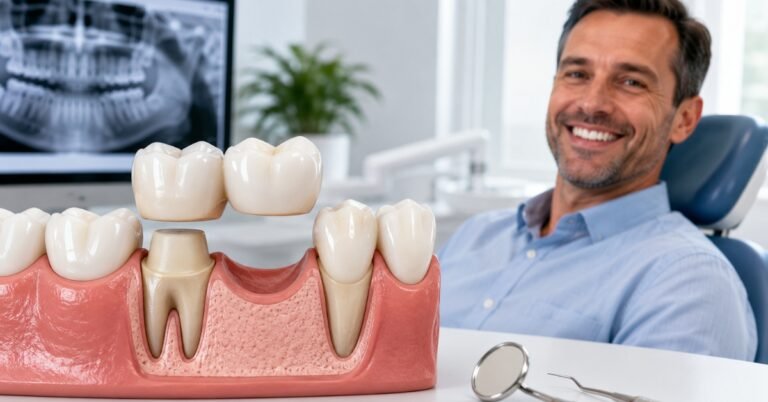
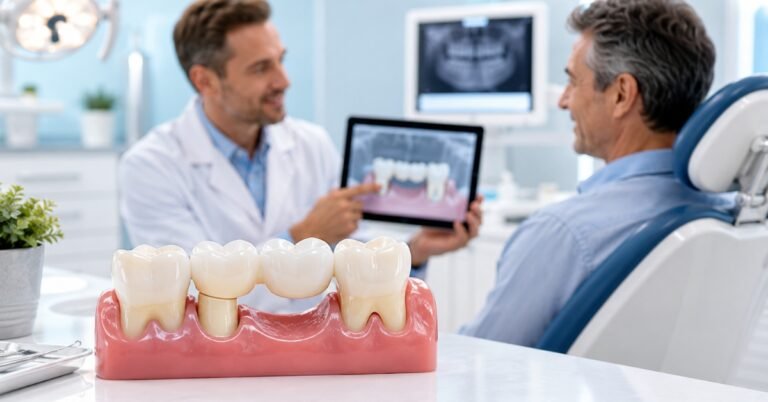
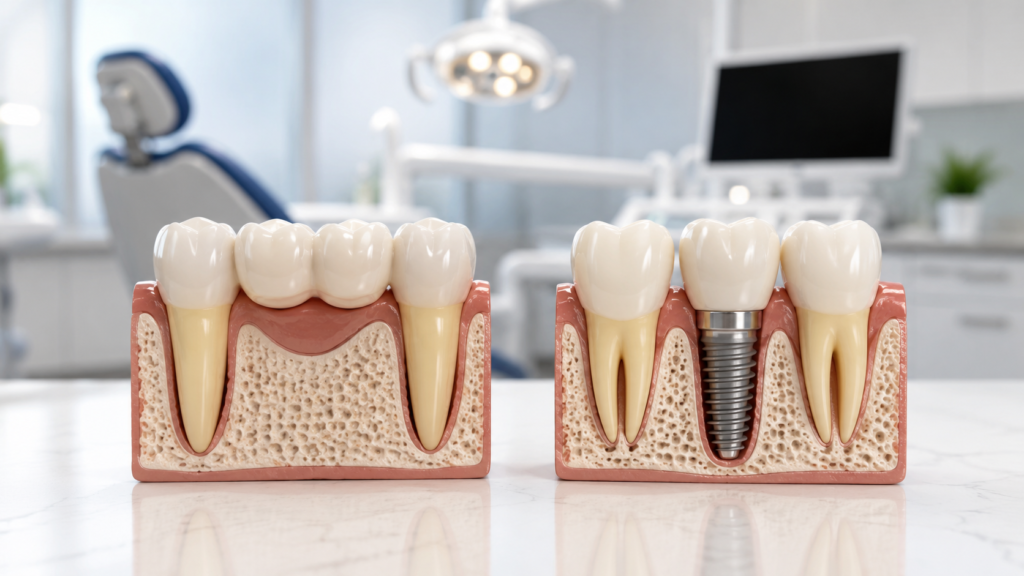
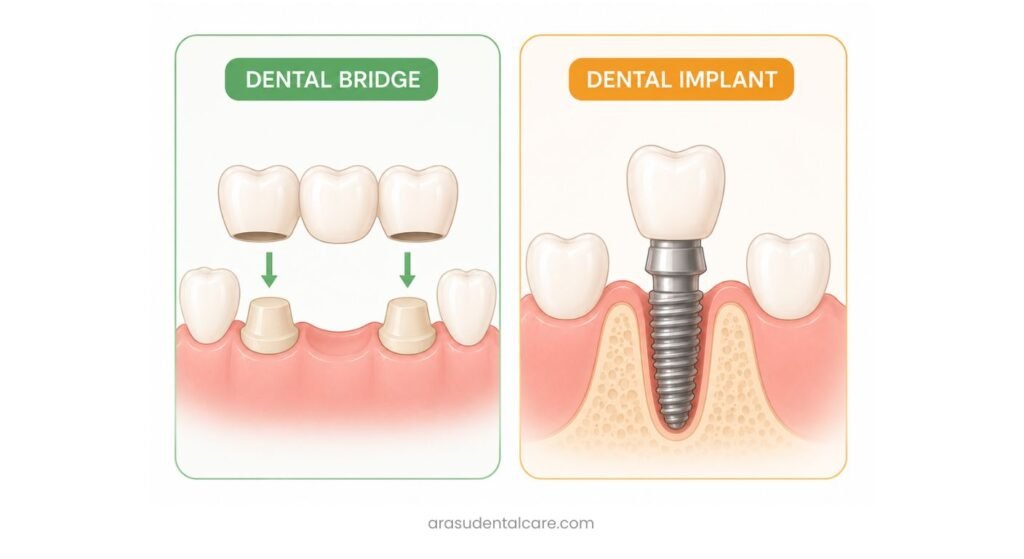
A dental bridge “bridges” the gap left by one or more missing teeth. It uses the natural teeth on either side of the gap (called abutment teeth) as support, with one or more artificial teeth (called pontics) filling the space in between.
To place a traditional bridge, the dentist reshapes the two neighbouring teeth so that crowns can be fitted over them. These crowns anchor the false tooth securely in place.
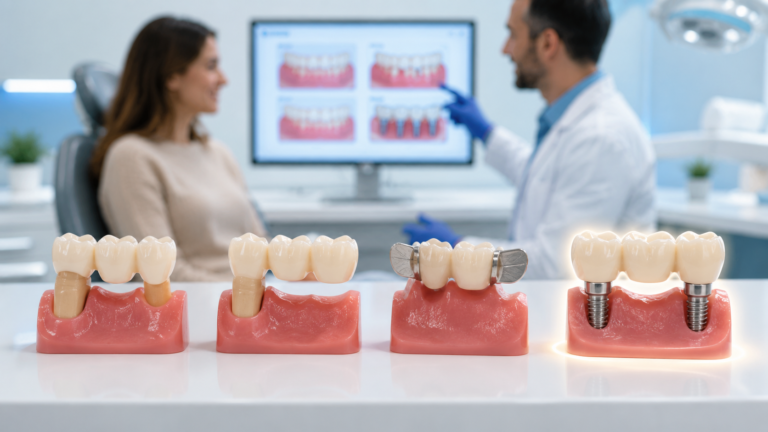
Common Types of Dental Bridges
- Traditional bridge — crowns on both adjacent teeth hold the false tooth. The most widely used type.
- Cantilever bridge — supported by a tooth on only one side; used in specific situations.
- Maryland bridge — uses a metal or porcelain framework bonded to the back of adjacent teeth, requiring minimal reshaping.
- Implant-supported bridge — held by implants rather than natural teeth, ideal for replacing several missing teeth in a row.
A bridge typically requires only two visits over a couple of weeks, making it a quicker solution for many patients.
What Is a Dental Implant?
A dental implant in coimbatore replaces the entire missing tooth — including the root. A small titanium post is gently placed into the jawbone under appropriate anesthesia. Over the following months, the bone naturally fuses around the post in a process called osseointegration, creating a strong, stable foundation.
Once healing is complete, a custom crown is attached on top. The result looks, feels, and functions remarkably like a natural tooth.
Because the implant stimulates the jawbone the way a natural root does, it helps preserve bone over time — an advantage that bridges cannot offer. According to the American Academy of Periodontology, implants are designed to be a long-term solution when patients have healthy gums and adequate bone support.
Dental Bridge vs Dental Implant: Quick Comparison
|
Feature |
Dental Bridge |
Dental Implant |
|
What it replaces |
The crown only (supported by adjacent teeth) |
Entire tooth, including the root |
|
Adjacent teeth |
Need to be reshaped/trimmed |
Left untouched and healthy |
|
Procedure time |
1–2 weeks (two visits) |
3–6 months (includes healing) |
|
Durability |
Typically 10–15 years |
Can last a lifetime with proper care |
|
Jawbone health |
Does not prevent bone loss |
Preserves and stimulates jawbone |
|
Surgery needed |
No surgery |
Minor surgical procedure |
|
Cleaning |
Slightly harder (special floss needed) |
Cleaned like a natural tooth |
|
Upfront cost |
Lower |
Higher |
Pros and Cons of Dental Bridges
Understanding the trade-offs helps you make a confident, informed decision.
Advantages of Dental Bridges
- Faster treatment — usually completed in two visits over a couple of weeks.
- No surgery required — a good option for patients who prefer to avoid a surgical procedure.
- Lower upfront cost — more budget-friendly initially.
- No bone grafting needed — suitable even when some bone loss is present.
- Predictable, well-established outcome — bridges have been used successfully for decades.
Drawbacks of Dental Bridges
- Affects healthy teeth — adjacent teeth must be reshaped, which permanently alters them.
- Shorter lifespan — usually needs replacement after 10–15 years.
- Doesn’t prevent bone loss — the jawbone beneath the gap can gradually shrink.
- Cleaning challenges — the connected teeth require extra care to avoid decay around the supports.
Pros and Cons of Dental Implants
Advantages of Dental Implants
- Long-lasting — with good care, an implant can last a lifetime.
- Natural look and feel — closely mimics a real tooth in both appearance and function.
- Protects neighbouring teeth — no reshaping of healthy adjacent teeth.
- Preserves jawbone — stimulates bone and helps maintain facial structure.
- No cavities on the implant — though gum health around it must still be maintained.
Drawbacks of Dental Implants
- Minor surgery required — performed comfortably under appropriate anesthesia.
- Longer timeline — healing and osseointegration can take a few months.
- Higher upfront cost — though often more cost-effective over the long term.
- Requires adequate bone — patients with significant bone loss may need bone grafting first.
Procedure: What to Expect Step by Step
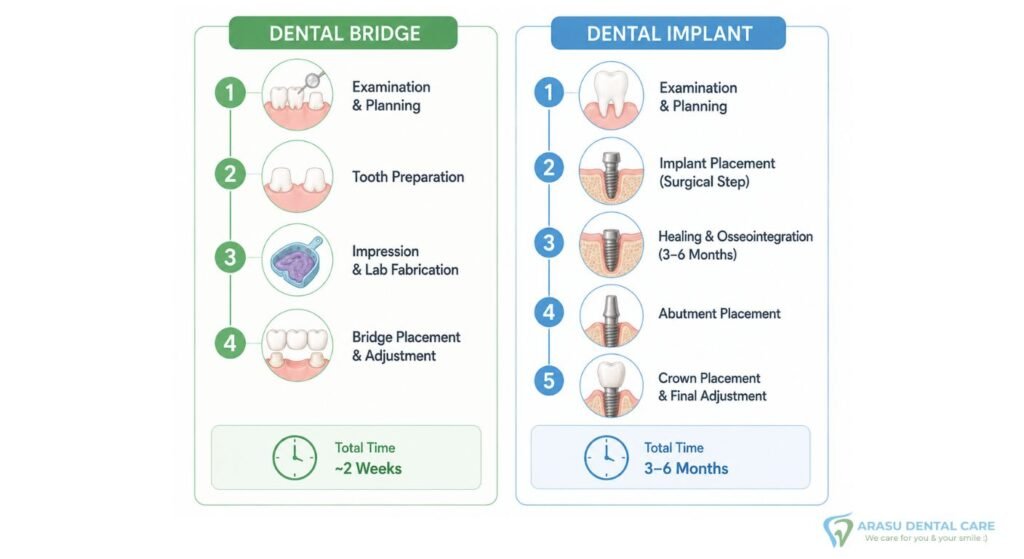
How a Dental Bridge Is Placed
- Examination and imaging — your dentist evaluates the gap and the supporting teeth.
- Preparation of adjacent teeth — the neighbouring teeth are reshaped to fit crowns.
- Impressions — a mould is taken so the bridge matches your natural teeth.
- Temporary bridge — placed while your permanent bridge is being crafted.
- Final fitting — the permanent bridge is cemented and your bite is checked for comfort.
How a Dental Implant Is Placed
- Consultation and 3D imaging — bone quality and quantity are assessed.
- Implant placement — the titanium post is positioned into the jawbone under local anesthesia.
- Healing (osseointegration) — the bone fuses with the implant over 2–6 months.
- Abutment placement — a connector is attached to support the crown.
- Crown fitting — a custom crown is secured, completing your new tooth.
How to Choose Between a Bridge and an Implant
There’s no single “best” answer — the right choice depends on your individual situation. Here are the key factors our specialists discuss with every patient.
Your Oral and Overall Health
If you have healthy gums and enough jawbone, you may be an excellent candidate for an implant. Patients with conditions that slow healing — such as poorly controlled diabetes — should discuss suitability carefully with their dentist. The National Institute of Dental and Craniofacial Research offers helpful background on how oral health connects to overall wellbeing.
Number of Missing Teeth
For several missing teeth in a row, a bridge or an implant-supported bridge may be practical. For preserving long-term bone health, implants often have the edge.
Time and Convenience
If you want a quicker result without surgery, a bridge may suit you. If you’re comfortable with a longer process for a longer-lasting outcome, an implant is worth considering.
Budget — Short-Term vs Long-Term
A bridge costs less upfront, but may need replacing over the years. An implant costs more initially but can be more economical across your lifetime. At Arasu Dental Care, we believe in transparent pricing, so you’ll understand the full picture with no hidden surprises.
Adjacent Teeth
If the teeth beside the gap are already weak or need crowns, a bridge can address both at once. If they’re perfectly healthy, an implant lets you keep them untouched.
A Real-World Perspective From Our Clinic
Many patients who visit us are initially drawn to a bridge purely because of the lower upfront cost. After a complete evaluation, we explain how their jawbone health, age, and the condition of neighbouring teeth all factor in.
For a younger patient with healthy adjacent teeth, we’ll often explain why an implant may protect those teeth and offer better long-term value. For someone who prefers to avoid surgery or needs a faster solution, a well-made bridge can be an excellent, comfortable choice.
The goal is always the same: helping you make an informed decision that fits your life — not selling a procedure.
Frequently Asked Questions
1. Which lasts longer — a bridge or an implant?Dental implants generally last longer and can serve a lifetime with proper care. Bridges typically last 10–15 years before needing replacement.
2. Is getting a dental implant painful?It’s a minor surgical procedure performed under appropriate anesthesia, so most patients feel comfortable during treatment. Mild discomfort afterward is usually well managed with simple care.
3. Do implants look more natural than bridges?Yes. Because an implant replaces the entire tooth from root to crown, it closely mimics a natural tooth in both look and feel.
4. Can I get a bridge if I’ve lost bone in my jaw?Often, yes — bridges don’t rely on jawbone for support, which is why they can be suitable when bone loss is present and an implant would otherwise require grafting.
5. Why do bridges affect the neighbouring teeth?A traditional bridge requires reshaping the adjacent teeth so crowns can be fitted over them, which permanently alters those healthy teeth.
6. Does a dental implant prevent bone loss?Yes. The implant stimulates the jawbone the way a natural root does, helping preserve bone and maintain facial structure over time.
7. How long is the dental implant process?From placement to the final crown, it typically takes 3–6 months to allow the bone to fuse securely with the implant.
8. Which option is more affordable?A bridge usually has a lower upfront cost, while an implant may be more cost-effective over the long term due to its durability. Our team will explain both clearly so you can plan with confidence.
9. Can a bridge or implant replace more than one tooth?Yes. Bridges can replace several teeth in a row, and implant-supported bridges can restore multiple missing teeth with excellent stability.
The Bottom Line
Both dental bridges and dental implants are reliable, well-established ways to restore your smile, your bite, and your confidence. A bridge offers a faster, lower-cost, surgery-free path, while an implant provides a longer-lasting, natural-feeling solution that protects your bone and neighbouring teeth.
The best choice always depends on your unique oral health, your priorities, and a thorough professional assessment.
Ready to Restore Your Smile With Confidence?
At Arasu Dental Care, Coimbatore, our experienced implantologists and prosthodontists will evaluate your condition, explain every option in clear, simple terms, and help you choose the treatment that’s right for you — with transparent pricing and comfortable, patient-first care.
📍 Visit us at R.S. Puram or Saibaba Colony — open all seven days, 10:00 AM – 8:30 PM.📞 Call us at +91 88380 22157 or WhatsApp +91 96007 56297 to book your consultation today.
We Care for You and Your Smile.