Why Choose Dental Implants for Missing Teeth?
If you’re living with one or more missing teeth, you’ve probably already noticed how much it affects your daily life — from chewing your favourite foods to feeling confident when you smile. The good news is that dental implants for missing teeth offer a long-term, natural-looking solution that can restore both your smile and your confidence.
At Arasu Dental Care, we believe the best decisions come from understanding your options clearly. So in this guide, we’ll walk you through what dental implants are, why so many patients choose them over other treatments, and what you can realistically expect — all explained in simple, honest terms.
What Are Dental Implants?
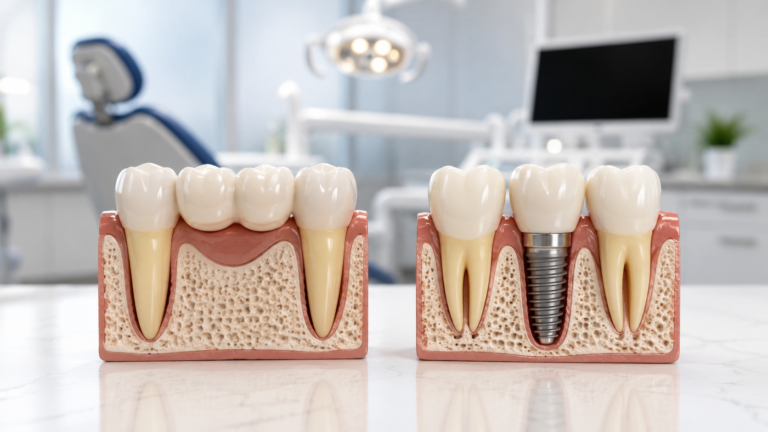
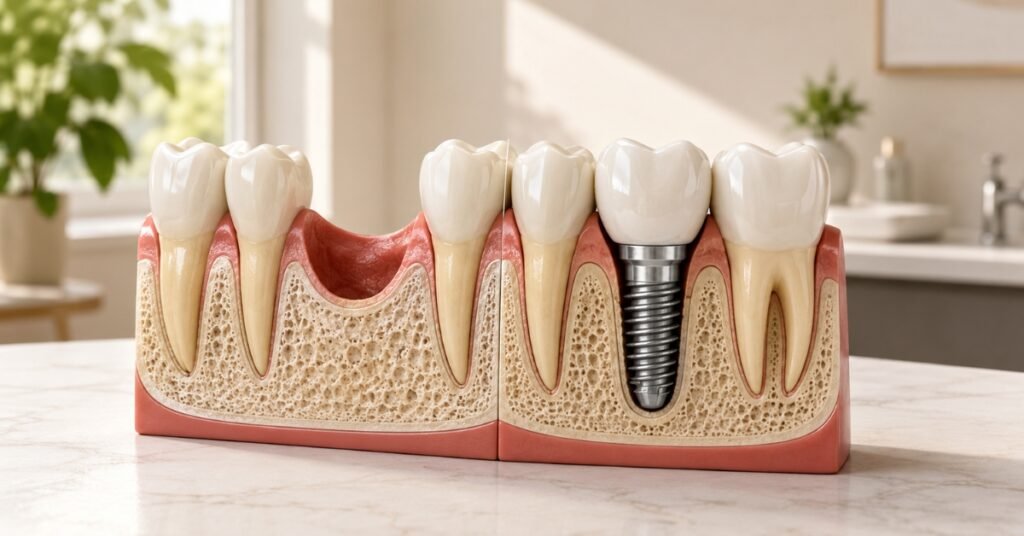
A dental implant is a small, biocompatible post — usually made of titanium — that’s placed into your jawbone to act as an artificial tooth root. Once it heals, your dentist attaches a custom-made crown, bridge, or denture on top.
The result is a replacement tooth that looks, feels, and functions remarkably close to a natural one.
A complete dental implant has three main parts:
|
Part |
What It Does |
|
Implant post |
The titanium screw placed in the jawbone, acting as the new tooth root |
|
Abutment |
A small connector that links the post to the visible tooth |
|
Restoration |
The crown, bridge, or denture that becomes your new tooth |
According to the Cleveland Clinic, dental providers place over 3 million implants each year — a clear sign of how trusted and reliable this treatment has become.
Why Missing Teeth Shouldn’t Be Ignored
Many people assume a single missing tooth — especially at the back — isn’t a big deal. But tooth loss affects more than appearance.
When a tooth is gone, the jawbone underneath begins to shrink over time because it no longer receives stimulation from chewing. This is called bone resorption, and it can gradually change your facial structure.
Missing teeth can also lead to:
- Difficulty chewing certain foods, affecting nutrition
- Changes in speech and pronunciation
- Neighbouring teeth shifting into the gap
- Bite problems and uneven wear
- Reduced confidence in social situations
In short, replacing a missing tooth isn’t just cosmetic — it’s an investment in your long-term oral health.
Why Choose Dental Implants for Missing Teeth? 8 Key Benefits
Here’s why so many patients and dental specialists consider implants the closest thing to natural teeth.
1. They Look and Feel Natural
Implants are designed to blend seamlessly with your existing teeth. The crown is colour-matched to your natural shade, so most people won’t even notice it’s a replacement.
2. They Preserve Your Jawbone
Unlike dentures or bridges, an implant replaces the tooth root. This stimulates the jawbone and helps prevent the bone loss that often follows tooth extraction — a benefit highlighted by the American Academy of Periodontology.
3. They Protect Your Neighbouring Teeth
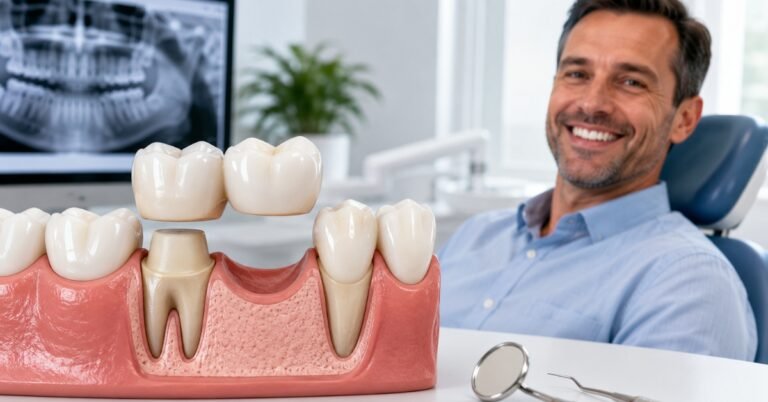
A traditional bridge requires your dentist to shave down the healthy teeth on either side of the gap. An implant stands on its own — a one-tooth solution to a one-tooth problem, leaving your other teeth untouched.
4. They Restore Full Chewing Power
Because implants are anchored firmly in the jaw, you can eat the foods you love without worrying about slipping or discomfort — something that’s often a struggle with loose dentures.
5. They Offer Predictable, Long-Lasting Outcomes
With proper care and regular check-ups, implants can last for decades — often a lifetime. The restoration (crown) may need replacing eventually, but the implant itself is built for the long term.
6. They Improve Speech
Missing teeth or ill-fitting dentures can make certain words harder to pronounce. A stable implant helps you speak clearly and naturally.
7. They Don’t Decay
While you still need to care for your gums, the implant itself can’t develop cavities like a natural tooth.
8. They Restore Confidence
Perhaps the most valued benefit of all — being able to smile, laugh, and socialise without holding back.
Dental Implants vs Other Tooth Replacement Options
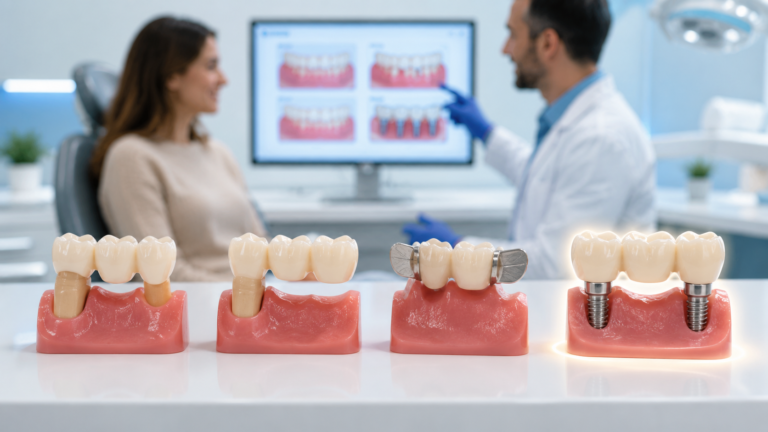
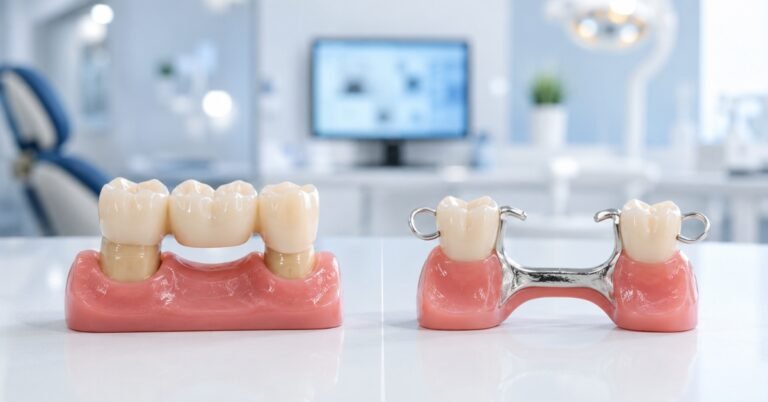
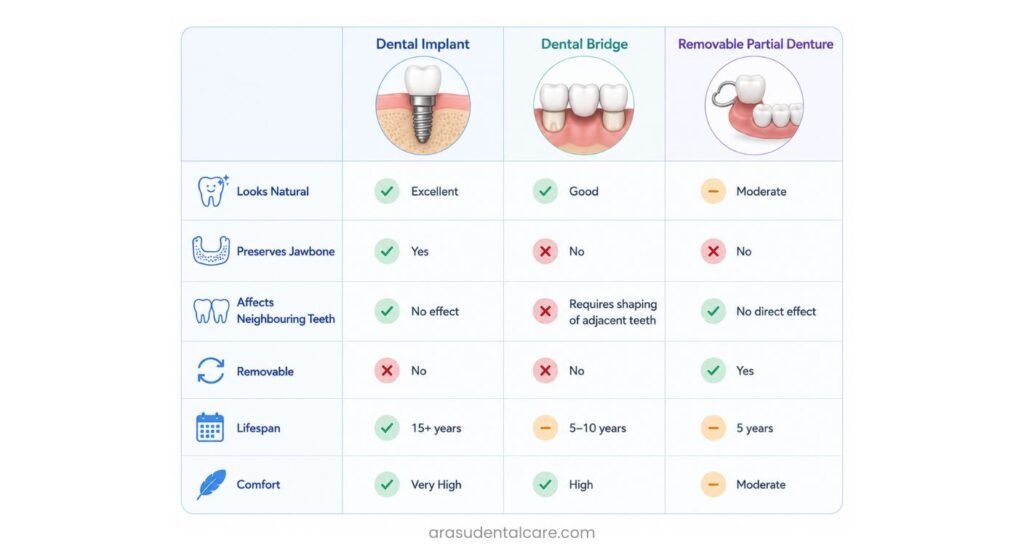
To help you make an informed choice, here’s how implants compare to the two most common alternatives.
|
Feature |
Dental Implant |
Dental Bridge |
Removable Denture |
|
Lifespan |
Can last a lifetime |
~10–15 years |
~5–7 years |
|
Preserves jawbone |
Yes |
No |
No |
|
Affects nearby teeth |
No |
Yes (requires reshaping) |
No |
|
Stability |
Excellent (fixed) |
Good |
Can slip |
|
Feels natural |
Very high |
Moderate |
Lower |
|
Maintenance |
Like natural teeth |
Special cleaning needed |
Daily removal |
Each option has its place, and the right choice depends on your unique situation. We always explain all available treatment options so you can choose what suits you best — never what’s pushed on you.
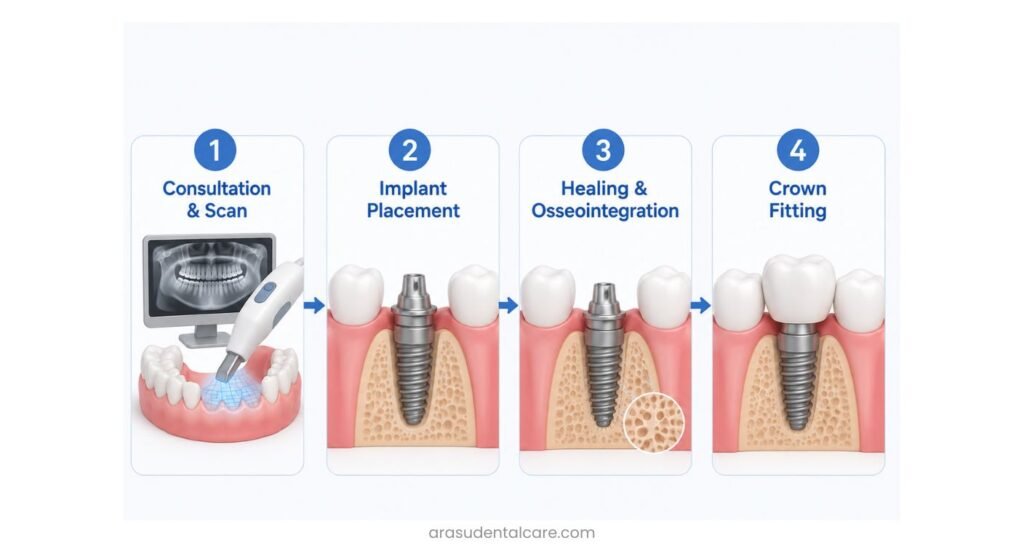
How the Dental Implant Procedure Works
Many patients feel anxious about the procedure simply because they don’t know what to expect. Here’s a clear, step-by-step overview.
Step 1: Consultation and Assessment
Your dentist examines your mouth, takes digital X-rays or 3D scans, and checks your jawbone density to confirm whether you’re a suitable candidate.
Step 2: Implant Placement
The titanium post is placed into the jawbone. This is performed comfortably under appropriate anaesthesia, and sedation options are available for anxious patients.
Step 3: Healing (Osseointegration)
Over the next few months, the bone naturally fuses around the implant — a process called osseointegration. This typically takes three to six months, depending on your healing.
Step 4: Abutment and Crown Placement
Once the implant is secure, the abutment is attached, followed by your custom-made crown. The result is a fully functional new tooth.
Who Is a Good Candidate for Dental Implants?
You may be a strong candidate for implants if you:
- Have one or more missing teeth
- Have healthy gums and adequate jawbone
- Maintain good oral hygiene
- Are in reasonably good general health
For patients with reduced bone density — common in older adults — advanced options like bone grafting, All-on-Four, or Basal Implants can make treatment possible. Our implantology team handles these complex cases regularly.
There’s no upper age limit for implants. As the U.S. Food and Drug Administration notes, your overall health — not your age — is the key factor.
Caring for Your Dental Implants
Looking after implants is wonderfully simple — it’s much like caring for your natural teeth.
- Brush twice daily with a soft-bristled brush
- Floss daily to keep the gum area healthy
- Avoid smoking, which can affect healing and long-term success
- Visit your dentist for regular check-ups every six months
With consistent care, your implant can serve you well for decades.
Frequently Asked Questions
1. Is getting a dental implant painful?
The procedure is performed under appropriate anaesthesia, so you shouldn’t feel pain during placement. Afterwards, mild discomfort or swelling is normal and usually managed easily with over-the-counter pain relief.
2. How long does the entire implant process take?
From consultation to the final crown, most cases take around three to six months, depending on your healing and whether any preparatory treatment (like bone grafting) is needed.
3. How long do dental implants last?
The implant post can last a lifetime with good care. The crown on top may need replacing after around 15 years, depending on wear.
4. Can older adults get dental implants?
Yes. Age isn’t a barrier — what matters is healthy gums, sufficient bone, and good general health. Many of our senior patients enjoy excellent outcomes.
5. What if I don’t have enough jawbone?
Don’t worry — options like bone grafting or specialised techniques such as Basal Implants can rebuild support or work around limited bone. Your dentist will explain what’s suitable for you.
6. Are dental implants safe?
Yes. Implants have a high success rate and are made from biocompatible materials trusted in medicine for decades. When placed by experienced specialists, complications are uncommon.
7. How much do dental implants cost?
The cost varies depending on the number of implants, the type of restoration, and whether additional procedures are needed. We provide a transparent, written cost breakdown after your evaluation, so there are no hidden surprises.
8. Will people notice I have an implant?
Not at all. The crown is custom-designed to match the shape and colour of your natural teeth, blending in seamlessly.
The Bottom Line
Missing teeth can affect far more than your smile — they impact how you eat, speak, and feel about yourself. Dental implants offer one of the most reliable, natural-looking, and long-lasting solutions available today, with the added benefit of protecting your jawbone and surrounding teeth.
The most important step is a proper evaluation, so you can understand all your options and choose the treatment that’s genuinely right for you.
Ready to Explore Your Options?
At Arasu Dental Care, our experienced implant specialists combine advanced technology with a comfort-first, patient-focused approach. We’ll assess your needs, explain your choices clearly, and help you make a confident decision — with transparent pricing and no pressure.
📍 Visit us at our R.S. Puram or Saibaba Colony branches in Coimbatore — open all seven days, 10:00 AM – 8:30 PM.
📞 Call +91 88380 22157 or WhatsApp +91 96007 56297 to book your consultation today.
We Care for You and Your Smile.