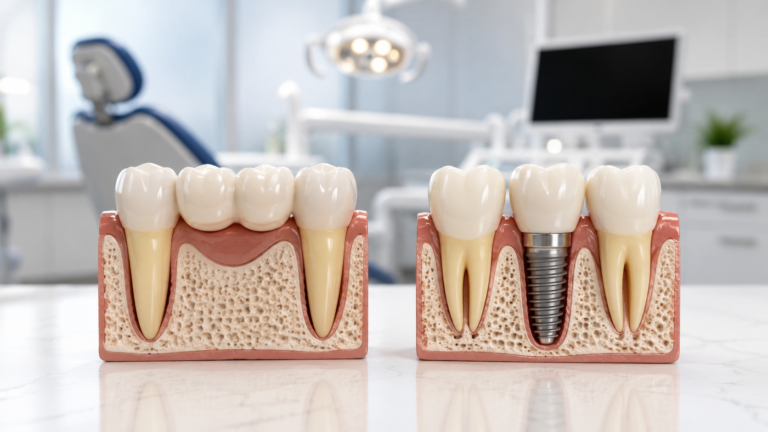
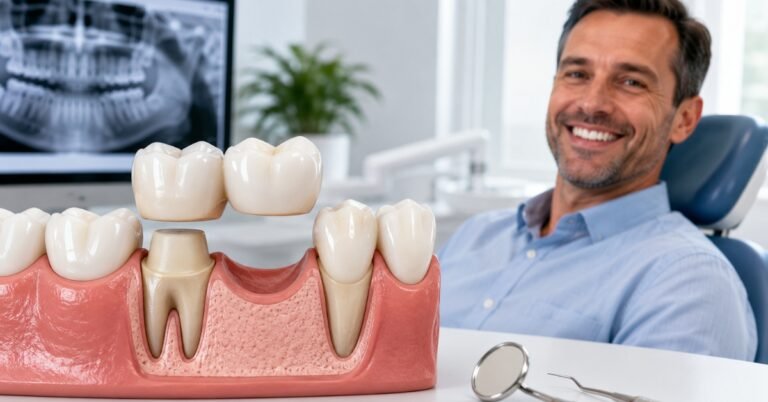
Dental Implants vs Dental Bridges
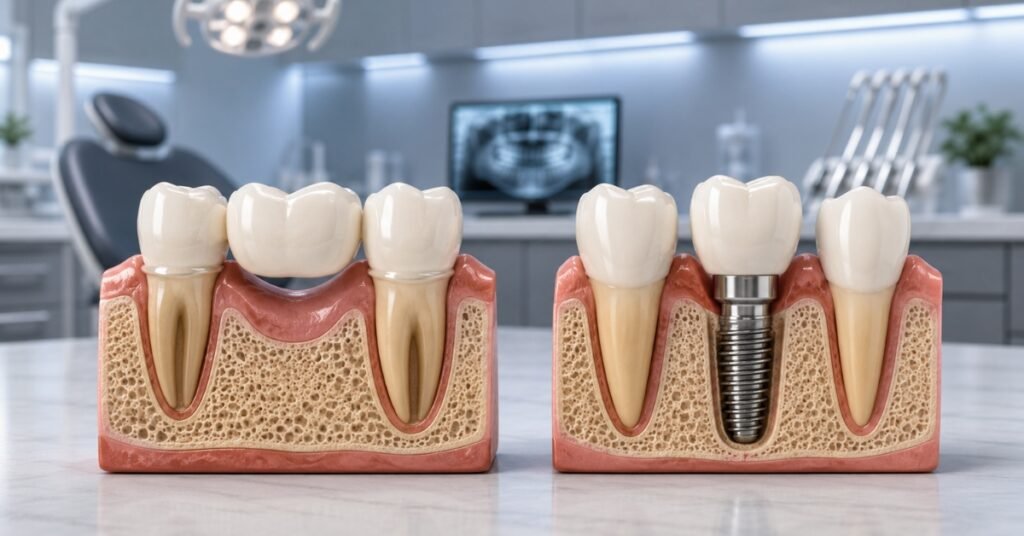
Losing a tooth affects more than your smile — it changes how you chew, speak, and feel about yourself. When weighing dental implants vs bridges, most patients feel overwhelmed by conflicting advice and unclear costs. We understand that concern.
At Arasu Dental Care, we believe the best decision comes from understanding your options clearly, not from pressure. This guide explains how each treatment works, what it costs, how long it lasts, and which factors genuinely matter for your situation — so you can choose with confidence.
Tooth loss is far more common than people realise. Research published by the National Institutes of Health shows nearly 69% of adults aged 35–44 have lost at least one permanent tooth. The good news? Both implants and bridges are proven, reliable ways to restore your smile.
Why Replacing a Missing Tooth Matters
A gap in your smile is not only a cosmetic concern. When a tooth is lost, the surrounding teeth often begin to drift into the empty space, gradually affecting your bite and alignment.
The jawbone beneath a missing tooth also stops receiving the natural stimulation it once got from chewing. Over time, this can lead to bone loss, changes in facial shape, and difficulty with eating or speaking clearly.
Replacing a missing tooth early helps protect your long-term oral health — and gives you more treatment options to choose from.
What Is a Dental Implant?
A dental implant in coimbatore is an artificial tooth root, usually made from titanium, that is gently placed into your jawbone under appropriate anaesthesia.
Over the following months, the implant fuses with the bone through a natural process called osseointegration. This creates a stable, secure foundation. Once healing is complete, a custom crown is attached to the implant — giving you a replacement tooth that looks and functions like a natural one.
Because implants stand independently, they do not rely on neighbouring teeth for support. They are widely regarded as the gold standard for tooth replacement, with a 10-year success rate of around 97%, according to clinical data from the National Library of Medicine.
What Is a Dental Bridge?
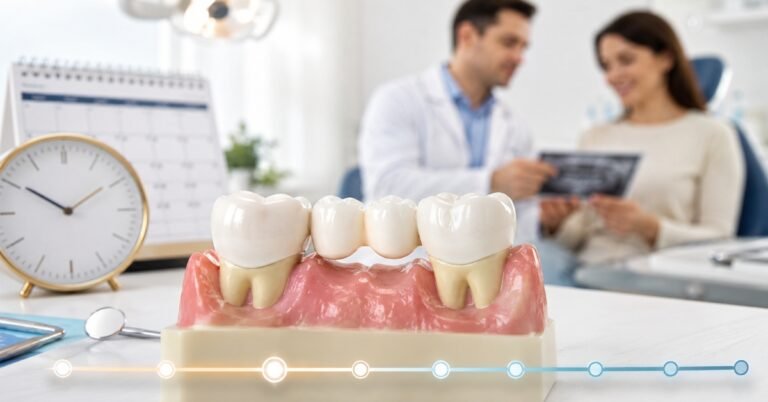
A dental bridge “bridges the gap” left by one or more missing teeth. It consists of one or more artificial teeth (called pontics) held in place by dental crowns fitted over the natural teeth on either side of the gap.
These supporting teeth are called abutment teeth. To fit the crowns, a small amount of enamel is removed from them.
Bridges have been used successfully for decades and offer a faster, non-surgical solution. There are several types, each suited to different needs.
Types of Dental Bridges
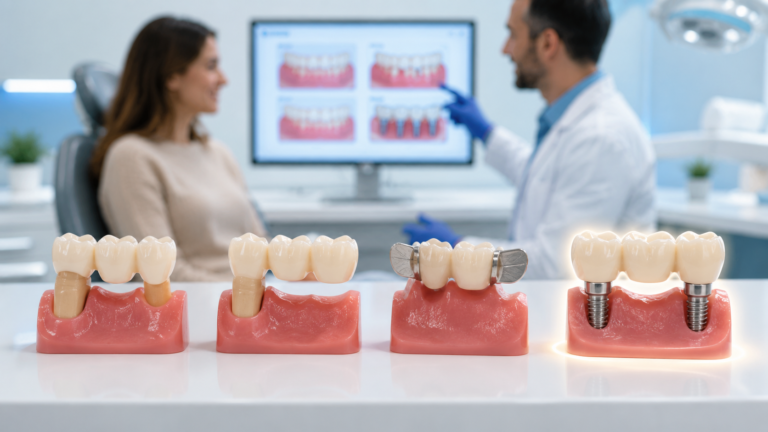
- Traditional bridge — the most common type, anchored by crowns on healthy teeth on both sides of the gap.
- Cantilever bridge — supported by a crown on just one side, used when only one neighbouring tooth is available.
- Maryland bridge — uses metal or porcelain wings bonded to the back of adjacent teeth, often for front teeth.
- Implant-supported bridge — held in place by implants rather than natural teeth, ideal for replacing several teeth in a row.
Dental Implants vs Bridges: A Side-by-Side Comparison
Here’s a clear overview of how the two options compare across the factors that matter most to patients.
|
Factor |
Dental Implant |
Dental Bridge |
|
Procedure |
Minor surgery; implant placed in jawbone |
Non-surgical; adjacent teeth reshaped |
|
Treatment time |
3–6 months (allows healing) |
2–3 visits over a few weeks |
|
Longevity |
15+ years; often a lifetime with care |
5–15 years before replacement |
|
Effect on nearby teeth |
None — stands independently |
Requires reshaping healthy teeth |
|
Bone health |
Preserves and stimulates jawbone |
Does not prevent bone loss |
|
Appearance |
Most natural look and feel |
Natural, but may change as bone shifts |
|
Maintenance |
Brush and floss like natural teeth |
Needs special floss threaders |
|
Upfront cost |
Higher |
Lower |
Pros and Cons at a Glance
Dental Implants
Advantages
- Longest-lasting option available
- Preserves jawbone and facial structure
- Does not damage surrounding teeth
- Functions and feels like a natural tooth
Considerations
- Requires a minor surgical procedure
- Longer overall treatment timeline
- Higher initial investment
- Needs sufficient healthy jawbone
Dental Bridges
Advantages
- No surgery required
- Faster completion
- Lower upfront cost
- A predictable, well-established treatment
Considerations
- Requires reshaping healthy adjacent teeth
- Does not prevent jawbone loss
- Typically needs replacement after several years
- Cleaning underneath needs extra care
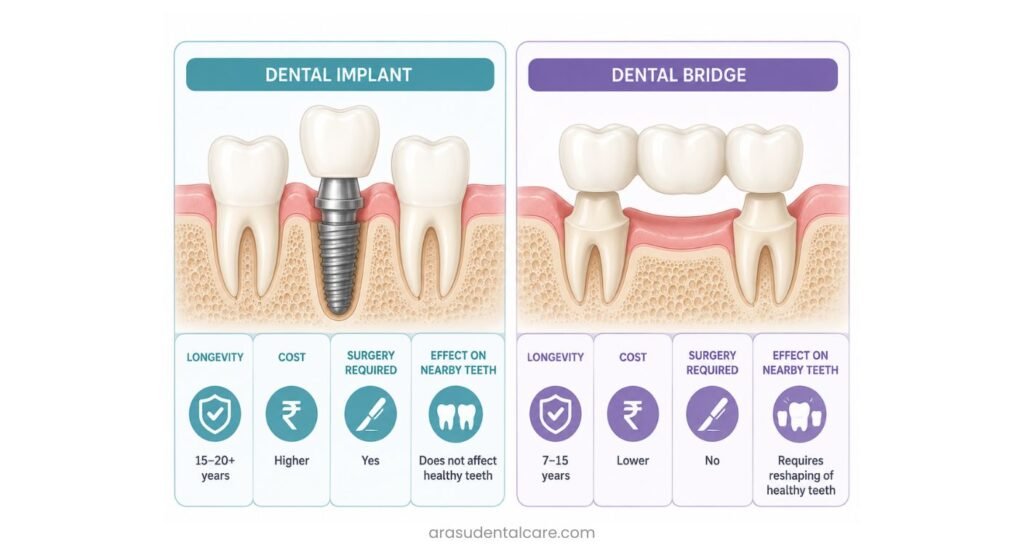
Cost Comparison: Implants vs Bridges
Cost is often the deciding factor — and it deserves an honest, transparent answer.
Dental bridges generally have a lower upfront cost and are completed faster. Dental implants involve a higher initial investment because they require surgery and a custom crown.
However, the long-term picture is different. Because implants can last decades — often a lifetime with proper care — they may prove more cost-effective over time, while bridges typically need replacing every 5–15 years.
For exact pricing tailored to your needs, we recommend checking the treatment costs on our website or speaking with our team directly. We believe in transparent pricing with no hidden surprises.
How to Choose Between an Implant and a Bridge
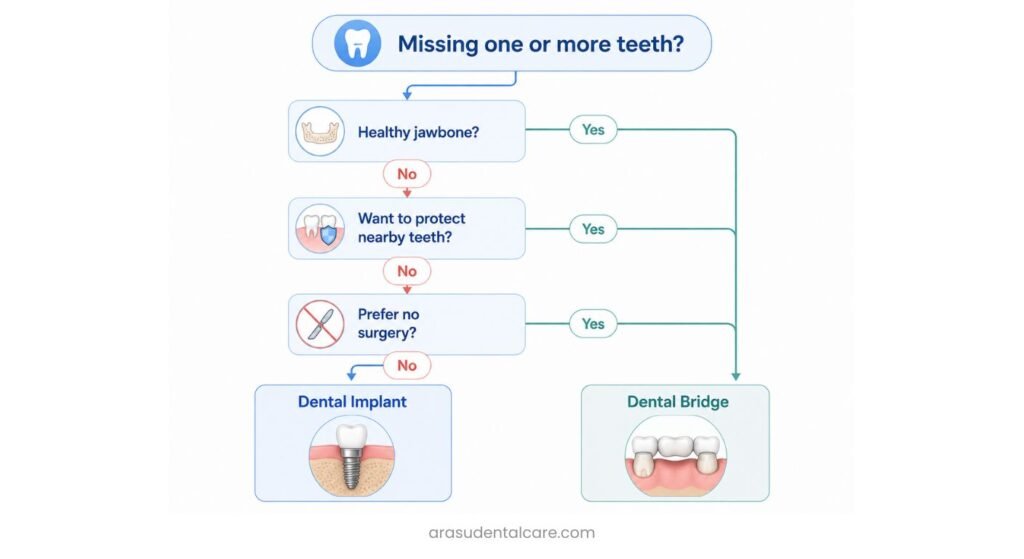
Choosing the right option is a personal decision. After evaluating your condition, our dental specialists will explain the available options and help you choose what best suits your needs. Here are the key factors we consider together.
1. Bone Density and Oral Health
Implants need enough healthy jawbone for support. If you’ve experienced significant bone loss, you may need a bone graft first — or a bridge may be the more practical choice.
2. Number of Missing Teeth
A bridge can be efficient for replacing one or a few teeth in a row. For multiple missing teeth, implant-supported solutions often provide better long-term stability.
3. Overall Health
Certain conditions that slow healing — or habits like smoking — can affect implant success. In these cases, a bridge may be the recommended option. Always share your full medical history with your dentist.
4. Condition of Neighbouring Teeth
If the teeth beside the gap already have large fillings or need crowns, a bridge may make sense. If they’re perfectly healthy, an implant avoids altering them.
5. Time and Budget
If you prefer a quicker, non-surgical solution, a bridge fits well. If you’re investing in a long-term, natural-feeling result, an implant is often worth the wait.
How the Treatment Process Works
Understanding the journey can ease anxiety. Here’s what to expect with each option.
Getting a Dental Implant
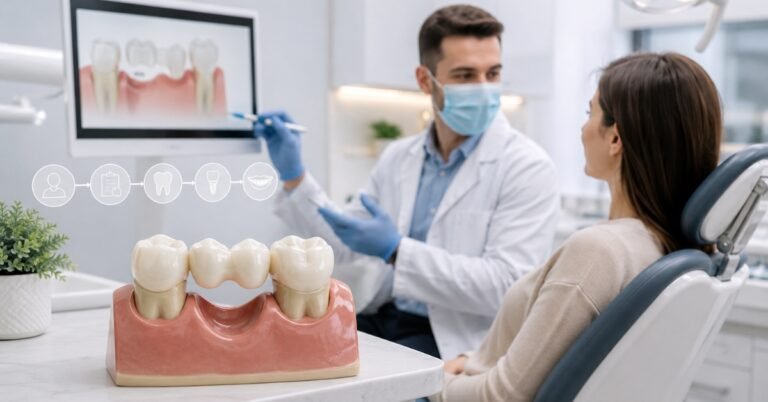
- Consultation & imaging — a thorough examination and 3D scan to assess bone and plan treatment.
- Implant placement — the titanium post is placed in the jawbone, comfortably under appropriate anaesthesia.
- Healing (osseointegration) — the implant fuses with the bone over 3–6 months.
- Crown placement — a custom-made crown is fitted, completing your new tooth.
Getting a Dental Bridge
- Consultation & preparation — the abutment teeth are gently reshaped to hold the crowns.
- Impressions — moulds are taken so a lab can craft your bridge to match your natural teeth.
- Temporary bridge — a temporary is placed while your final bridge is made.
- Final fitting — your custom bridge is checked, adjusted, and bonded securely in place.
Other Tooth Replacement Options
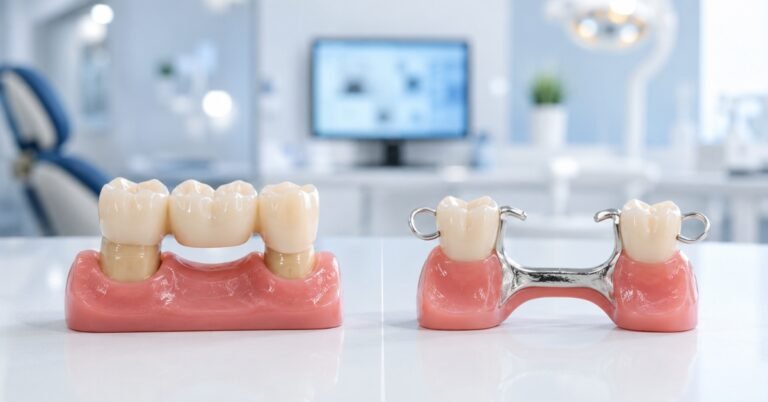
Implants and bridges aren’t the only choices. Partial dentures offer a removable, more affordable option when surrounding teeth can’t support a bridge — though they’re generally less stable. Space maintainers are commonly used for children to keep gaps open until adult teeth emerge.
Your dentist can help you understand whether any of these alternatives suit your situation better.
Frequently Asked Questions
1. Which lasts longer — a dental implant or a bridge?Dental implants typically last 15 years or more, often a lifetime with proper care. Bridges usually last 5–15 years before needing replacement.
2. Is getting a dental implant comfortable?The procedure is performed under appropriate anaesthesia to ensure a comfortable experience. Most patients report far less discomfort than they expected.
3. Are dental implants better than bridges?Neither is universally “better.” Implants offer longevity and protect bone, while bridges are faster and less invasive. The right choice depends on your oral health, budget, and preferences.
4. Does a bridge damage healthy teeth?A traditional bridge requires reshaping the neighbouring teeth to fit crowns, which alters healthy tooth structure. Implants avoid this entirely.
5. Can I get an implant if I’ve lost jawbone?Possibly. Procedures like bone grafting or basal implants can help patients with reduced bone density. A consultation and 3D scan will confirm your options.
6. Which option is more affordable?Bridges have a lower upfront cost. Implants cost more initially but can be more cost-effective long-term since they rarely need replacing.
7. How do I care for each option?Implants are cared for like natural teeth — daily brushing and flossing. Bridges need extra cleaning underneath using floss threaders or interdental brushes.
8. Can a bridge be supported by implants?Yes. An implant-supported bridge combines the stability of implants with the efficiency of a bridge, ideal for several missing teeth in a row.
Making Your Decision With Confidence
Both dental implants and bridges are proven, effective ways to restore a missing tooth. Bridges offer a faster, non-surgical, lower-cost solution, while implants deliver long-term durability, bone preservation, and the most natural feel.
The most important step is a proper evaluation by an experienced specialist who can guide you toward the option that fits your health, lifestyle, and goals — without pressure.
Talk to Our Specialists at Arasu Dental Care
If you’re weighing dental implants vs bridges, you don’t have to decide alone. At Arasu **dental cl